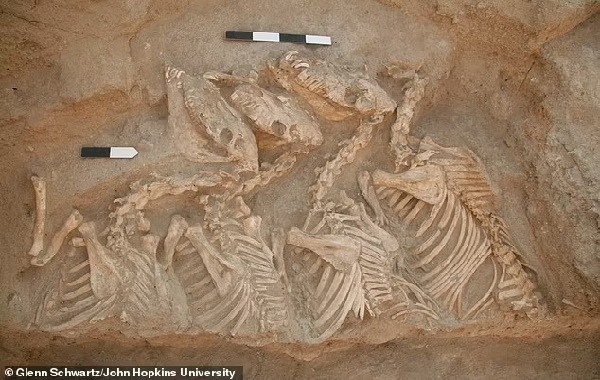
How ‘super donkeys’ were the original war horses: Asses were interbred to be stronger and faster so they could haul a chariot into battle centuries before horses, DNA analysis of 4,500 year-old skeletons reveals
4,500-year-old equid skeletons found in Syria belonged to hybrids called kungas
Kungas were bred 500 years before there were horses in the region, say experts
The impressive size and speed of kungas made them better than asses for battle
Results provide the earliest known evidence of hybrid animal breeding, they add
Equids have played a key role in the evolution of human warfare through history
People of ancient Mesopotamia created a super-strength hybrid animal by crossing domestic donkeys with wild asses, a new genome sequencing study reveals.
Researchers in Paris have studied genomes from equid skeletons found at a 4,500-year-old burial site at Umm el-Marra in northern Syria.
Results suggest the skeletons once belonged to a domesticated hybrid animal called a ‘kunga’ – a cross between female donkeys and male Syrian wild asses – and therefore provide the earliest known evidence of hybrid animal breeding.
Humans didn’t ride on top of kungas, according to the experts; rather, the animals were likely used to transport goods and equipment and pull chariots in battle.
The size and speed of kungas made these hybrid animals a better option than asses for the towing of four-wheeled war wagons.
Kungas were produced by societies in Mesopotamia – the historical region of Western Asia – 500 years before the arrival of domesticated horses in the region.
It’s already known that sumerians – people of southern Mesopotamia – had been using equid-drawn four-wheeled war wagons on the battlefield for centuries, as evidenced by the famous ‘Standard of Ur’, a 4,500-year-old Sumerian mosaic.

The new study was conducted by palaeogeneticists at the Institut Jacques Monod in Paris, France.
‘Kungas were F1 hybrids between female domestic donkeys and male hemippes [Syrian wild ass], thus documenting the earliest evidence of hybrid animal breeding,’ they say.
‘Large-sized male kungas were used to pull the vehicles of “nobility and gods”, and their size and speed made them more desirable than asses for the towing of four-wheeled war wagons.’
Mesopotamia was a historical area of the Middle-East that spans most of what is now known as Iraq but also stretched to include parts of Syria and Turkey.
Domestic horses in the region date back to 4,000 years ago, according to previous finding of the same research group published in 2020, while the new finding dates kungas in the region date back 4,500 years ago.
Clay tablets from 4,500 years ago featuring a syllabic writing system called cuneiform are already known to mention prestigious equids with a high market value as ‘kunga’.
Ancient tablets and seals document that kungas, which cost up to six times the price of a donkey, were intentionally bred in Mesopotamia during the Early Bronze Age.
However, although it was thought one kunga parent was likely a donkey, the other parent’s identity had remained unclear.
Source: daily mail
Earliest human remains in eastern Africa dated to more than 230,000 years ago
Earliest human remains in eastern Africa dated to more than 230,000 years ago
How ‘super donkeys’ were the original war horses: Asses were interbred to be stronger and faster so they could haul a chariot into battle centuries before horses, DNA analysis of 4,500 year-old skeletons reveals