How does this daisy create 3D fake flies? Decades-long mystery solved
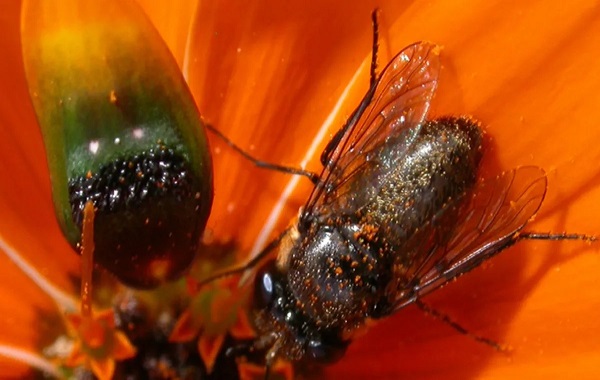
The only daisy that makes a three-dimensional fake female fly for enticing male flies into pollinating it is the Gorteria diffusa from South Africa. For decades, scientists have been enthralled by the mechanism underlying this impressive deception which is complete with realistic hairy lumps and white highlights.
Now, researchers have discovered three sets of genes that are involved in creating the fake fly on the daisy’s petals, according to a new study published in Current Biology on March 23.
The deceitful daisy’s fake ladies- how did this come to be?
The biggest surprise, according to the researchers, is that each of the three sets of genes already serves different purposes within the plant. For example, one set regulates when flowers are produced, while the other two transfer iron around and create root hairs.

It so happens that the three gene sets have been combined in novel ways to make the false ladies:
The ‘iron shifting’ genes change the petal’s pigments from their natural reddish-purple color to a more fly-like blue-green by adding iron. The root hair genes cause the hairs to spread out to add texture to the petal. The random position of the false flies on the petals arises due to the third set of genes.
“This daisy didn’t evolve a new ‘make a fly’ gene. Instead, it did something even cleverer – it brought together existing genes, which already do other things in different parts of the plant, to make a complicated spot on the petals that deceives male flies,” said co-author Professor Beverley Glover in a press release, from the University of Cambridge’s Department of Plant Sciences.
The daisy’s petals, argued the researchers, provide the flower with an evolutionary advantage by luring more male flies to pollinate it.
In South Africa, the plants live in a hostile desert environment with only a brief rainy season to develop flowers, receive pollination, and set seeds before they perish. As a result, there is a fierce rivalry to draw pollinators, and the South African daisy stands out from the crowd thanks to its petals decorated with lady flies.
The group of plants that includes the sexually deceiving daisy is relatively young in evolutionary terms—it has only been around for 1.5–2 million years—compared to most other living things. The authors suggest that the lack of artificial fly spots in the earliest members of this family tree indicates how quickly they must have developed on the petals of daisies.
“It’s almost like evolving a whole new organ in a very short time frame. Male flies don’t stay long on flowers with simple spots, but they’re so convinced by these fake flies that they spend extra time trying to mate and rub off more pollen onto the flower – helping to pollinate it,” described first author Dr. Roman Kellenberger.
Source: Interesting Engineering
$28,000 to deep freeze your body after death, cryonics expert explains
$28,000 to deep freeze your body after death, cryonics expert explains
How does this daisy create 3D fake flies? Decades-long mystery solved