How Did Prehistoric Humans Outsmart the Sun Long Before Modern Sunscreen—and Could Their Forgotten Survival Secrets Change What We Know About Human Evolution?
“If I could offer you only one tip for the future, sunscreen would be it.” The famous opening line from Baz Luhrmann’s Everybody’s Free (To Wear Sunscreen) has become increasingly relevant as skin cancer rates continue to rise across the world. Yet this raises a fascinating question. Long before pharmacies stocked bottles of sunscreen, before hats, sunglasses, or modern medicine existed, how did prehistoric humans survive beneath an unforgiving Sun?
Did our ancestors simply endure the relentless ultraviolet radiation, or did they develop ingenious ways to shield themselves? More intriguingly, did prehistoric humans suffer from skin cancer in the same way modern populations do?
The answers reveal a remarkable story of evolution, adaptation, and innovation—one that stretches back hundreds of thousands of years and continues to shape humanity today.
How Did Prehistoric Humans Protect Themselves From the Sun Naturally?
The first line of defense against the Sun was not clothing or technology. It was human biology itself.
For millions of years, the ancestors of modern humans evolved under the intense African Sun. In this environment, natural selection favored darker skin rich in melanin, a pigment that absorbs and scatters harmful ultraviolet radiation before it can damage cells.
Melanin functions as nature’s sunscreen. It significantly reduces DNA damage caused by ultraviolet rays and lowers the risk of severe sunburn. However, this remarkable protection comes with an important trade-off.
Although melanin blocks dangerous radiation, it also limits the skin’s ability to produce vitamin D. As early humans gradually migrated into northern regions where sunlight was weaker and winters lasted much longer, darker skin became less advantageous. Over thousands of generations, populations living at higher latitudes evolved lighter skin, allowing more ultraviolet light to penetrate the skin and stimulate vitamin D production.
This evolutionary balancing act demonstrates that human skin color was never simply about appearance. Instead, it reflects millions of years of adaptation to dramatically different environments.
But was protection against skin cancer the primary force driving this evolution?
Did Skin Cancer Shape Human Evolution? Scientists Are Rethinking the Answer
For decades, one of the leading explanations suggested that darker skin evolved mainly to reduce skin cancer risk. At first glance, the theory seems logical. Strong sunlight increases ultraviolet exposure, and ultraviolet radiation can trigger dangerous mutations in skin cells.
However, recent research presents a more nuanced picture.
A study published during the current year examined skin cancer patterns among individuals of Anglo-Celtic ancestry living in Australia. Despite having relatively low levels of melanin and experiencing extremely high ultraviolet exposure, most participants developed skin cancers only after reaching reproductive age.
From an evolutionary perspective, this finding is important.
Natural selection primarily favors traits that improve reproductive success. If skin cancer usually develops after people have already had children, then it would have exerted only limited evolutionary pressure on human populations.
Consequently, researchers increasingly believe that darker skin evolved primarily because it protected against other immediate dangers caused by intense solar radiation.
One major threat was dehydration resulting from severe sunburn. Another involved the destruction of folate, a vitamin essential for healthy fetal development, DNA synthesis, and cell division. Ultraviolet radiation can significantly reduce folate levels in the body, potentially affecting pregnancy outcomes and long-term survival.
Therefore, rather than preventing cancer alone, melanin may have evolved because it protected the body’s most critical biological systems during the years when survival and reproduction mattered most.
Could preserving fertility have been even more important than preventing cancer?
Ancient Sunscreen: Did Prehistoric Humans Discover Ochre as UV Protection?
Even the darkest skin cannot completely block intense ultraviolet radiation. Prehistoric humans therefore appear to have developed another extraordinary solution long before chemistry laboratories existed.
That solution was ochre.
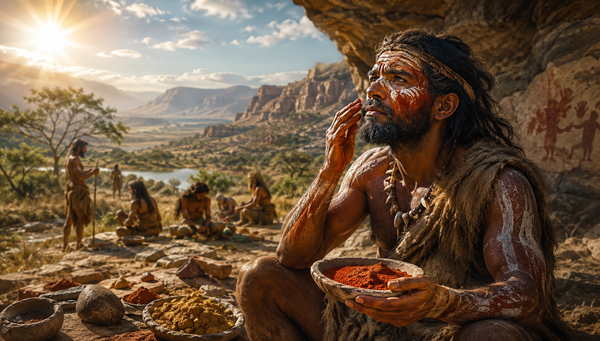
Ochre is a naturally occurring clay rich in iron oxide, recognizable by its striking red, yellow, and brown colors. Archaeologists have long known that prehistoric communities used ochre for rituals, cave paintings, body decoration, and symbolic purposes.
Yet mounting evidence suggests another remarkable function.
Ochre may have served as one of humanity’s earliest sunscreens.
Experimental research published in two thousand fifteen demonstrated that finely ground ochre possesses measurable sun protection properties. Scientists found that smaller mineral particles provided a significantly higher sun protection factor than coarser material because they dispersed ultraviolet radiation more effectively.
This discovery transformed archaeologists’ understanding of ancient behavior.
Perhaps prehistoric people were not merely decorating themselves.
Perhaps they were protecting themselves.
Why Did Early Homo Sapiens Travel So Far for Better Ochre?
One of the strongest clues comes from Qafzeh Cave in present-day Israel.
Archaeological evidence shows that early Homo sapiens deliberately ignored nearby ochre deposits. Instead, they transported a finer-quality variety from locations more than sixty kilometers away.
Such journeys demanded considerable time, planning, and energy.
Why invest so much effort if local supplies were available?
One explanation is that these early humans recognized practical differences between various ochre types. Finer ochre adhered better to the skin and offered superior protection against ultraviolet radiation.
Although archaeologists cannot determine exactly what these people believed, their behavior strongly suggests they understood that certain minerals provided important benefits beyond decoration.
Even today, several Indigenous communities in Africa continue applying ochre mixed with animal fat or clarified butter to protect their skin from harsh sunlight while also reducing water loss from the skin.
Could these traditions preserve knowledge passed down across thousands of generations?
Did Earth’s Magnetic Field Force Humans to Invent Better Sun Protection?
One of the most fascinating chapters in this story unfolded approximately forty-two thousand years ago.
During an event known as the Laschamp Excursion, Earth’s magnetic field weakened dramatically for roughly three centuries.
Normally, the planet’s magnetic field shields Earth from harmful cosmic particles and helps reduce ultraviolet radiation reaching the surface. During the Laschamp event, however, that natural protection declined substantially.
As a result, both cosmic radiation and ultraviolet exposure likely increased across many regions of the planet.
Intriguingly, archaeologists have identified a dramatic rise in ochre use during approximately the same period.
The timing has inspired an exciting hypothesis.
Faced with intensified solar radiation, prehistoric humans may have responded by increasing their use of protective pigments, improving clothing technology, and spending more time in sheltered environments.
Although researchers continue investigating this possibility, the overlap between these events remains one of the most intriguing mysteries in human prehistory.
Was this one of humanity’s earliest large-scale environmental adaptations?
Could Better Sun Protection Have Helped Homo Sapiens Outlive Neanderthals?
The disappearance of the Neanderthals remains one of archaeology’s greatest unsolved mysteries.
Climate change, competition, disease, interbreeding, and demographic decline have all been proposed as contributing factors.
Another controversial hypothesis focuses on ultraviolet radiation.
Unlike modern humans, Homo sapiens developed sophisticated bone awls and sewing needles that allowed them to manufacture tightly fitted clothing from animal hides. Such garments covered much more of the body and likely reduced direct sunlight exposure.
Neanderthals, in contrast, appear to have worn animal skins more loosely, leaving larger areas of skin exposed.
If modern humans also applied ochre regularly, they may have benefited from a combination of protective clothing and mineral-based sunscreen.
Could this technological advantage have improved survival during periods of unusually intense ultraviolet radiation?
Possibly.
However, scientists emphasize that the connection remains highly speculative. There is currently no direct evidence demonstrating that ultraviolet exposure caused Neanderthal extinction.
Instead, it is more likely that numerous environmental and biological pressures interacted over thousands of years.
Nevertheless, the hypothesis highlights just how valuable even simple forms of sun protection may have been.
What Can Ancient Human Survival Teach Us About Modern Sunscreen?
The challenges faced by prehistoric humans continue to influence our lives today.
Modern sunscreen contains advanced chemical and mineral filters developed through decades of scientific research. Yet the underlying principle remains remarkably familiar.
Reduce ultraviolet exposure before irreversible damage occurs.
Evolution provided humans with melanin. Prehistoric innovation introduced ochre and increasingly sophisticated clothing. Modern science added dermatology, ultraviolet filters, protective fabrics, and public health campaigns.
Each represents another chapter in humanity’s long struggle against the same star that makes life possible.
Ironically, despite possessing better protection than any previous generation, modern lifestyles often expose us to intense sunlight for extended periods, contributing to rising rates of skin cancer worldwide.
Perhaps our ancestors understood something surprisingly simple.
Surviving under the Sun has always required adaptation.
The Enduring Mystery of Humanity’s First Sunscreen
The story of prehistoric sun protection is far more complex than scientists once imagined.
Rather than relying on a single solution, early humans combined evolutionary adaptations with practical innovation. Dark pigmentation reduced ultraviolet damage, carefully selected minerals may have functioned as primitive sunscreen, fitted clothing provided additional protection, and cultural knowledge likely spread these survival strategies across generations.
Many questions, however, remain unanswered.
How widespread was the use of ochre specifically for sun protection?
Did different prehistoric cultures develop similar techniques independently?
Could future archaeological discoveries reveal even earlier evidence of sunscreen-like behavior?
Every new excavation and scientific study brings us closer to understanding how our ancestors survived one of Earth’s most powerful natural forces.
Perhaps the greatest lesson is this: humanity’s relationship with the Sun has never been simple. From the African savannas to modern cities, we have always depended upon sunlight for life while simultaneously learning how to defend ourselves from its hidden dangers.
And perhaps that ancient struggle is still far from over.
Source: How Did Prehistoric Humans Outsmart the Sun Long Before Modern Sunscreen—and Could Their Forgotten Survival Secrets Change What We Know About Human Evolution?
How Did Prehistoric Humans Outsmart the Sun Long Before Modern Sunscreen—and Could Their Forgotten Survival Secrets Change What We Know About Human Evolution?
Sources
- Journal of Human Evolution – Research on human pigmentation and evolutionary adaptation.
- Proceedings of the Royal Society B – Studies examining the evolution of skin pigmentation and ultraviolet radiation.
- Nature Ecology & Evolution – Research on folate preservation, ultraviolet exposure, and human evolution.
- PLOS ONE – Experimental investigation into the ultraviolet protective properties of ochre.
- Journal of Archaeological Science – Studies of ochre procurement and use at Qafzeh Cave.
- IFLScience – How Did Prehistoric Humans Protect Themselves From The Sun? And Did They Get Skin Cancer?
- World Health Organization (WHO) – Ultraviolet radiation and skin cancer resources.
- American Academy of Dermatology – Scientific information on ultraviolet exposure, melanin, and skin cancer prevention.