How Did Jupiter’s Giant Moons Really Form — And Could It Happen Around Other Worlds?
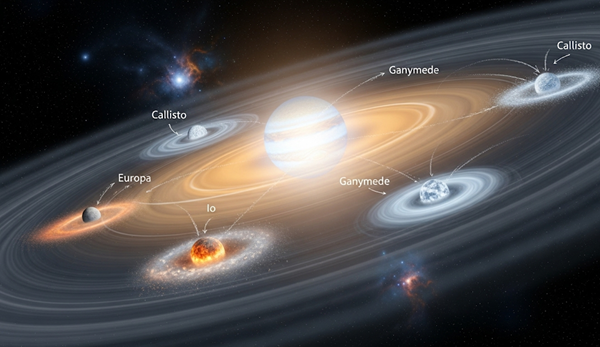
We know a lot about how planets form, but the birth of moons is a more mysterious story. Our own Moon’s violent origin — likely from a massive impact — cannot explain the vast and complex satellite systems found around gas giants like Jupiter. In particular, the four Galilean moons — Io, Europa, Ganymede, and Callisto — remain one of the great puzzles of planetary science.
A recent book chapter (also released as a preprint) by Yuhito Shibaike and Yann Alibert from the University of Bern takes a closer look at the competing theories behind the formation of large moon systems, with the Galileans as the prime example. Could their story reveal how moons form not just in our solar system, but also around giant planets in other star systems?
The Circum-Jovian Disc: A Birthplace for Moons
The Galilean moons likely formed in the circum-Jovian disc (CJD), a miniature version of the protoplanetary discs (CSDs) that form planets around stars. Jupiter sat at the center of this swirling cloud of gas and dust, while material from the solar nebula continually flowed in.
Unlike the 90+ smaller irregular moons captured later, the Galileans appear to have grown directly from this disc. But how exactly did this happen?
Key Differences Between Planet Formation and Moon Formation
According to Shibaike and Alibert, moon formation differs from planet formation in three crucial ways:
Faster Timescale – Moons form 10 to 100 times faster than planets.
Constant Exchange of Material – Circumplanetary discs both gain gas and dust from the solar disc and lose material to the central planet.
Rarity of Large Moon Systems – Unlike exoplanets, which are now found by the thousands, multi-moon systems are still extremely rare in our observations. For now, only Jupiter and Saturn serve as clear examples.
This scarcity makes every clue from the Galilean moons vital.
Competing Models: Minimum-Mass vs. Gas-Starved Disc
The first model, developed in the 1980s, proposed a minimum-mass disc: a dense, static disc holding just enough material to form the Galilean moons.
But in 2002, the gas-starved disc model was introduced. In this scenario, the original disc had less mass but was constantly replenished with material captured from the solar disc. This steady inflow of fresh dust and gas could have fueled the moons’ growth.
Which of these models better explains the moons we see today?
The Role of Gravitational Capture and Pebble Accretion
Jupiter’s immense gravity shaped the second phase of moon formation. As the giant planet cleared its orbit, it swept up or deflected “pebbles” — meter-sized boulders — that might otherwise have built the moons.
So how did the Galilean moons accrete? Scientists propose two possible pathways:
Pebble and Dust Accretion: Tiny dust grains slipped through Jupiter’s gravitational barrier, gradually building up the moons.
Planetesimal Capture: Proto-planetary cores, disturbed by Saturn’s gravity, may have been slowed down and captured within Jupiter’s gas-rich disc, transforming into moons instead of planets.
Both processes may have played a role — but to what extent remains unclear.
Callisto: The Odd Moon Out
Among the Galileans, Callisto stands apart. Unlike Io, Europa, and Ganymede, it is not locked into orbital resonance with Jupiter. It is also only partially differentiated, meaning its interior has not fully separated into core, mantle, and crust.
Why is Callisto different? Did it form under separate conditions? Was it struck by a massive impactor that altered its evolution? Or is it simply still “unfinished,” slowly accreting material over billions of years?
These lingering mysteries suggest that moon formation may not follow a single, uniform path.
What Future Missions and Exomoons Could Reveal
The upcoming Jupiter Icy Moons Explorer (JUICE) mission will soon provide close-up observations of Ganymede and Callisto, offering vital data on their composition and evolution. But even JUICE will only scratch the surface.
The real breakthroughs may come when telescopes can finally detect exomoons — satellites orbiting giant planets beyond our solar system. If we find large moon systems elsewhere, will they look like Jupiter’s Galileans, Saturn’s Titan-centered system, or something entirely different?
The Bigger Question: Are Moon Systems the Norm or the Exception?
The formation of the Galilean moons is more than just a story about Jupiter. It raises a profound question: are large moon systems common across the universe, or is our solar system a rare exception?
For now, the Galileans remain our best laboratory for moon formation science. But as new missions and exoplanet discoveries unfold, the answers may reshape how we understand not only moons — but the entire architecture of planetary systems.
Final Thought: The Galilean moons are more than just satellites of Jupiter — they are keys to unlocking the cosmic recipe for building worlds. But until we peer into other planetary systems, their story remains an unfinished chapter.
Source: How Did Jupiter’s Giant Moons Really Form — And Could It Happen Around Other Worlds?
Can the Outer TRAPPIST-1 Planets Still Save Our Alien Life Dreams?
Can the Outer TRAPPIST-1 Planets Still Save Our Alien Life Dreams?
How Did Jupiter’s Giant Moons Really Form — And Could It Happen Around Other Worlds?