“Historic Discovery: 10th-Century Hungarian Woman Buried with Weapons”
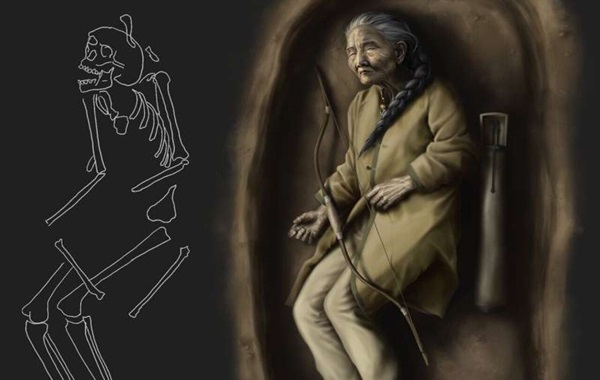
A recent study led by Dr. Balázs Tihanyi and his colleagues, published in PLOS ONE, has led to the positive identification of the first-known female burial with weapons in the 10th-century Carpathian Basin, Hungary.
The existence of female burials with weapons has always been a topic of great interest and debate for scholars and the general public. However, interpreting them remains challenging, for simply finding weapons within a female burial site does not automatically equate that female to a warrior. However, past studies have sometimes rushed to conclusions about female warriors without first conducting a careful scientific analysis of the remains.
This includes using both morphological and genetic testing whenever possible to first determine if the individual interred is indeed female. Both morphological and genetic approaches can be limited due to low preservation and high fragmentation. It is important to take these factors into account during the interpretation process. Additionally, genetic tests may also become contaminated by modern humans, thus leading to false identification of the sex of the remains.
Meanwhile, interpreting whether an individual was a warrior is even more complex, and many studies do not take the necessary precautions when interpreting them, possibly leading to the overinterpretation of warrior burials. Warriors are part of a social and legal class. Many aspects of their lives, including religion and economics, are hidden in archaeology. However, some physical markers may remain.
Certain physical activities, if repeated on a daily basis, may lead to changes in bone morphology. This includes practicing with weapons or horse riding. Additionally, warriors are often likely to experience physical trauma due to warfare or other conflict. However, it is important to consider these changes may also result from a non-warrior lifestyle.
Therefore, it is prudent not to jump to conclusions simply because one finds weapons within a burial. Multiple lines of evidence are needed to substantiate these claims.
The individual SH-63 was found within the Sárrétudvari–Hízóföld cemetery, which is the largest 10th-century-CE cemetery in Hungary and contains a large number of burials containing weapons and horse-riding equipment. It was in use during the Hungarian Conquest period, in which many mounted archers conducted and fought battles across Europe.
Despite not having many particularly “wealthy” grave goods, the burial of SH-63 was unique for its grave goods composition, says Dr. Tihanyi. “Male burials often contained functional items, such as simple jewelry (e.g., penannular hair rings and bracelets), clothing fittings (e.g., belt buckles), and tools (e.g., fire-lighting kits and knives). Their most distinctive grave goods included weapons, usually archery equipment, with two graves containing sabers and one grave containing an axe.
“Horse-riding equipment and, in some cases, horse bones (e.g., skull and extremities) were also found. Female burials, in contrast, more frequently contained jewelry (e.g., hair rings, braid ornaments, bead necklaces, bracelets, and finger rings) and clothing fittings (e.g., bell buttons and metal ornaments). Tools, such as knives and awls, appeared less often.
“The grave goods found in the burial of SH-63 contained a mix of these characteristics. Compared to other graves in the cemetery, its inventory was relatively simple, including common jewelry and clothing fittings.”

More specifically, SH-63 was found together with a silver penannular hair ring, three bell buttons, a string of stone and glass beads, an “armor-piercing” arrowhead, iron parts of a quiver, and an antler bow plate.
However, simply finding archery-related weapons within the burial was not enough to draw conclusions; the researchers conducted both morphological and genetic analyses to determine if the individual was female. Despite the skeleton’s poor preservation, the skull and genetic markers from different regions in the body indicated the interred was a female. This made her the first-known female to be buried with weapons in the Carpathian Basin during the 10th century CE.
Source: phys.org
“Echoes of the Past: Acoustics May Have Drawn Ancient Artists to South African Rock Art Sites”
“Historic Discovery: 10th-Century Hungarian Woman Buried with Weapons”/”Historic Discovery: 10th-Century Hungarian Woman Buried with Weapons”