Have We Finally Found the Key to Unlocking Dark Matter?
Recent research suggests that neutron stars, particularly those with extreme spinning properties, could be the birthplace of one of the most sought-after particles in physics: the axion. Though still hypothetical, the discovery of axions would not only deepen our understanding of the cosmos but could solve one of astronomy’s biggest mysteries—revealing the true nature of dark matter.
Axions: Ghost Particles That Could Solve Dark Matter Mysteries
Proposed in the 1970s, axions are thought to interact so weakly with matter that they remain nearly invisible, behaving similarly to neutrinos. However, unlike neutrinos, axions are theorized to have characteristics that allow them to act like dark matter, exerting gravitational influence without directly interacting with regular matter. If we can detect them, axions could explain phenomena currently attributed to dark matter and reveal the particle’s mass and properties.
Pulsars: Supercharged Laboratories for Axion Detection
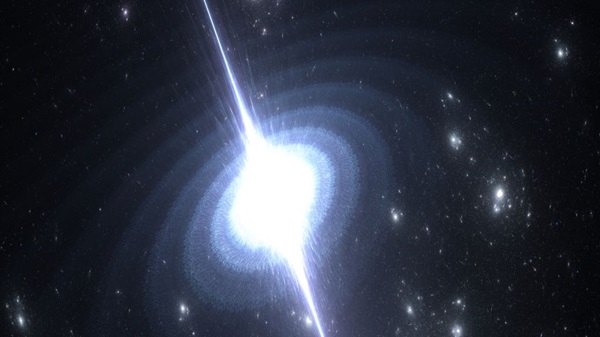
Neutron stars, the dense remnants of massive stars that exploded as supernovae, have strong magnetic fields and gravitational pulls. Some of these stars, known as pulsars, spin at astonishing speeds, creating intense magnetic fields and emitting pulses of radio waves. This rapid spinning amplifies the pulsar’s magnetic field, potentially making it a prime location for axions to be produced and eventually detected.
How Axions Could Become Visible in Pulsar Environments
Under extreme magnetic fields, axions are predicted to decay into photons, effectively making them visible. Physicist Dion Noordhuis and colleagues from the University of Amsterdam recently suggested that rapidly spinning neutron stars could produce a 50-digit number of axions every minute. When axions escape the pulsar’s magnetic field, they should transform into photons, slightly increasing the star’s brightness. Although this signal hasn’t been detected yet, researchers are narrowing down the potential parameters of axions’ mass and behavior.
The “Axion Cloud” Theory: A New Search Strategy
Building on previous findings, recent research proposes that axions could be captured by the pulsar’s gravity, forming an “axion cloud” over time. This cloud would create a faint, consistent glow over the neutron star’s surface, potentially lasting millions of years. Researchers suggest that these clouds could be common across all neutron stars, which would make the particles’ signals dense enough to be detectable by observing photon leaks.
What Axion Detection Could Look Like
The team proposed two potential signals to watch for: a continuous narrow radio line in the pulsar’s spectrum or a burst of light emitted as the star fades. The continuous signal would be easier to detect, as neutron stars take trillions of years to dim entirely—a timeframe longer than the age of the Universe. Despite not finding a definitive signal of axions yet, researchers have strengthened the constraints on their mass, helping direct future efforts.
Future Pulsar Studies: A New Path to Unlocking Cosmic Secrets
The axion cloud hypothesis offers astronomers new techniques to hunt for these elusive particles. If axions can be confirmed, they may finally explain dark matter and solve several long-standing cosmic mysteries, unveiling the hidden components of the Universe. With ongoing advancements in telescope technology, scientists are inching closer to unveiling the axion’s secrets, holding the promise of groundbreaking discoveries in physics and cosmology.
Source: Have We Finally Found the Key to Unlocking Dark Matter?
A Journey Beyond Voyager: Are We on the Verge of Deep Space Exploration?
A Journey Beyond Voyager: Are We on the Verge of Deep Space Exploration?