Have Scientists Finally Uncovered the Truth About Dyson Spheres?
Expanding the Search for Technosignatures in SETI
For over sixty years, the Search for Extraterrestrial Intelligence (SETI) has focused primarily on detecting radio signals from distant sources. However, scientists are increasingly broadening their approach to include other potential technosignatures. These include non-radio communication methods such as directed energy, neutrinos, and gravitational waves, as well as the search for megastructures like Dyson Spheres, Clarke Bands, and Niven Rings.
Project Hephaistos: Sweden’s Dedicated SETI Initiative
One of the most modern and ambitious searches is Project Hephaistos, Sweden’s first dedicated SETI project named after the Greek god of blacksmiths. Unlike traditional SETI endeavors that focus on signals directed at Earth, Hephaistos emphasizes the detection of technosignatures in general. A recent study led by the University of Manchester investigated a Dyson Sphere candidate identified by Hephaistos. This candidate turned out to be contaminated by background emissions from an Active Galactic Nucleus (AGN).
Investigating a Promising Candidate
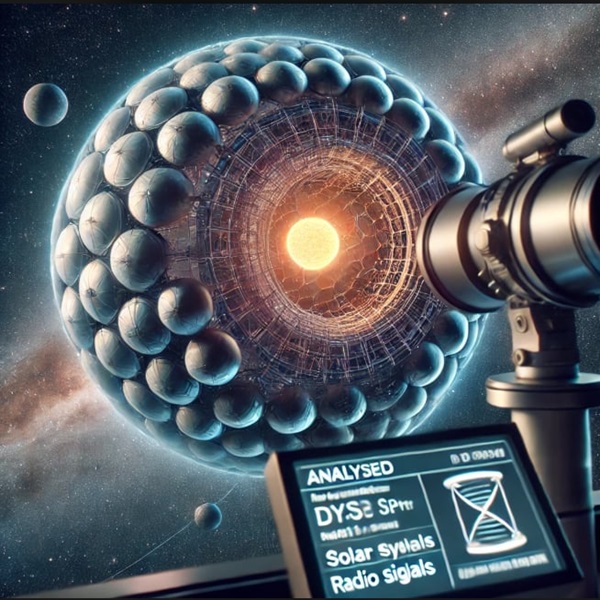
The research team, led by Tongtian Ren, a Ph.D. student from the Jodrell Bank Centre for Astrophysics at the University of Manchester, included renowned scientists like Prof. Michael Garrett and Andrew Siemion. Their findings were published in the Monthly Notices of the Royal Astronomical Society. Dyson Spheres, originally proposed by physicist Freeman Dyson, are theoretical megastructures capable of enclosing stars to capture their energy output.

Project Hephaestos, led by Prof. Erik Zackrisson, identified seven potential Dyson Sphere candidates (designated A to G) around M-type stars from a sample of 5 million detected by the European Space Agency’s Gaia Observatory. The fourth and latest paper in the series examined these candidates using various observational methods.
Evaluating Natural Explanations
Previous research by Ren and his team explored possible natural explanations, such as dust-rich debris disks that absorb and re-emit light as infrared radiation. While this can lead to infrared excess—a characteristic Dyson suggested could indicate a megastructure—the project’s measurements did not match typical debris disks.
Prof. Garrett shared his initial skepticism regarding the findings: “When I saw the original results from Project Hephaestos last year, I was skeptical—they had surveyed 5 million stars. You don’t expect stars to show radio emission at this level, which basically tells you that the radio emission is probably coming from background (radio) galaxies.”
The team suspected that Dust Obscured Galaxies (DOGs) might be causing the anomalies, as these galaxies are faint in the optical but extremely bright in the infrared spectrum.

The Hypothesis of Radio Emissions from Dyson Spheres
Inspired by research from Prof. Jason T. Wright at Penn State, who hypothesized that a true Dyson Sphere might emit radio signals as waste heat, the team investigated further. They examined data from the enhanced Multi-Element Radio Linked Interferometer Network (e-MERLIN) and the European VLBI Network (EVN) for candidate G, one of the brightest sources.
Evidence Points to Background Contamination
Surprisingly, they found radio counterparts for three of the seven candidates in existing astronomy databases. Tongtian Ren explained that the most logical explanation was contamination from background radio sources such as AGNs:
“They shouldn’t belong to one civilization. Otherwise, many anomalous stars would be connected as a swarm in the sky, not isolated seven. At that moment, we realized that either different extraterrestrial civilizations located hundreds of light-years away all have mastered the same or similar advanced radio emission technologies, or these signals originate from some form of natural contamination.”
Implications for the Search for Extraterrestrial Intelligence
These findings confirmed the team’s earlier hypothesis that some candidates identified by Project Hephaistos were contaminated by bright radio sources mimicking Dyson Sphere characteristics. However, this does not rule out the remaining six candidates. Prof. Garrett emphasized the importance of multi-wavelength analysis to rule out background contamination:
“We don’t know that all of the candidates are contaminated, but some, maybe all, probably are. I really hope some of them are indeed good Dyson Sphere candidates.”
The Future of Dyson Sphere Research

Tongtian Ren highlighted the challenges of future large-scale Dyson Sphere search programs:
“The development of new astronomical instruments does not follow the rapid update cycles of consumer electronics—it takes decades. Gaia (launched in 2013 and recently decommissioned) and WISE (launched in 2009 and expired in 2024) provided a crucial observational window. The next generation of similar probes may not be available for a long time, making it unlikely that a large-scale Dyson Sphere search program like Project Hephaistos will be conducted again in the near future. So the current seven Dyson Sphere candidates deserve to be carefully examined.”
Conclusion
The search for extraterrestrial intelligence continues to evolve, driven by advancements in astronomical instruments and innovative research methods. While high-resolution imaging revealed no definitive radio signals from the Dyson Sphere candidate, the study underscores the need for thorough, multi-wavelength analyses. The remaining candidates hold promise, and careful examination may yet yield groundbreaking discoveries in the quest for evidence of advanced extraterrestrial civilizations.
Source: Have Scientists Finally Uncovered the Truth About Dyson Spheres?
Is This Super-Earth the Key to Unlocking Alien Life?
Have Scientists Finally Uncovered the Truth About Dyson Spheres?