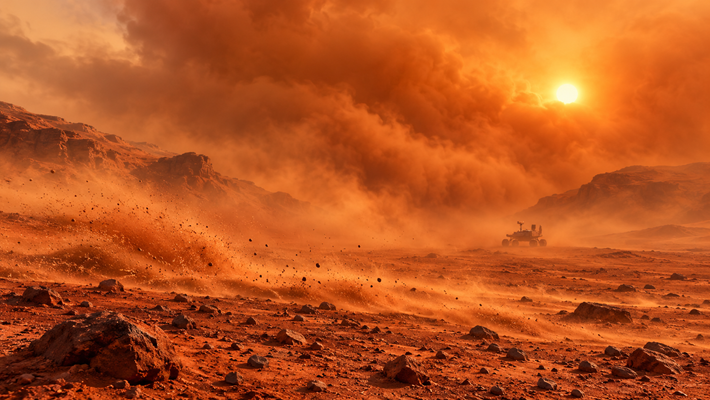
Has the Mystery of the Storms That Plunged Mars into Darkness for Months Been Solved? The Answer May Lie in a Grain of Sand!
Imagine standing on Mars as the sky gradually changes color. At first, a thin veil of dust appears near the horizon. Then the wind strengthens, the atmosphere turns increasingly hazy, and sunlight begins to disappear. Within days or weeks, the entire landscape may become trapped beneath a vast, reddish darkness.
This is not science fiction. It is a phenomenon that occurs on the Red Planet, where powerful dust storms can expand beyond individual regions and eventually surround the entire world.
On Earth, even the most destructive dust storms generally remain limited to particular geographical areas. Mars, however, operates under a very different set of atmospheric conditions. Every few Martian years, enormous quantities of dust can enter the atmosphere, creating planet-encircling events that dramatically alter the planet’s climate.
But what makes these storms grow to such extraordinary proportions? Why do they sometimes spread across the entire planet, while in other years similar conditions fail to produce a global event?
An international research team has now offered an important explanation. Surprisingly, the answer may lie in the interaction between two seemingly ordinary materials: sand and dust.
Researchers suggest that the way sand grains move, collide and interact with the finer particles covering the Martian surface could play a crucial role in triggering these enormous atmospheric events.
The findings provide a new perspective on Martian weather and could eventually help scientists predict dangerous storms before they threaten robotic missions or future human explorers.
The Hidden Science Behind Mars Global Dust Storms: Why Sand and Dust Must Work Together
To understand this discovery, scientists first had to examine something that happens almost invisibly at ground level.
Although sand and dust may look similar from a distance, they behave very differently when exposed to wind. Their differences in size, mass and physical properties determine how easily they move across the surface and enter the atmosphere.
In the scientific classification used by the Aarhus University report, sand grains measure approximately two millimeters to zero point zero six millimeters in diameter. Dust particles are considerably smaller, measuring less than zero point zero five millimeters.
This distinction is extremely important.
Sand grains are relatively heavy. Consequently, ordinary atmospheric turbulence cannot easily carry them high into the sky. Instead, they tend to travel close to the ground, rolling, sliding and repeatedly bouncing across the surface.
Dust behaves differently. Once fine particles escape the surface, atmospheric turbulence can keep them suspended for much longer periods. Powerful winds can then transport them across enormous distances.
But how does dust escape from the ground in the first place?
The answer involves a physical process known as saltation.
Imagine thousands of tiny sand grains moving across a barren Martian landscape. As the wind pushes them forward, they begin to roll and jump. Eventually, gravity pulls them back toward the ground.
However, their journey does not end when they land.
Each impact transfers energy to the surface. The grains strike other particles, disturb the thin layer of material covering the ground and break apart the forces holding finer dust particles together.
In effect, the sand acts like countless microscopic hammers.
Once released, the dust particles can enter the turbulent airflow and rise into the atmosphere. Scientists call this process suspension.
The difference between these two movements is fundamental to understanding Martian weather.
Sand generally travels relatively short distances through a series of jumps. Dust, meanwhile, can remain airborne and travel hundreds or even thousands of kilometers.
On Earth, Saharan dust sometimes crosses the Mediterranean and reaches northern Europe. Similar transport processes operate on Mars, although the planet’s atmospheric pressure, gravity and wind conditions are very different.
So why does this mechanism sometimes produce an enormous storm rather than an ordinary regional dust event?
Scientists believe the answer depends on the availability and geographical distribution of suitable surface particles.
Too few mobile sand-sized grains may prevent efficient dust lifting. Conversely, surfaces dominated by particles that are too large or too tightly bound may contribute very little dust to the atmosphere.
The most effective conditions occur when the surface contains an appropriate combination of particles capable of initiating saltation and fine dust that can be released.
Yet the latest research adds another important dimension: the distribution of dust across the Martian surface may be just as important as the total quantity available.
Why the Distribution of Martian Surface Dust Could Change Everything
For years, scientists have investigated why Mars experiences planet-encircling dust storms in certain years but remains relatively quiet in others.
One possibility involved the amount of dust stored in different regions. Researchers considered whether major storms might remove dust from important source areas, leaving those regions depleted for several years.
However, this explanation did not fully account for observations.
The new study by Demetrius Ramette and colleagues investigates a different but closely connected possibility: the geographical variation in surface dust cover and particle sizes.
Rather than treating the entire Martian surface as if it had identical properties, the researchers incorporated regional differences into their mathematical model.
This is a significant change.
Some areas contain surfaces covered almost completely by extremely fine dust. Other regions have fewer fine particles or contain a different mixture of grain sizes.
These differences influence how much wind stress is necessary to release dust into the atmosphere.
For example, very fine particles can stick together because of cohesive forces. This means that stronger wind stress may be necessary to mobilize them directly.
However, once the required threshold is exceeded, a region can potentially release substantial quantities of dust.
In other words, a landscape that remains relatively quiet under ordinary conditions could suddenly become an important source of atmospheric dust when the wind becomes sufficiently strong.
The researchers used the Dust Cover Index, a measure derived from observations of surface brightness and thermal properties, to represent differences in dust coverage.
They then incorporated these variations into a saltation-based model to estimate how much dust different surface regions could release under different wind conditions.
The results suggest that geographical differences in surface particle sizes may help explain why some Martian years produce enormous storms while others do not.
Even relatively small natural variations in wind stress could potentially determine whether the atmosphere crosses the threshold needed for a global dust event.
This raises an intriguing question: Could the difference between a quiet Martian year and a planet-wide atmospheric catastrophe be determined by relatively subtle changes in wind strength and the microscopic properties of the soil?
According to the research, that possibility deserves serious attention.
Importantly, the study does not establish that every global storm can be explained by a single sand-to-dust ratio. Instead, it provides a more sophisticated framework for investigating how surface conditions and atmospheric forces interact.
Inside the Aarhus University Laboratory: Recreating the Weather of Mars on Earth
Understanding the Martian atmosphere from a distance is difficult. Scientists cannot simply travel to Mars, collect unlimited quantities of its soil and repeat experiments under controlled conditions.
Instead, researchers must recreate important aspects of the planet’s environment inside specialized laboratories.
At Aarhus University in Denmark, senior researcher Jonathan P. Merrison leads a laboratory dedicated to investigating the physical processes that shape the Martian surface and atmosphere.
The facility contains specialized environmental chambers capable of simulating aspects of Martian conditions.
For more than twenty-five years, Merrison and his colleagues have studied how wind interacts with different combinations of sand and dust.
Inside these chambers, researchers introduce carefully prepared particles and use fans to generate controlled airflow. They can then adjust experimental conditions and observe how grains move across the surface.
More importantly, they can measure the wind speeds required to initiate particle movement and investigate how different surface compositions influence dust emission.
Why is this important?
Because the Martian atmosphere is dramatically different from Earth’s.
Mars has a much thinner atmosphere. Its surface atmospheric pressure is only a small fraction of Earth’s sea-level pressure. Consequently, wind does not interact with sand and dust in exactly the same way on the two planets.
A wind that appears relatively ordinary in terms of speed may behave very differently under Martian atmospheric conditions.
Furthermore, Mars has lower gravity. This influences the trajectories of airborne particles and the way grains move after they leave the surface.
Researchers therefore need more than ordinary desert experiments. They must reproduce the physical conditions that determine particle movement on the Red Planet.
The Aarhus experiments have contributed to the development of models used to investigate Martian dust transport.
However, even decades of laboratory work had not fully explained why global dust storms occur intermittently.
A new connection between experimental measurements and mathematical modelling offered a promising way forward.
An Unexpected Email Helped Unlock the Martian Dust Storm Mystery
Scientific breakthroughs do not always begin with expensive spacecraft or spectacular discoveries.
Sometimes, they begin with an email.
According to Merrison, German researcher Demetrius Ramette contacted him to request access to a collection of experimental measurements that had never been published.
These measurements contained information that could help investigate how sand and dust behave under controlled conditions.
Merrison shared the data.
Ramette then incorporated the relevant information into a new modelling framework, working alongside Lena Noack, Jonathan P. Merrison and Kerstin Schepanski.
The resulting research examined how variations in surface dust coverage and particle-size distributions influence dust emission under different wind conditions.
Unlike earlier approaches that treated surface properties more uniformly, this model considered geographical differences across Mars.
The research appeared in Geophysical Research Letters in June twenty twenty-six.
Its full title is Investigating the Impact of the Spatially Heterogeneous Surface Dust Cover on Martian Global Dust Event Occurrence.
The study provides a new way to examine the conditions that can encourage the explosive growth of global dust events.
It also highlights why combining laboratory measurements, orbital observations and mathematical simulations is essential when studying another planet’s climate.
Scientists Have Another Problem: Mars Dust Is Extremely Difficult to Reproduce
There is another challenge hidden behind these experiments.
Scientists do not have unlimited supplies of genuine Martian soil in laboratories on Earth.
Unlike lunar material, which has been brought back by several crewed and robotic missions, Martian surface samples have not yet been delivered to Earth.
Researchers must therefore produce artificial materials that closely reproduce the physical and mineralogical properties of Martian dust.
This is far more difficult than it might initially appear.
A suitable analogue must contain appropriate minerals and reproduce the particle sizes and other physical characteristics that influence how dust behaves.
According to Merrison, a Spanish research team working with him spent approximately three years producing just three kilograms of dust that closely resembles the material found on Mars.
The process involved selecting suitable minerals, crushing them and grinding the particles until they reached the required sizes.
The work was so demanding that the researchers reportedly had little enthusiasm for repeating the process.
Merrison still keeps approximately one hundred grams of this valuable analogue material in his laboratory.
Why does such a small quantity matter so much?
Because even tiny differences in particle composition, size and surface properties can change how grains respond to wind.
If scientists use material that behaves differently from genuine Martian soil, their experiments may produce misleading results.
This makes the development of accurate Martian dust analogues an important part of planetary research.
It also demonstrates that understanding another world sometimes requires painstaking work with a few grams of carefully prepared material.
The Twenty Eighteen Global Dust Storm: How Mars Lost Its Sunlight for Months
The importance of understanding global dust storms becomes much clearer when we look at one of the most dramatic events in modern Martian exploration.
In June twenty eighteen, an enormous dust storm began developing on Mars. What initially appeared to be a regional disturbance gradually expanded until dust surrounded the entire planet.
Within weeks, the Martian atmosphere had become so filled with suspended particles that sunlight reaching the surface dropped dramatically.
The storm continued for months. It was not until October that conditions improved sufficiently for sunlight to return to the surface.
For scientists, this was an extraordinary natural experiment. It demonstrated just how dramatically Martian weather can change and how vulnerable surface missions can become when dust fills the atmosphere.
One spacecraft paid a particularly high price.
NASA’s Opportunity rover had been exploring Mars since January two thousand and four. It relied on solar panels to generate the electricity needed for its scientific instruments, communications and daily operations.
However, as the global storm intensified, thick dust accumulated in the atmosphere and blocked sunlight from reaching its solar panels.
Without sufficient sunlight, Opportunity could no longer recharge its batteries effectively.
NASA eventually lost communication with the rover. After repeated attempts to restore contact, the agency officially ended the mission in February two thousand and nineteen.
A spacecraft designed to operate for approximately ninety Martian days had survived for almost fifteen Earth years.
Its final chapter illustrated a serious problem for future Mars exploration.
What happens when an entire planet becomes covered in dust and the technology supporting a mission can no longer function?
And what would happen if the people living there depended on the same vulnerable infrastructure?
Could Scientists Predict Mars Global Dust Storms Before They Begin?
Understanding how a global dust storm develops is only part of the challenge.
The next major objective is predicting when one might occur.
On Earth, weather forecasting relies on enormous quantities of observations collected by satellites, weather stations, aircraft and atmospheric instruments.
Meteorologists combine these measurements with mathematical models to estimate how atmospheric conditions will change.
Mars presents a much more difficult problem.
There are no permanent networks of weather stations distributed across the planet. Instead, scientists must rely on a limited number of orbiters, landers and rovers.
These instruments provide valuable information about atmospheric temperature, pressure, wind conditions, dust concentrations and seasonal changes.
However, they cannot observe every location continuously.
This is where improved dust emission models could make a difference.
By understanding how surface particle sizes, dust coverage and wind stress influence atmospheric dust release, researchers may become better equipped to identify conditions that favor the development of large storms.
A more accurate model could help scientists distinguish between an ordinary regional disturbance and an atmospheric event with the potential to expand across the planet.
Consider what that could mean for future missions.
If scientists detect that a major storm is becoming increasingly likely, mission controllers might have time to change operational plans.
Solar-powered rovers could be directed toward safer locations when possible. Sensitive instruments could enter protective operating modes. Scientific observations could be adjusted before atmospheric conditions deteriorate.
Even a limited warning period could make an enormous difference.
However, reliable forecasting will require further research and continuous improvements in atmospheric observations.
The new model represents an important step, not a fully operational Martian weather forecasting system.
Why Dust Storm Forecasting Could Determine the Future of Human Settlements on Mars
The consequences of Martian dust storms extend far beyond robotic exploration.
For years, scientists, engineers and private space companies have discussed the possibility of establishing permanent human settlements on the Red Planet.
However, building a habitat is only the beginning.
A human settlement would need reliable electricity, breathable air, water supplies, food production systems, communication equipment and protection from the harsh external environment.
Many proposed technologies rely on solar energy.
But what happens when a storm blocks sunlight for weeks or months?
Solar panels could produce substantially less electricity. Dust accumulation could further reduce their efficiency. Equipment exposed to powerful winds and abrasive particles would also require careful protection.
Even if a settlement possessed alternative energy sources, prolonged atmospheric disturbances could place enormous pressure on its infrastructure.
Consequently, future Martian settlements would need multiple layers of protection.
Energy storage systems, nuclear power, dust-resistant equipment and carefully designed shelters could all become essential components of a sustainable habitat.
Weather forecasting would be another critical element.
Imagine receiving a warning that a planet-wide dust storm could develop within the coming days. Could astronauts move vulnerable equipment underground? Could autonomous robots secure solar panels and external instruments? Could life-support systems switch to emergency power arrangements?
These are not simply engineering questions.
They are questions about whether humans can safely survive in an environment where even the weather can threaten an entire settlement.
As Merrison emphasizes, reliable forecasts would be essential if people are ever to establish a lasting presence on Mars.
Mars Is More Than a Desert: Why Its Climate Matters to Earth
Despite its barren appearance, Mars is one of the most scientifically valuable planets in the Solar System.
Its landscape contains enormous volcanoes, ancient river channels, dried lake basins, sedimentary deposits and geological structures that preserve evidence of a very different past.
Scientists believe that early Mars had a considerably different climate. Evidence from ancient river valleys and water-altered minerals suggests that liquid water once played a much more prominent role on its surface.
Could understanding its ancient climate also help us understand how planets change over geological timescales?
The answer is potentially yes.
Mars offers researchers an opportunity to investigate how an atmosphere behaves under conditions very different from those on Earth.
Its thin atmosphere, seasonal carbon dioxide frost, powerful dust cycles and changing surface temperatures create a natural laboratory for planetary climate science.
Dust is particularly important because it does more than reduce visibility.
Suspended particles absorb and scatter sunlight. This changes how energy enters and moves through the atmosphere.
As atmospheric temperatures change, wind circulation can also respond. Those winds may then transport more dust, creating interactions between the surface and atmosphere.
In this way, dust storms can influence the very atmospheric conditions that help sustain them.
Scientists therefore need to understand more than how particles rise from the ground. They must also investigate how atmospheric circulation, seasonal changes and surface conditions interact.
This is one reason why accurate Martian climate models are so important.
The same research can also improve our understanding of atmospheric processes on Earth and other planetary bodies.
Is Mars Research Losing Its Priority in the New Space Race?
Despite the scientific importance of the discovery, Merrison has expressed concern about the direction of international space exploration.
According to his comments in the Aarhus University report, the Moon has become a major priority for space agencies and governments.
The United States, China and India are investing heavily in lunar exploration, with ambitions that include establishing a more permanent human presence.
These programmes could produce important scientific and technological advances.
Nevertheless, Merrison believes that the growing focus on lunar exploration has come at the expense of Mars research.
One example is the complicated effort to return samples collected by NASA’s Perseverance rover.
Perseverance has been exploring Jezero Crater since February two thousand and twenty-one. Its mission includes collecting and storing samples of Martian rocks and soil that could eventually be transported to Earth.
Those samples could help scientists investigate ancient environmental conditions, geological processes and the possibility that Mars once supported microbial life.
However, the original Mars Sample Return programme encountered substantial technical and financial challenges, and NASA subsequently moved away from its original mission architecture.
For planetary scientists, this creates a difficult situation.
Returning Martian material to Earth would open extraordinary research opportunities. Yet the cost and complexity of such a mission make it one of the most challenging projects ever proposed for planetary exploration.
Merrison argues that Mars deserves greater scientific attention.
The Moon is an important destination, but Mars offers something different: a planet with an atmosphere, active weather systems, enormous geological structures and a history that may preserve evidence of ancient environments once more similar to those on Earth.
Could concentrating too heavily on one destination mean missing some of the most important discoveries waiting elsewhere in the Solar System?
That question remains central to the future of planetary science.
A Tiny Grain of Sand Could Hold the Key to Understanding an Entire Planet
The discovery surrounding Martian dust storms offers a fascinating reminder of how small physical processes can produce enormous planetary consequences.
A sand grain bouncing across the surface may appear insignificant. A tiny dust particle rising into the atmosphere may seem even less important.
Yet, when billions upon billions of particles interact with the wind, their collective behavior can influence the weather of an entire world.
The new research brings scientists closer to understanding why Mars sometimes experiences relatively quiet atmospheric conditions and, in other years, develops storms that surround the planet.
It also highlights the importance of looking beyond atmospheric conditions alone. The physical properties of the ground itself may help determine the future of the Martian climate.
Nevertheless, several questions remain.
Can researchers determine precisely when the atmospheric conditions will cross the threshold for a global dust event?
Will future observations confirm that geographical differences in surface particle sizes are a major factor behind the irregular appearance of these storms?
Could improved forecasting eventually protect human settlements from months of darkness?
And perhaps the most fascinating question of all:
If something as small as a bouncing grain of sand can help trigger a storm that engulfs an entire planet, how many other seemingly insignificant processes are we overlooking when trying to understand the worlds around us?
Mars may look like a silent, lifeless desert from millions of kilometers away. Yet beneath its reddish surface lies an extraordinarily complex system of interacting forces.
Scientists are only beginning to understand how those forces work together.
Source: Has the Mystery of the Storms That Plunged Mars into Darkness for Months Been Solved? The Answer May Lie in a Grain of Sand!
A mysterious twist in the universe’s oldest light could reveal new physics
A mysterious twist in the universe’s oldest light could reveal new physics
Has the Mystery of the Storms That Plunged Mars into Darkness for Months Been Solved? The Answer May Lie in a Grain of Sand!
Sources and Scientific References
The following sources were consulted to expand and scientifically contextualize the article.
1. Aarhus University – Original Research News (November seventeenth, twenty twenty-six): The discovery, Jonathan P. Merrison’s laboratory, Martian dust analogues and implications for weather forecasting.
The Mystery of Global Dust Storms on Mars Has Been Solved2. Geophysical Research Letters – Original Peer-Reviewed Study (June second, twenty twenty-six): Demetrius Ramette, Lena Noack, Jonathan P. Merrison and Kerstin Schepanski.
Investigating the Impact of the Spatially Heterogeneous Surface Dust Cover on Martian Global Dust Event Occurrence
DOI: https://doi.org/10.1029/2026GL122003
3. NASA / American Geophysical Union – Research on the twenty eighteen global dust storm: Atmospheric effects and observations from the Curiosity rover.
First In Situ Meteorological Observations of a Mars Global Dust Storm4. Geophysical Research Letters – Martian Dust Redistribution (October seventh, twenty twenty-six): Research investigating how dust moves between different regions of Mars over multiple Martian years.
Modeling the Redistribution of Dust Across the Martian Surface for Mars Years Twenty-Four to Thirty-Six5. Planetary and Space Science – Saltation and Dust Lifting (February, two thousand and two): Experimental research examining how bouncing sand grains can release dust under Martian atmospheric pressure.
Has the Mystery of the Storms That Plunged Mars into Darkness for Months Been Solved? The Answer May Lie in a Grain of Sand!