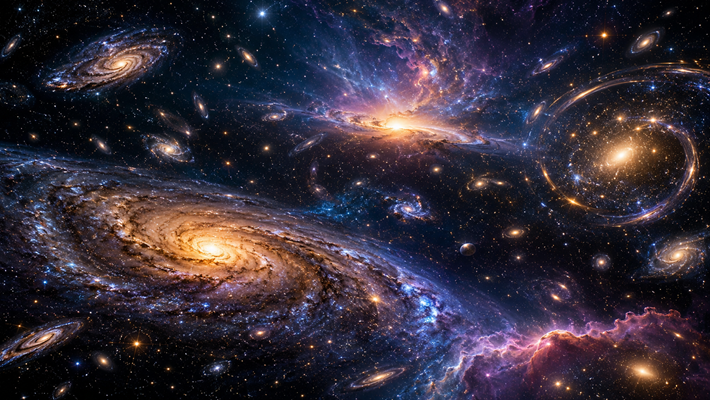
Is the Universe Much Older Than We Thought? Scientists Are Debating a 26.7-billion-year-old cosmos!
For decades, astronomers have relied on two mysterious ingredients to explain how the Universe works: dark matter and dark energy. One holds galaxies together through its gravitational influence. The other appears to drive the accelerated expansion of the cosmos. Yet neither has ever been directly detected.
Now, a controversial alternative theory is challenging this familiar picture. Researchers at the University of Ottawa have tested a cosmological model that could explain several major astronomical observations without requiring either dark matter or dark energy.
Even more remarkably, the model suggests that the Universe may be approximately twenty-six point seven billion years old. That is almost twice the age predicted by the conventional cosmological model.
Could our understanding of cosmic history be fundamentally wrong? Are dark matter and dark energy real components of the Universe, or are astronomers interpreting the effects of changing physical laws as evidence for invisible substances?
The proposal, known as Covarying Coupling Constants plus Tired Light, or CCC+TL, is attracting renewed attention. Its recent results have opened an intriguing possibility: perhaps the Universe is much older, and its history considerably different, than scientists have traditionally believed.
However, the theory also faces serious scientific challenges. Understanding what researchers have actually discovered requires looking beyond the headline.
The CCC+TL Cosmology Challenge: Why Are Scientists Questioning Dark Matter and Dark Energy?
The modern understanding of the Universe rests largely on a framework called Lambda Cold Dark Matter, commonly written as ΛCDM.
This model describes a cosmos containing ordinary matter, cold dark matter, dark energy, and radiation. Together, these components explain a remarkable range of observations, from the formation of galaxies to the large-scale structure of the Universe.
The foundations of this picture developed over several decades.
During the nineteen-seventies, astronomer Vera C. Rubin and her colleagues produced compelling evidence that galaxies rotate in ways ordinary visible matter cannot adequately explain. Stars near the outer regions of spiral galaxies move faster than expected from the gravitational influence of their visible contents.
According to conventional gravitational calculations, these stars should move more slowly. Otherwise, the galaxies would struggle to remain gravitationally bound.
The proposed solution was dark matter: an invisible form of matter that contributes gravitational attraction without emitting or absorbing light in the ordinary way.
Later, observations of distant supernovae revealed another unexpected phenomenon. In the nineteen-nineties, independent research teams discovered that the expansion of the Universe is accelerating.
Scientists introduced dark energy to explain this acceleration. In the standard cosmological model, it accounts for approximately sixty-eight percent of the Universe’s total energy density.
Despite its extraordinary success, ΛCDM is not without unanswered questions.
The James Webb Space Telescope (JWST), for example, has identified surprisingly bright, massive, and apparently developed galaxies at very early stages of cosmic history.
Some observations initially appeared difficult to reconcile with conventional galaxy-formation timelines.
Does this mean the standard model is fundamentally incorrect? Not necessarily. Astronomers continue to investigate whether revised assumptions about star formation, black holes, dust, and galaxy evolution can explain these observations.
Nevertheless, such discoveries have encouraged scientists to investigate alternative cosmological explanations.
One of the most unusual possibilities is CCC+TL.
What Is CCC+TL? The Alternative Cosmological Theory That Changes Fundamental Physics
The CCC+TL framework combines two distinct ideas: covarying coupling constants and tired light.
Although these concepts sound highly theoretical, they address a fundamental question: could some of the astronomical effects currently attributed to dark matter and dark energy arise from changes in the physical constants governing the Universe?
The first component, Covarying Coupling Constants (CCC), proposes that certain fundamental constants do not remain completely unchanged throughout cosmic history.
In conventional physics, constants such as the gravitational coupling and electromagnetic coupling play essential roles in determining how particles and forces behave.
The CCC hypothesis explores whether these quantities could evolve together as the Universe expands.
This idea has connections to earlier proposals concerning the possible variation of fundamental constants, including ideas associated with physicist Paul Dirac.
However, changing fundamental constants is not a minor adjustment. It affects the mathematical relationships underlying physical theories.
Consequently, a cosmological framework incorporating such changes must explain how gravity, matter, radiation, and cosmic expansion behave consistently.
The second component is the Tired Light hypothesis.
First proposed by Fritz Zwicky in the nineteen-twenties, tired light offers an alternative explanation for the redshift of distant galaxies.
When astronomers observe distant galaxies, their light appears shifted toward longer wavelengths. In standard cosmology, this phenomenon primarily occurs because space itself expands while light travels through it.
Tired light proposes that photons could also lose energy during their journey through space, producing an additional redshift.
In CCC+TL, these two mechanisms operate together. The observed redshift contains contributions from both cosmic expansion and the proposed tired-light effect.
This changes how astronomers interpret the distances, ages, and evolution of distant galaxies.
Could a different interpretation of redshift fundamentally change the estimated age of the Universe?
That is precisely what makes this theory so controversial.
A Universe Twenty-Six Point Seven Billion Years Old: How Could Cosmic History Change?
Under the conventional ΛCDM model, the Universe is approximately thirteen point eight billion years old.
This estimate comes from combining observations of the cosmic microwave background, the expansion history, and other cosmological measurements.
CCC+TL produces a dramatically different timeline.
According to Rajendra P. Gupta’s calculations, the Universe could be approximately twenty-six point seven billion years old.
The difference is enormous.
Instead of assuming that the first galaxies formed during an extremely short period after the Big Bang, this alternative framework provides considerably more time for cosmic structures to develop.
Consider the period known as Cosmic Dawn.
In the standard cosmological picture, the Universe was approximately three hundred million years old when the earliest stars and galaxies began appearing.
These first structures formed in an environment dominated by primordial gas, radiation, and gravitational interactions.
Yet the James Webb Space Telescope has revealed distant galaxies that appear surprisingly developed.
Some contain substantial stellar populations and exhibit structures that challenge existing expectations about how quickly galaxies could assemble.
Under CCC+TL, the Universe would have been approximately four point six billion years old at the corresponding observed cosmic epoch.
That additional time could make the formation of apparently mature galaxies considerably easier to explain.
In other words, galaxies that seem extraordinarily difficult to produce within the conventional timeline might become less surprising under a much older cosmic history.
But does an older Universe automatically solve every problem raised by JWST?
No. The theory must also reproduce the observed properties of those galaxies, their distribution, their brightness, and their evolution. A longer timeline is an interesting possibility, not a complete explanation by itself.
Nevertheless, the difference is significant enough to deserve serious investigation.
University of Ottawa Researchers Test CCC+TL Against Major Astronomical Observations
During twenty twenty-five and twenty twenty-six, Rajendra Gupta, an adjunct professor in the University of Ottawa’s Department of Physics, and postdoctoral researcher Dr. Nikolaos Samaras investigated whether CCC+TL could withstand several important observational tests.
Their work went beyond simply proposing a different age for the Universe.
They developed mathematical equations and computer calculations specifically adapted to the alternative framework.
This was necessary because CCC+TL modifies the standard equations used to describe gravitational interactions and cosmic expansion.
The researchers examined several major areas of cosmology, including primordial element formation, galaxy rotation, galaxy-cluster dynamics, and the expansion history of the Universe.
Their findings were encouraging in several respects.
However, the strength of the evidence varies between individual tests. Some results appear in peer-reviewed publications, while others remain preliminary or require further independent verification.
Big Bang Nucleosynthesis: Can CCC+TL Explain the First Elements?
One of the most important tests of any cosmological theory concerns the formation of the lightest chemical elements.
According to the Big Bang nucleosynthesis framework, the early Universe was extremely hot and dense. During its first few minutes, nuclear reactions produced the primordial abundance of hydrogen, helium, and small quantities of other light elements.
These predicted abundances provide an important record of conditions in the early cosmos.
A theory that changes the history of the Universe must explain how these elements formed without contradicting astronomical measurements.
Gupta and Samaras investigated this problem using CCC+TL-specific calculations.
Their study, titled A Big Bang Nucleosynthesis Consistency Test of the CCC+TL Cosmology, was published in the journal Universe in twenty twenty-six.
The researchers reported that their model could reproduce the expected primordial abundances of hydrogen, helium, and other light elements.
This matters because the theory must explain more than distant galaxies. It must also account for the chemical foundations of the observable Universe.
If CCC+TL cannot reproduce these primordial signatures, its alternative timeline would face a fundamental problem.
The reported agreement therefore represents an important step in evaluating the model.
Cosmic Chronometers: Can Galaxy Ages Reveal a Different Expansion History?
Another important investigation involved cosmic chronometers.
These are not physical clocks floating through space. Instead, astronomers use the ages of certain galaxies to estimate how quickly the Universe expanded at different stages of its history.
The method focuses on populations of relatively old, passively evolving galaxies.
By comparing their stellar ages at different redshifts, researchers can estimate the expansion rate, commonly represented by the Hubble parameter, H(z).
Gupta examined whether these measurements could be interpreted consistently within CCC+TL.
A study published in the Monthly Notices of the Royal Astronomical Society in June twenty twenty-six discussed this question.
The paper found that ΛCDM and CCC+TL could provide statistically comparable fits to a particular thirty-two-point cosmic-chronometer dataset.
However, there is an important qualification.
The study also acknowledged that the stellar-evolution assumptions and population-synthesis models used to calculate galaxy ages would need to be reconsidered within the alternative framework.
Therefore, the result should not be interpreted as a definitive confirmation of CCC+TL.
Instead, it demonstrates that the available dataset does not independently rule out the model under the specific approach examined.
Galaxy Rotation Curves: Could Galaxies Work Without Dark Matter?
One of the strongest reasons astronomers proposed dark matter was the unexpected rotation of spiral galaxies.
Stars and gas in the outer regions of these galaxies often move faster than calculations based solely on visible matter predict.
The standard explanation introduces extended halos of invisible dark matter.
CCC+TL proposes another possibility.
According to Gupta, evolving coupling constants could produce additional effective gravitational effects. These effects could influence galactic motion without requiring conventional dark matter halos.
In twenty twenty-five, Gupta published research examining galaxy rotation curves using observations from the SPARC database.
This database contains detailed measurements of the rotation properties of nearby galaxies.
The subsequent University of Ottawa research announcement reports that the CCC+TL framework was applied to all one hundred and seventy-five galaxies in the database.
The researchers found that the model could reproduce their rotation curves without introducing dark matter in the conventional way.
This is an important claim because galaxy rotation provides one of the clearest observational challenges that any alternative gravity-related theory must address.
However, reproducing individual rotation curves is not sufficient to establish a successful replacement for dark matter.
A convincing model must also perform consistently across different galaxy populations, reproduce gravitational lensing, and explain the large-scale distribution of matter.
Could changing fundamental constants provide a common explanation for all these phenomena?
That remains one of the central questions.
The Bullet Cluster: One of the Biggest Challenges for Theories Without Dark Matter
Few astronomical observations have become as influential in the dark matter debate as the Bullet Cluster.
This system consists of two galaxy clusters that collided during a tremendous cosmic encounter.
During the collision, the hot gas associated with the clusters interacted and slowed down. Astronomers detected this gas through X-ray observations.
However, gravitational lensing revealed that much of the gravitational mass appeared displaced from the hot gas.
Instead, the inferred mass distribution was associated more closely with the galaxies.
This separation became one of the most frequently cited pieces of evidence supporting dark matter.
Why?
Because the galaxies largely passed through the collision, while the hot gas experienced strong interactions.
If the dominant gravitational mass follows the galaxies rather than the gas, an additional component beyond ordinary matter appears necessary within conventional gravity.
Gupta and Samaras have investigated whether CCC+TL can reproduce this gravitational behaviour.
Their October twenty twenty-six proof-of-concept study examined gravitational lensing in the Bullet Cluster.
The researchers constructed gravitational convergence maps using observations of cluster galaxies and multiple gravitationally lensed images.
Their calculations indicated that the model could reproduce important aspects of the observed gravitational distribution.
In particular, its predicted additional gravitational effect followed the galaxy distribution rather than the X-ray-emitting gas.
The authors described this as an early proof of concept.
However, the study also contains important limitations. Its effective-density prescription uses assumptions tied to the cluster’s mass distribution. The authors therefore identify the work as an initial step rather than a definitive demonstration.
A full comparison using more comprehensive lensing analysis remains necessary.
Nevertheless, the Bullet Cluster investigation addresses one of the most demanding questions facing any theory that attempts to explain cosmic gravity without conventional dark matter.
Type Ia Supernovae and Cosmic Time Dilation: Another Test of the Alternative Universe Model
Supernovae provide another essential tool for understanding cosmic expansion.
Type Ia supernovae are particularly useful because their observed brightness can be used to estimate astronomical distances.
By studying these explosions across different redshifts, astronomers can reconstruct the expansion history of the Universe.
They can also examine an important relativistic phenomenon known as cosmological time dilation.
Light curves from distant supernovae appear stretched in time compared with similar events closer to Earth.
This behaviour is consistent with the expansion of space and provides another way to investigate cosmic history.
Gupta and his collaborators have examined whether CCC+TL can reproduce these observations.
A separate investigation involving Utkarsh Kumar, a postdoctoral researcher in observational cosmology at the University of Ottawa, explored the relationship between the model and observed supernova time dilation.
The University of Ottawa announcement reported that this separate study supported the framework, although it was still awaiting peer review at the time of publication.
That distinction is important.
A promising result from a manuscript awaiting independent scientific review does not carry the same evidential weight as a fully published and independently replicated finding.
Even so, supernova observations provide an important opportunity to test whether the alternative interpretation of redshift can survive comparisons with established cosmological evidence.
James Webb Space Telescope: Could the Universe Contain Galaxies Older Than Expected?
Perhaps the most exciting aspect of CCC+TL concerns the discoveries being made by the James Webb Space Telescope.
Since beginning scientific observations, JWST has revealed galaxies at extraordinary distances.
Some appear brighter, more massive, or more developed than astronomers initially expected to find so early in cosmic history.
These observations have triggered extensive discussions about the speed of galaxy formation.
Under ΛCDM, galaxies needed to assemble substantial quantities of gas, form stars, and develop their structures within a relatively short period.
That does not mean the standard model cannot explain them. Astronomers continue to refine models of stellar formation, black-hole growth, and early galaxy evolution.
Nevertheless, CCC+TL offers a different interpretation.
If the Universe is substantially older, galaxies would have had more time to accumulate matter and develop complex structures.
Gupta’s calculations suggest that early galaxies could be approximately twelve times larger in size and mass than corresponding predictions from the conventional model.
The additional time available under CCC+TL could help explain why some observed galaxies appear so developed.
But the theory makes a prediction that could prove even more interesting.
According to Gupta, galaxies may exist at distances beyond those already explored by JWST.
This raises a fascinating question: what might astronomers discover if they look even deeper into the early Universe?
The GLIMPSE Program: A Future Test of the CCC+TL Prediction
One opportunity comes from the James Webb Space Telescope’s GLIMPSE observing program.
The name stands for Gravitational Lensing and NIRCam IMaging Program to probe Early galaxy formation and Sources of reionization.
The project uses JWST’s Near-Infrared Camera, known as NIRCam, together with gravitational lensing from the massive Abell S1063 galaxy cluster.
Gravitational lensing occurs when the gravity of a massive object bends and magnifies light from more distant sources.
In effect, the cluster acts as a natural cosmic telescope.
This allows astronomers to investigate extremely faint and distant galaxies that would otherwise be difficult to observe.
The GLIMPSE observations could provide valuable evidence about the earliest stages of galaxy formation.
They may also test predictions made by alternative cosmological frameworks.
If astronomers identify galaxies at redshifts beyond those comfortably accommodated by conventional formation scenarios, researchers will need to investigate the underlying physics carefully.
However, discovering an exceptionally distant galaxy would not automatically prove CCC+TL.
Astronomers would need to establish its distance, physical properties, stellar population, and evolutionary history.
The decisive question is whether the model can correctly predict observations that have not yet been used to construct it.
That is where the strongest scientific test will emerge.
A Serious Scientific Challenge: Does CCC+TL Really Pass Every Cosmological Test?
Despite the encouraging results reported by the University of Ottawa, CCC+TL remains controversial.
There is an important reason.
In March twenty twenty-six, another study published in the Monthly Notices of the Royal Astronomical Society examined the model using cosmic-chronometer measurements of the expansion rate.
The researchers reported significant tension between CCC+TL predictions and the observed H(z) data.
Their analysis found that the parameter values used to fit Type Ia supernova observations did not successfully reproduce the cosmic-chronometer measurements.
In their statistical comparison, ΛCDM performed substantially better.
This creates an important challenge.
A cosmological theory cannot simply explain one group of observations while requiring substantially different parameters to explain another.
Its predictions must remain consistent across independent measurements.
Gupta subsequently published a response in the same journal in June twenty twenty-six.
That study argued that the interpretation of cosmic-chronometer measurements requires additional consideration within CCC+TL.
In particular, the authors questioned whether existing stellar-population models could be transferred directly into a framework with a different cosmic timeline and evolving physical constants.
They reported that a modified treatment could produce statistically comparable fits for the dataset they examined.
Consequently, the disagreement has not been resolved.
This is precisely why the theory needs further independent investigation.
There is also another challenge: the standard ΛCDM model explains a remarkably broad collection of observations, including the cosmic microwave background, baryon acoustic oscillations, gravitational lensing, and large-scale structure.
Any alternative must reproduce these successes, not simply explain a few observations that initially appear problematic.
The scientific question is therefore much larger than whether CCC+TL can eliminate the need for dark matter in selected calculations.
Can it explain the entire observable Universe with one consistent mathematical framework?
What Would Happen If Dark Matter and Dark Energy Were Not What We Think?
The implications of CCC+TL extend far beyond the estimated age of the Universe.
If the model eventually proves successful, astronomers may need to reconsider some of the most fundamental assumptions in modern cosmology.
Dark matter would no longer necessarily represent a separate invisible substance responsible for the additional gravitational attraction observed in galaxies and galaxy clusters.
Instead, some of those effects could emerge from the evolution of fundamental physical constants.
Similarly, dark energy might not require a mysterious component filling space and driving accelerated expansion.
Its apparent influence could arise from changes in the underlying relationships governing gravity and cosmic evolution.
This would represent a profound shift in our understanding of the Universe.
However, it is important to distinguish between an alternative explanation and an experimentally established discovery.
The absence of direct detection does not prove that dark matter or dark energy do not exist.
Dark matter has substantial indirect observational support. Dark energy also remains a central component of the standard interpretation of cosmic expansion.
Furthermore, changing fundamental constants would have consequences for atomic physics, stellar evolution, nuclear reactions, and many other physical processes.
A successful alternative must account for all these consequences.
That is a demanding scientific challenge, but it is also what makes the investigation worthwhile.
The Future of Cosmology: Could New Observations Rewrite the History of the Universe?
The debate surrounding CCC+TL highlights an important moment in modern astronomy.
For decades, ΛCDM has provided the most successful overall description of cosmic evolution.
Yet new telescopes, more precise measurements, and increasingly sophisticated simulations continue to expose questions that scientists must investigate.
JWST has transformed our understanding of early galaxies.
Gravitational-lensing observations are providing increasingly detailed maps of cosmic mass.
Supernova measurements and galaxy-age estimates are offering new ways to reconstruct the expansion history.
Each new observation provides another opportunity to test competing theories.
For CCC+TL, the coming years will be particularly important.
Researchers must demonstrate that its predictions remain consistent across independent datasets. They must also establish whether the proposed evolution of fundamental constants can be reconciled with established laboratory physics and astronomical observations.
Independent research teams will need to reproduce its results using transparent methods and comprehensive statistical comparisons.
Most importantly, the model must make successful predictions that distinguish it from ΛCDM.
That is how a radical scientific proposal becomes a credible replacement for an established theory.
Is the Universe Really Older Than Thirteen Point Eight Billion Years?
Imagine discovering that the Universe is almost twice as old as generations of astronomers have calculated.
Imagine that the mysterious gravitational effects attributed to dark matter arise from something entirely different.
Imagine that the force responsible for cosmic acceleration is not a separate substance, but a consequence of deeper physical relationships that scientists have yet to understand.
These possibilities are extraordinary.
Yet science does not advance by accepting the most exciting explanation. It advances by testing ideas against observations, questioning assumptions, and rejecting models that fail to explain the evidence.
CCC+TL has produced results that deserve attention. Its proposed explanation for early galaxy formation, its treatment of galaxy rotation, and its investigations of gravitational lensing offer interesting directions for future research.
At the same time, conflicting expansion-rate measurements and unresolved theoretical questions prevent anyone from declaring the model a replacement for ΛCDM.
Perhaps the most important question is not whether the Universe is twenty-six point seven billion years old.
It is whether the physical laws we use to understand the cosmos have remained exactly as we imagine throughout its history.
Could fundamental constants evolve with time? Could some of the Universe’s greatest mysteries have a common explanation? And if future observations support this radical proposal, how much of modern cosmology will need to be rewritten?
For now, the mystery remains open.
But one thing is certain: the deeper astronomers look into the Universe, the more reasons they find to question how much we truly understand about its origins.
Source: Is the Universe Much Older Than We Thought? Scientists Are Debating a 26.7-billion-year-old cosmos!
Astronomers discover remarkable triple-star system just 28 light-years from Earth
Astronomers discover remarkable triple-star system just 28 light-years from Earth
Is the Universe Much Older Than We Thought? Scientists Are Debating a 26.7-billion-year-old cosmos!
Sources and further scientific reading
The following sources provide the original research, institutional announcement, and independent scientific assessments.
1. University of Ottawa – Official research announcement (November sixth, twenty twenty-six): Theory predicting an older Universe without dark matter or dark energy passes key cosmological tests.
Faculty of Science
2. Universe – Big Bang nucleosynthesis test (twenty twenty-six): A Big Bang Nucleosynthesis Consistency Test of the CCC+TL Cosmology.
3. Monthly Notices of the Royal Astronomical Society – Cosmic chronometer response (June twenty twenty-six): Testing the CCC+TL cosmology with cosmic-chronometer measurements of the Hubble parameter.
OUP Academic
4. Monthly Notices of the Royal Astronomical Society – Independent challenge (March twenty twenty-six): Stringent constraint on the CCC+TL cosmology with H(z) measurements.
OUP Academic
5. Galaxies – Galaxy rotation curves (September twelfth, twenty twenty-five): Testing CCC+TL Cosmology with Galaxy Rotation Curves.
MDPI
6. ArXiv – Bullet Cluster gravitational lensing (October twenty-second, twenty twenty-six): Gravitational Lensing of the Bullet Cluster in the CCC+TL Cosmology.
arxiv.org
7. Monthly Notices of the Royal Astronomical Society – Full SPARC sample assessment: Testing Covarying Coupling Constants against the full SPARC rotation-curve sample.
OUP Academic
Is the Universe Much Older Than We Thought? Scientists Are Debating a 26.7-billion-year-old cosmos!