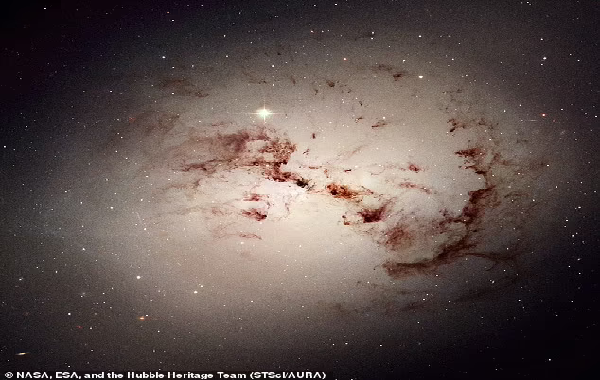
Has the ‘missing’ 70% of the universe FINALLY been found? Scientists find first evidence that black holes are the source of mysterious dark energy
It makes up most of the universe, yet hardly anything is known about the so-called Dark Energy that envelopes us.
The unusual ‘something’ – one of the great mysteries of cosmology – is believed to be an unknown force that is pushing things apart more strongly than gravity and causing the universe’s expansion to accelerate.
Now, scientists from Imperial College London believe they may finally have an explanation for the source of unknown energy — black holes.
Dr Chris Pearson, study co-author, said: ‘If the theory holds, then this is going to revolutionise the whole of cosmology.
‘At last we’ve got a solution for the origin of dark energy that’s been perplexing cosmologists and theoretical physicists for more than 20 years.’
Astronomers have always believed that Dark Energy could revolutionise physics as we know it, because its discovery 20 years ago threatened to blow Albert Einstein’s research out of the water.
The legendary physicist can rest easy for now, however, because the team of international researchers have found the first evidence that Dark Energy really does fit with his Theory of Relativity after all.
The main stumbling block to Einstein’s science – black holes and how their extremely strong gravity could be opposed by a secret force expanding the universe – has been dismissed by experts at the University of Hawaii and Imperial.
WHAT DO WE KNOW ABOUT BLACK HOLES?
Black holes are so dense and their gravitational pull is so strong that no form of radiation can escape them – not even light.
They act as intense sources of gravity which hoover up dust and gas around them. Their intense gravitational pull is thought to be what stars in galaxies orbit around.
How they are formed is still poorly understood. Astronomers believe they may form when a large cloud of gas up to 100,000 times bigger than the sun, collapses into a black hole.
Many of these black hole seeds then merge to form much larger supermassive black holes, which are found at the centre of every known massive galaxy.
Alternatively, a supermassive black hole seed could come from a giant star, about 100 times the sun’s mass, that ultimately forms into a black hole after it runs out of fuel and collapses.
When these giant stars die, they also go ‘supernova’, a huge explosion that expels the matter from the outer layers of the star into deep space.
They say that the Theory of General Relativity is correct because black holes actually contain Dark Energy, or the energy from space that Einstein originally predicted.
It also means that nothing ‘new’ or undiscovered has to be added to our picture of the universe to account for the ‘missing’ 68 per cent that Dark Energy equates to.
Not only that, but the idea of black holes having a ‘singularity’ at their centre where nothing – not even light – can escape, has been brought into question, too.
The new theory provides a way to ‘circumvent’ this mathematical problem, the researchers say, by making the idea of a singularity ‘go away’.
Confused?
Essentially, the Big Bang theory of the creation of our universe originally predicted that its expansion would slow down – or even begin to contract – because of the pull of gravity.
But in 1998, astronomers were surprised to find that not only was the universe still expanding, this expansion was also accelerating.
To account for this discovery, it was proposed that a ‘Dark Energy’ was responsible for pushing things apart more strongly than gravity.
This was linked to a concept Einstein had proposed but later discarded — a ‘cosmological constant’ that opposed gravity and kept the universe from collapsing.
Black holes posed a problem though — their extremely strong gravity is hard to oppose, especially at their centres, where everything seems to break down in a phenomenon called a ‘singularity’.
To dig deeper into the problem, a team of 17 researchers from nine countries studied nine billion years of black hole evolution.
They observed ancient and dormant galaxies and found that black holes gain mass in a way that is consistent with them containing vacuum energy, or Dark Energy.
In fact, the size of the universe at different points in time fitted closely with the mass of supermassive black holes at the heart of galaxies.
In other words, the amount of Dark Energy in the universe can be accounted for by black hole vacuum energy — meaning black holes are the source of dark energy.
Such is the excitement and significance of the discovery, the scientists responsible for the new research said they ‘may have found the answer to one of the biggest problems in cosmology’.
Study co-author Dr Dave Clements, from the Department of Physics at Imperial, said: ‘This is a really surprising result. We started off looking at how black holes grow over time, and may have found the answer to one of the biggest problems in cosmology.’
The research is the first observational evidence that black holes actually contain vacuum energy and are ‘coupled’ to the expansion of the universe, increasing in mass as the universe expands — a phenomenon called ‘cosmological coupling’.
Black holes are formed when massive stars come to the end of their life and are known as supermassive ones when found at the centres of galaxies.
These contain millions to billions of times the mass of our sun inside them in a comparatively small space, creating extremely strong gravity.
Black holes can increase in size by accreting matter, such as by swallowing stars that get too close, or by merging with other black holes.
However, the researchers found that this increase in mass was ‘significantly bigger’ than what could be explained purely by astrophysical processes such as merging, which led them to the theory that black holes contain Dark Energy and are linked to the expansion of the universe.
If further observations confirm it, cosmological coupling will redefine our understanding of what a black hole is, the astronomers added.
Study author Duncan Farrah, from the University of Hawaii, said: ‘We’re really saying two things at once: that there’s evidence the typical black hole solutions don’t work for you on a long, long timescale, and we have the first proposed astrophysical source for dark energy.
‘What that means, though, is not that other people haven’t proposed sources for dark energy, but this is the first observational paper where we’re not adding anything new to the universe as a source for dark energy: black holes in Einstein’s theory of gravity are the dark energy.’
Source: daily mail
Packing Aerogel With Uranium Could Give Us The Space Engine We’ve Been Looking For
Packing Aerogel With Uranium Could Give Us The Space Engine We’ve Been Looking For
Has the ‘missing’ 70% of the universe FINALLY been found? Scientists find first evidence that black holes are the source of mysterious dark energy/Has the ‘missing’ 70% of the universe FINALLY been found? Scientists find first evidence that black holes are the source of mysterious dark energy