Has Radio Astronomy Found a Gravitational Wave Laboratory?
Discovery of CHIME J1634+44: A New Long Period Radio Transient “Unicorn”
Astronomers at the NSF’s Green Bank Observatory (GBO) have revealed the first—and so far only—Long Period Radio Transient (LPT) that’s speeding up instead of slowing down. Designated CHIME J1634+44, this enigmatic source produces repeating radio bursts every 14 minutes (841 s) and also exhibits a secondary cycle of exactly 70 minutes (4 206 s). How can one object maintain two precise, interlocked periods—and why is its spin actually decreasing?
How CHIME and the VLA Pinpoint Transient Radio Signals
CHIME’s enormous field of view first flagged the repeating bursts of CHIME J1634+44, tracking both its arrival times and its surprising shortening spin period. Meanwhile, the Very Large Array’s realfast system performed high‑frequency interferometric imaging to correct for interstellar medium (ISM) distortions and zero in on the source’s location. Together, these facilities laid the groundwork for a multi‑telescope campaign to characterize this radio “unicorn.”
Precision Timing with GBT and Polarization Insights
Using the Green Bank Telescope’s unparalleled timing resolution, the team analyzed how each burst is polarized. Weirdly, the radio waves are entirely circularly polarized, swirling through space in a perfect spiral. Such pure circular polarization is unheard of among other neutron-star–driven bursts. What emission mechanism could produce this flawless swirl?
Multi‑Observatory Campaign: CHIME, VLA, LOFAR & Swift
To capture every facet of CHIME J1634+44’s activity, researchers coordinated:
CHIME Fast Radio Burst and Pulsar Project: Burst detection and spin monitoring
VLA realfast: High‑frequency imaging to de‑disperse ISM effects and locate the source
GBT high‑resolution timing: Polarization measurements and precise spin modeling
LOFAR: Low‑frequency follow‑up to probe spectral structure
Swift X‑ray data: Search for any high‑energy counterpart
This synergy across the radio spectrum—and into X‑rays—has painted the most complete picture yet of any LPT.
Unprecedented Spin‑Up: Evidence for a Shrinking Binary Orbit
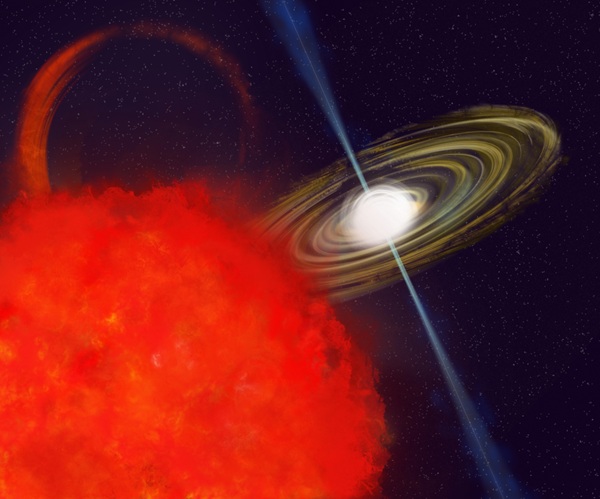
Typically, isolated neutron stars lose rotational energy and slow down over time. Yet CHIME J1634+44 is spinning up, its period shrinking with each cycle. No single star can explain this acceleration. The team’s leading hypothesis: CHIME J1634+44 belongs to a tight binary system, where orbital decay—possibly driven by gravitational‑wave emission—causes periodic Doppler boosts that mimic intrinsic spin‑up. Could we be witnessing gravitational waves at work in a neutron‑star pair?
Circular Polarization: A New Clue to Emission Physics
The pure circular polarization of CHIME J1634+44’s bursts suggests an emission mechanism fundamentally different from conventional pulsars or magnetars. Do magnetic field geometries or plasma processes in a binary environment twist the radio waves into this perfect spiral? Investigating this could unlock fresh insights into neutron‑star magnetospheres and particle acceleration.
Implications for Radio Astronomy and High‑Energy Astrophysics
CHIME J1634+44 expands the roster of known LPTs and forces theorists to rethink models of neutron‑star evolution. If other “spinning‑up” LPTs lurk undetected, what does that say about population statistics and the gravitational‑wave background? Future surveys with CHIME, VLA, SKA‑precursors, and next‑generation interferometers may uncover more of these rare systems, transforming our understanding of compact‑object demographics.
What other cosmic oddities await discovery in the depths of the radio sky? Only by probing all frequencies, refining our timing precision, and embracing multi‑messenger follow‑ups can we hope to solve these puzzles at the frontier of astrophysics.
Source: Has Radio Astronomy Found a Gravitational Wave Laboratory?
What Happens When You Use the Kuiper Belt as a Launchpad for Proxima?
What Happens When You Use the Kuiper Belt as a Launchpad for Proxima?