Harnessing Copper: The Body’s Natural Weapon Against Antibiotic Resistance
As the global healthcare crisis of antibiotic resistance deepens, conventional treatments are becoming increasingly ineffective. In response, scientists are shifting their focus toward understanding and boosting the body’s innate defense systems. A research team led by Dr. Sarguru Subash at the Texas A&M School of Veterinary Medicine and Biomedical Sciences is exploring how the immune system weaponizes the essential mineral copper to neutralize bacterial invaders, particularly in the context of urinary tract infections (UTIs).
Key Mechanisms: How the Host Weaponizes Copper
Nutritional Immunity and Direct Toxicity:
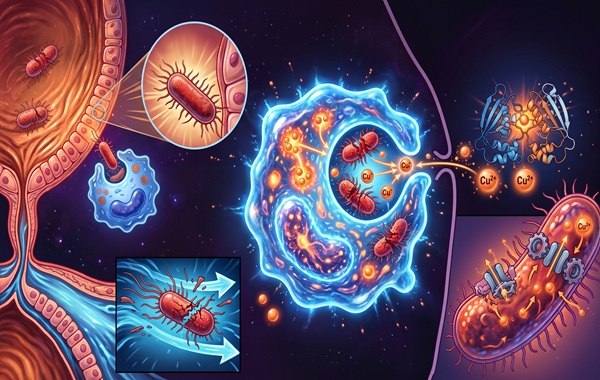
The host body uses trace metals in a sophisticated balancing act called nutritional immunity—withholding essential metals from pathogens while flooding them with toxic amounts of others. During an active urinary tract infection, the body markedly elevates copper levels in urine. Immune cells, such as macrophages, engulf invading bacteria and deliberately expose them to concentrated, copper-rich compartments to destroy vital bacterial proteins and induce lethal oxidative stress.
Inhibiting Bacterial Adhesion (Fimbriae):
To establish an infection, bacteria such as uropathogenic Escherichia coli (UPEC) rely on hair-like surface projections known as fimbriae to attach firmly to the lining of the bladder. Copper disrupts the function and assembly of these structures. By stripping pathogens of their grip, the immune system ensures that unanchored bacteria are naturally flushed out via the urinary stream.
Safe Delivery via Ceruloplasmin:
Because high levels of free copper are also toxic to healthy mammalian tissues, the body strictly regulates its trafficking. Dr. Subash’s research team is mapping the exact transport pathways involved, spotlighting the vital role of ceruloplasmin—a primary copper-carrying blood protein. During inflammation, ceruloplasmin safely shuttles copper to the site of infection, concentrating the antimicrobial payload precisely where it is needed while shielding host organs from collateral damage.
The Molecular Tug-of-War and Future Therapeutics
Bacteria have coexisted with copper in nature for billions of years and have evolved sophisticated countermeasures against it. Uropathogens deploy specialized export systems—such as copper-transporting efflux pumps and metallothionein-like periplasmic proteins—to purge excess copper from their cytoplasm and blunt the host’s chemical attack.
This ongoing evolutionary “tug-of-war” between host defenses and bacterial survival mechanisms holds the key to next-generation medicine:
Targeting Bacterial Copper Defenses: By decoding the molecular machinery bacteria use to tolerate copper, researchers aim to develop small-molecule inhibitors that specifically shut down these bacterial efflux pumps.
Restoring Pathogen Vulnerability: Disabling these defenses renders the bacteria hypersensitive to the host’s natural copper levels, allowing the immune system to clear the infection on its own.
Overcoming Antibiotic Resistance: Because this strategy targets virulence and metal tolerance rather than essential metabolic pathways targeted by standard antibiotics, it presents a compelling blueprint for clearing multidrug-resistant infections with a far lower likelihood of inducing future resistance.
Source: phys.org
A Warning Sign of Heart Attack And Stroke May Show Up on Your Face
Harnessing Copper: The Body’s Natural Weapon Against Antibiotic Resistance