Expecting a Dying Star, Astronomers Followed a Monstrous Flash to Something Else
A flash of powerful light from a galaxy just over a billion light-years away is upending our understanding of the most powerful explosions in the Universe.
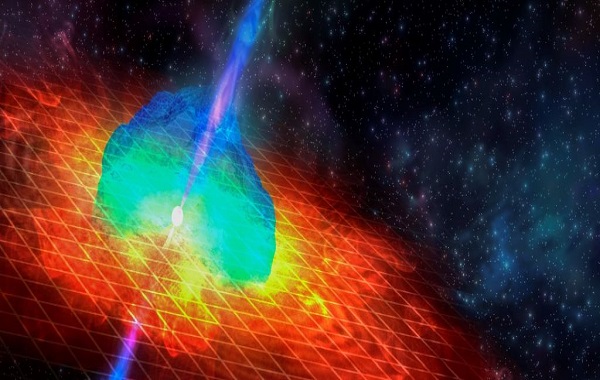
The gamma-ray burst appears to be the result of a merger between two neutron stars. This in itself isn’t a surprise; neutron stars can release a short, intense burst of high energy radiation as they crash together.
What is a shock is the duration of the outburst. The flash of gamma radiation lasted 50 seconds – a length previously thought only to be associated with supernova explosions.
“Astronomers have long believed that gamma-ray bursts fell into two categories: long-duration bursts from imploding stars and short-duration bursts from merging compact stellar objects,” explains astrophysicist Chris Fryer of Los Alamos National Laboratory.
“But in a recently observed event, we’ve found a kilonova along with a long-duration gamma-ray burst, and that has thrown a wrench into this simple picture.”
Gamma radiation is the most energetic form of light in the Universe, a product of the radioactive decay of atomic nuclei. And a gamma-ray burst is immense, discharging in a few seconds as much energy as the Sun would produce in 10 billion years. Only extremely violent events can produce these powerful bursts of light.
What is a shock is the duration of the outburst. The flash of gamma radiation lasted 50 seconds – a length previously thought only to be associated with supernova explosions.
“Astronomers have long believed that gamma-ray bursts fell into two categories: long-duration bursts from imploding stars and short-duration bursts from merging compact stellar objects,” explains astrophysicist Chris Fryer of Los Alamos National Laboratory.
“But in a recently observed event, we’ve found a kilonova along with a long-duration gamma-ray burst, and that has thrown a wrench into this simple picture.”
Gamma radiation is the most energetic form of light in the Universe, a product of the radioactive decay of atomic nuclei. And a gamma-ray burst is immense, discharging in a few seconds as much energy as the Sun would produce in 10 billion years. Only extremely violent events can produce these powerful bursts of light.
“We image a source in different filters to obtain color information, which helps us determine the source’s identity. In this case, red color prevailed, and bluer colors faded more quickly. This color evolution is a telltale signature of a kilonova, and kilonovae can only come from neutron star mergers.”
An analysis of the event revealed some more interesting tidbits. For example, tracing the event to its host galaxy 1.1 billion light-years away revealed a young galaxy still in the throes of star formation. This is very different from the old, dead, non-star-forming galaxy from which the 2017 collision emerged. This means that the search for kilonova events might need to be expanded to a wider range of galaxy types.
And, as we saw with the 2017 merger, neutron star mergers are responsible for the creation of heavy elements, such as gold and platinum. A team of scientists modeled the emission from GRB211211A and found that the explosion forged around 1,000 times the mass of Earth in heavy elements.
As for the reason why the event was so different in its duration, we don’t actually know yet. Everything about it except the gamma-ray burst fit the profile of a neutron star merger, which raises, scientists say, some incredibly exciting possibilities.
“This was a remarkable gamma-ray burst. We don’t expect mergers to last more than about two seconds. Somehow, this one powered a jet for almost a full minute. It’s possible the behavior could be explained by a long-lasting neutron star, but we can’t rule out that what we saw was a neutron star being ripped apart by a black hole,” says astrophysicist Benjamin Gompertz of the University of Birmingham in the UK.
“Studying more of these events will help us determine which is the right answer and the detailed information we gained from GRB 211211A will be invaluable for this interpretation.”
Source: Science Alert
Scientist Proposes Growing a Forest Inside a Bubble on Mars
Expecting a Dying Star, Astronomers Followed a Monstrous Flash to Something Else