Does Venus’s Atmosphere Hold the Key to Extraterrestrial Life?
Venus’s Atmospheric Shield: Can Life Thrive in Its Clouds?
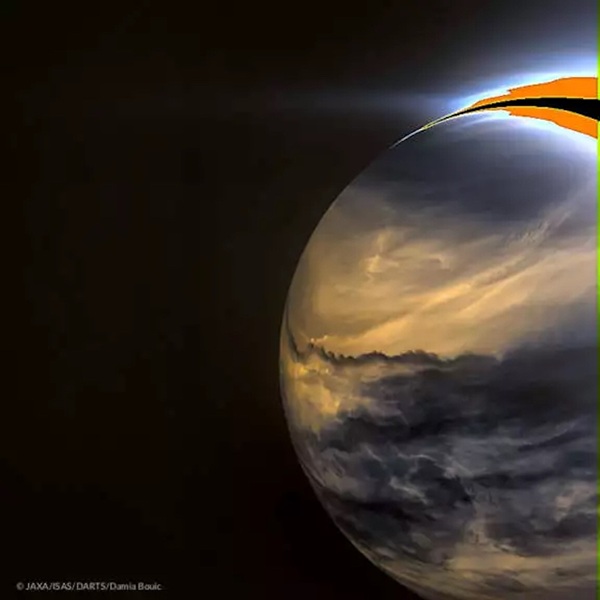
Venus is often referred to as Earth’s “sister planet” due to its similar size and composition, yet its environment is vastly different. With a suffocating atmosphere, scorching surface temperatures, and no planetary magnetic field, Venus appears to be an inhospitable world. However, a recent study has revealed that despite lacking a magnetic shield, Venus’s thick atmosphere may provide enough protection for microbial life to exist in its cloud layers.
The Harsh Reality of Venus’s Surface
Venus is the hottest planet in the solar system, with surface temperatures exceeding 475°C, hot enough to melt lead. The planet’s dense carbon dioxide atmosphere, laced with sulfuric acid clouds, creates an extreme greenhouse effect, trapping heat and pushing atmospheric pressure to more than 90 times that of Earth. Its volcanic landscapes, vast plains, and towering mountains are shrouded beneath an oppressive atmosphere, making the planet’s surface utterly uninhabitable. Despite these harsh conditions, the possibility of life beyond Earth has drawn scientific interest to Venus—not on the ground, but in its clouds.
A Surprising “Habitable Zone” in Venus’s Atmosphere
Although Venus’s surface is completely inhospitable, its atmosphere contains a region where conditions are strikingly more Earth-like. Between 40 and 60 kilometers above the surface, the temperature and pressure fall within ranges that could theoretically support life. This region, known as Venus’s “habitable zone,” offers conditions where microbial life might exist, similar to airborne bacteria found in Earth’s atmosphere.
In 2020, the detection of phosphine—a gas associated with biological processes—sparked renewed interest in Venus as a potential host for life. On Earth, phosphine is primarily produced by microbial activity. The discovery raised the question: Could life be thriving in Venus’s acidic cloud layers? While the presence of phosphine remains debated, it reinforced the idea that Venus’s cloud zone deserves further exploration.

Venus’s Atmosphere: A Natural Radiation Shield
One of the biggest challenges for life beyond Earth is radiation exposure. Without a protective magnetic field, planets are bombarded by high-energy cosmic rays and solar radiation. Earth’s magnetosphere plays a crucial role in deflecting this radiation, preventing it from reaching the surface. Venus, however, lacks this protective force, making scientists question whether life could survive in its atmospheric layers.
Recent atmospheric simulations have provided an unexpected answer. The dense Venusian atmosphere itself acts as a shield, significantly reducing the amount of radiation that penetrates the habitable cloud region. Simulations of cosmic ray interactions in Venus’s atmosphere have shown that, at equivalent atmospheric depths, the radiation levels in its habitable zone are comparable to those on Earth’s surface. While the upper boundary of the habitable zone experiences about 40% more radiation than Earth, this level is not necessarily lethal to microbial life.
Could Microbial Life Persist in Venus’s Clouds?
If life exists in Venus’s atmosphere, it would have to be resilient to extreme acidity, fluctuating radiation, and the lack of a stable surface environment. On Earth, microbial life has adapted to thrive in extreme conditions, from deep-sea hydrothermal vents to high-altitude clouds. The microorganisms that could potentially exist in Venus’s atmosphere would need to continuously survive in the cloud layers without the ability to migrate to safer regions, as there is no equivalent to Earth’s deep biosphere to provide refuge.
This means that if microbial life formed in Venus’s atmosphere, it must have persisted there for millions—or even billions—of years, continuously adapting to its harsh environment. The discovery of radiation levels similar to Earth’s surface strengthens the case that such life, if present, could survive long-term in Venus’s clouds.

The Future of Venusian Exploration
As interest in Venus grows, future missions are being planned to study its atmosphere in greater detail. Space agencies are developing probes and aerial platforms that could directly sample the cloud layers, searching for organic molecules, analyzing atmospheric chemistry, and measuring radiation levels firsthand. These missions may finally answer the question of whether life can exist in Venus’s skies.
Venus, long thought to be a barren and hostile world, may still hold secrets in its thick atmosphere. The discovery that its clouds provide radiation protection similar to Earth’s surface adds a new dimension to the search for extraterrestrial life. Whether microbial life is present remains unknown, but Venus has now become a prime target in the ongoing exploration of our solar system’s most enigmatic planets.
Source: Does Venus’s Atmosphere Hold the Key to Extraterrestrial Life?
Weird Ice That Could Form on Alien Planets Observed For First Time
Weird Ice That Could Form on Alien Planets Observed For First Time
Does Venus’s Atmosphere Hold the Key to Extraterrestrial Life?