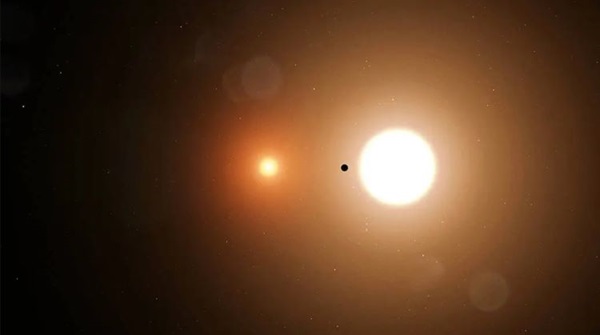
Do Moons Exist Around Planets With Two Suns? The Search for Exomoons in Binary Star Systems
Exomoons are a growing frontier in the field of astrophysics, capturing the imagination of scientists and space enthusiasts alike. Despite their potential significance, no exomoons have been confirmed yet, but researchers are developing innovative methods to detect these elusive celestial bodies. While most efforts have focused on exomoons orbiting exoplanets around single stars, a fascinating question arises: Could exomoons exist around exoplanets orbiting binary stars? This query was the focus of a recent study by a research team from Tufts University, led by Benjamin R. Gordon, who explored the statistical likelihood of exomoons orbiting circumbinary planets (CBPs). Their findings, recently submitted to The Astrophysical Journal, open new possibilities for understanding exomoons in diverse planetary systems.
Motivation Behind the Study: Why Investigate Exomoons Around Binary Stars?
The inspiration for this groundbreaking study came from the unique characteristics of circumbinary planets. Gordon explains, “Circumbinary planets are thought to have a farther minimum distance from their stars compared to single-star planets, which increases the likelihood of them residing within the ‘habitable zone.’ This made us wonder if moons of these planets could potentially form life, particularly if they are Earth-sized moons orbiting large planets.”
The study aimed to tackle the complex question of whether moons in such chaotic systems could remain stable, considering the dynamic interplay of two stars and a planet. By answering this, researchers hope to shed light on the habitability and stability of moons in such extraordinary settings.
How Do Exomoons Around Binary Star Planets Form and Stay Stable?
To address the stability of exomoons in these environments, the research team conducted extensive computer simulations. These simulations focused on a planet’s Hill radius, a crucial factor determining whether a planet can host stable moons. The researchers analyzed two populations of CBPs:
Population 1: Planets with an unlimited radius to host exomoons.
Population 2: Planets with a radius between three times Earth’s size and the size of a gas giant.
In total, 390 simulations were run for Population 1, while 484 were conducted for Population 2. These simulations explored various initial conditions and system parameters to identify the likelihood of stable exomoons.
Key Findings: Stable Exomoons and the Habitable Zone
The study’s results are both exciting and encouraging for exomoon hunters. Gordon highlights the major findings: “We discovered a section of parameter space that consistently results in stable exomoons around circumbinary planets. Additionally, 30-40% of these stable moons reside within the habitable zone, making them prime candidates for further investigation.”
The researchers also demonstrated that a disk-driven migration scenario could explain the formation of long-period CBPs and planetary-mass objects that freely float through space. This finding broadens our understanding of how such systems might come to exist.
Implications for Habitability: Searching for Earth-Like Exomoons
The ultimate goal of exoplanetary research is to identify Earth-like worlds capable of supporting life. While most confirmed exoplanets are gas giants, identifying exomoons within their habitable zones could reveal Earth-sized worlds that mimic our own planet’s conditions. Such moons could potentially harbor the building blocks of life.
Future Research Directions: Where Do We Go From Here?
The quest for exomoons is only beginning, and this study lays the groundwork for future explorations. Gordon outlines potential follow-up studies: “We’re interested in investigating the stability of moons under different inclinations and in multi-planet systems. Additionally, I’m planning to apply for telescope time with the upcoming Nancy Grace Roman Telescope to observe circumbinary systems resembling those in our simulations.”
Finding an exomoon, particularly around a CBP, would be a monumental achievement. Such discoveries could provide new opportunities to search for life using advanced instruments like the James Webb Space Telescope (JWST).
Known Candidates: Which Systems Offer the Most Promise?
Although no exomoons have been confirmed, almost two dozen candidates have emerged. Among the most intriguing are Kepler-1625b and Kepler-1708b, though their status remains debated. Two additional candidates, WASP-49b and HD 189733b, may host volcanically active exomoons. Interestingly, HD 189733b resides in a binary star system, further supporting the possibility of exomoons around CBPs.
Gordon points out that single-star systems might be easier for detecting exomoons due to the simplicity of their data. However, wide-separation binary systems also offer promising avenues. He notes, “Stable moons in these systems could orbit up to 10% of their planet’s Hill radius, which is a significant range for exploration.”
The Broader Significance: Could Exomoons Support Life?
Moons in our solar system, such as Europa, Titan, and Enceladus, showcase conditions that could potentially support life, even though they orbit far outside the Sun’s habitable zone. If similar moons exist within the habitable zones of binary star systems, they might represent ideal environments for life.
The Road Ahead: A New Era of Exomoon Hunting
With upcoming missions like the Nancy Grace Roman Telescope and ongoing efforts with the JWST, the search for exomoons will only accelerate. These missions promise to refine the techniques and technology required to detect these elusive worlds.
The question remains: How many exomoons orbiting circumbinary planets will be discovered in the coming years? As researchers continue to push the boundaries of science, each new finding brings us closer to answering fundamental questions about the universe and our place within it.
And this is why we science!
Source: Do Moons Exist Around Planets With Two Suns? The Search for Exomoons in Binary Star Systems
Galaxy-Sized Gravitational Wave Detector Reveals ‘Hot Spot’ of Activity
Galaxy-Sized Gravitational Wave Detector Reveals ‘Hot Spot’ of Activity
Do Moons Exist Around Planets With Two Suns? The Search for Exomoons in Binary Star Systems