Do Giant Disks Around Stars Hide a Turbulent Truth?
Are We Rethinking How Planets Are Born? A New Theory Emerges.
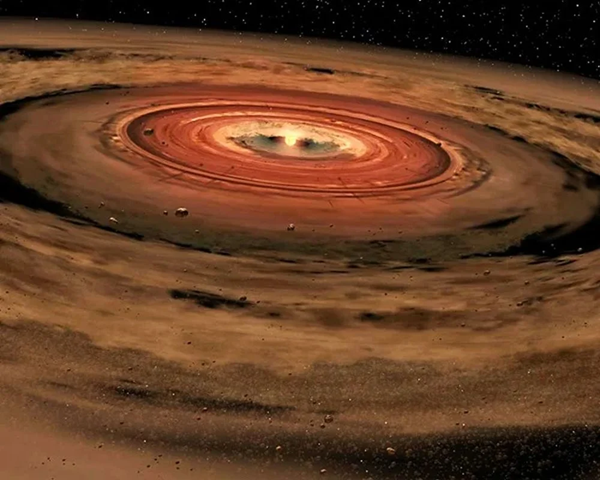
As young stars begin to form, they don’t simply sit idly in space—they actively reshape their surroundings. During their early development, these stars consume surrounding gas and dust, creating a swirling, rotating disk of material known as a protoplanetary disk (PD). These disks are the birthplaces of planets.
However, new research reveals a surprising twist: stars can consume material too rapidly, forcing them to “regurgitate” matter back into the disk. Could this self-regulating feeding process be the missing link in our understanding of planet formation?
ALMA Revolutionizes Our View of Protoplanetary Disk Structure
Thanks to the Atacama Large Millimetre/submillimetre Array (ALMA), astronomers now have an unprecedented view into over 100 protoplanetary disks. Before ALMA, these disks were thought to be smooth and uniform. But the telescope’s incredible angular resolution revealed something very different: these disks are riddled with gaps and disturbances—signatures of young planets taking shape.
Yet, amid this growing knowledge, a puzzling contradiction emerged. ALMA’s observations showed that more massive stars host larger protoplanetary disks, but those disks tend to dissipate much faster than disks around lower-mass stars. This created a paradox: how can larger disks vanish faster, even though they should have more time and material to form planets?
A New Accretion Model: Bondi–Hoyle May Hold the Answer

A groundbreaking study published in Nature Astronomy offers a possible solution to this puzzle. The research, led by Paolo Padoan from the Institute of Cosmos Sciences of the University of Barcelona, introduces a novel approach: protoplanetary disks may grow not only from leftover material after star formation but also through continuous infall from surrounding gas clouds, via a process called Bondi–Hoyle accretion.
“We propose a different scenario,” the authors explain, “in which protoplanetary disks of pre-main-sequence stars are primarily assembled by Bondi–Hoyle accretion from the parent gas cloud.” This process could explain both the mass and angular momentum observed in large disks—resolving the size-mass discrepancy.
Understanding Bondi–Hoyle Accretion in Star Formation
Unlike the symmetrical Bondi accretion—which describes how a stationary object gathers mass—Bondi–Hoyle accretion applies to objects moving through gas, such as young stars drifting through turbulent gas clouds. This movement creates asymmetric inflows, even forming dense wakes and filaments of gas.
According to the study, young stars embedded in clusters can continue pulling in surrounding gas for millions of years—not enough to significantly increase the star’s mass, but enough to reshape the protoplanetary disk and prolong its life. Could this ongoing accretion be a vital driver of planet-forming potential?
Turbulence, Filaments, and the Invisible Forces at Play
The simulations used by Padoan’s team modeled the chaotic turbulence of interstellar gas—a factor critical to understanding disk size and dynamics. Co-author Veli-Matti Pelkonen highlighted the importance of simulations: “They let us look beneath the surface—to the density, velocity, and magnetic fields—and trace how they evolve over time.”
Importantly, not all matter being accreted directly hits the disk. Some gas flows into dense filaments or wakes, with portions later falling onto the disk’s interior regions. These structures often escape detection by telescopes like ALMA, due to their low density. Still, their impact on the disk can be profound.
Simulation Meets Observation: Bridging the Gaps
Other teams have also observed large-scale gas flows feeding protoplanetary disks, aligning with this new model. The synergy between advanced simulations and observational data is giving researchers a clearer, more dynamic picture of how disks evolve.
“Comparing simulations with real observations is crucial,” Pelkonen said. “But simulations also allow us to go deeper—tracking the complex interactions that telescopes can’t directly observe.”
The Future of Observing Planet Birthplaces

What comes next in the quest to understand star and planet formation? More powerful tools. New telescopes like the James Webb Space Telescope and the upcoming Giant Magellan Telescope will allow astronomers to observe protoplanetary disks in unprecedented detail, tracking their evolution over time and revealing structures hidden to current instruments.
“With increasing computing power, our simulations will grow more realistic,” Pelkonen added. “Combined with better telescopes, we’re entering a new era of discovery.”
A Shift in the Star and Planet Formation Paradigm
This new research suggests that protoplanetary disks are not static remnants, but dynamic structures continually fed by their environment. If confirmed, this would necessitate major updates to our models of disk evolution and planet formation.
Could this breakthrough explain why some stars seem to form planets more efficiently than others? Could turbulence and environmental feeding play a larger role than we imagined?
As we move forward, these are the questions that will drive research—and possibly revolutionize our understanding of how solar systems like our own come into being.
Source: Do Giant Disks Around Stars Hide a Turbulent Truth?
Can Six Astronauts Conquer Two Worlds in One Mission?
Do Giant Disks Around Stars Hide a Turbulent Truth?