Did Scientists Recreate the First Moments of the Universe by Colliding Oxygen Atoms?
What happened in the universe just moments after the Big Bang? How did the first building blocks of matter behave under the extreme temperatures and pressures of the early cosmos? Scientists are searching for answers by recreating some of the universe’s earliest conditions inside powerful particle accelerators.
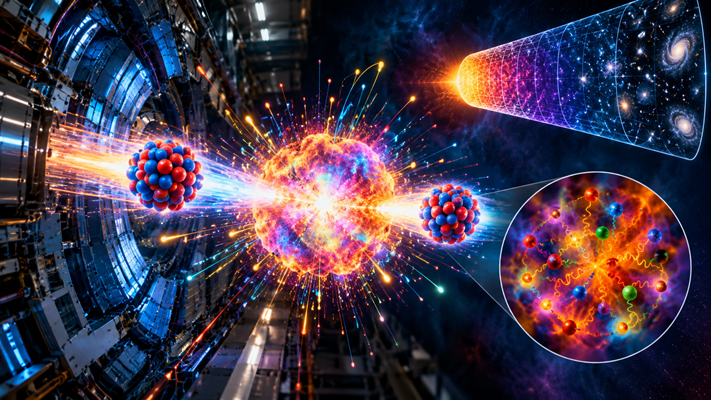
New findings from the STAR experiment at the Relativistic Heavy Ion Collider (RHIC) suggest that collisions between oxygen nuclei can produce a tiny amount of quark-gluon plasma (QGP) — an extraordinary state of matter believed to have existed shortly after the Big Bang.
The findings provide further evidence that even relatively small atomic nuclei can create the extreme conditions needed to produce this primordial form of matter.
What Is Quark-Gluon Plasma?
Under ordinary conditions, quarks and gluons are confined inside particles such as protons and neutrons. However, when matter is heated to extraordinarily high temperatures and compressed to extreme densities, these particles can break free from their usual confinement.
They then form a state of matter known as quark-gluon plasma.
Scientists believe that this plasma filled the universe during its earliest moments, before the cosmos cooled enough for quarks and gluons to combine into protons, neutrons, and other particles.
Recreating this state in a laboratory allows researchers to investigate how matter behaved in the young universe.
Why Are Scientists Colliding Oxygen Nuclei?
For many years, researchers at RHIC studied collisions involving much larger gold nuclei. A gold nucleus contains seventy-nine protons and approximately one hundred and eighteen neutrons.
These heavy-ion collisions produce extremely hot and dense conditions, providing strong evidence for the formation of quark-gluon plasma.
However, scientists wanted to understand whether smaller nuclei could produce similar effects.
Oxygen offers an important opportunity to investigate this question. An oxygen nucleus contains just eight protons and eight neutrons — considerably fewer particles than a gold nucleus.
By colliding oxygen nuclei, researchers can examine how the size of the colliding systems influences the formation of quark-gluon plasma.
A Key Clue: High-Energy Particles Lose Energy
One of the most important signs scientists look for is a phenomenon known as jet quenching.
When particles collide at extremely high energies, they can produce streams of particles called jets. If these jets travel through a dense medium, they may lose energy through interactions with that material.
This energy loss can change the number and properties of the particles detected after the collision.
Such suppression is an important indication that the particles may have travelled through a hot, dense environment — potentially quark-gluon plasma.
In the STAR experiment, researchers analysed oxygen-oxygen collisions recorded at RHIC in 2021, at a collision energy of two hundred giga-electronvolts.
Their analysis revealed an approximately twenty-percent suppression of high-energy particles, a result consistent with jet quenching.
Although the effect was smaller than that observed in collisions involving gold nuclei, this was expected because oxygen nuclei create a smaller collision system.
How Long Does This Primordial Matter Exist?
Quark-gluon plasma is extraordinarily short-lived.
The plasma produced in a particle collision exists for less than a billionth of a billionth of a second. As it expands and cools, its quarks and gluons recombine to form ordinary particles.
Scientists cannot observe this plasma directly for an extended period. Instead, they study the particles produced as the collision system evolves.
By analysing their energy, direction, and distribution, researchers can reconstruct important details about the conditions that existed immediately after the collision.
How Do RHIC and CERN Compare?
The oxygen-collision results at RHIC are particularly interesting when considered alongside research at CERN’s Large Hadron Collider (LHC).
In 2025, scientists at the LHC also studied collisions involving oxygen nuclei. Those experiments were conducted at energies exceeding five thousand giga-electronvolts.
Researchers reported observations including collective behaviour and signs of jet quenching.
The RHIC experiment, by comparison, studied oxygen collisions at a substantially lower energy of two hundred giga-electronvolts.
Together, these studies help scientists investigate whether the properties associated with quark-gluon plasma appear in relatively small collision systems across different energy ranges.
The End of RHIC Operations, but Not the End of Discovery
The findings also carry historical significance for RHIC.
After decades of research, operations at the Relativistic Heavy Ion Collider concluded on February sixth, 2026.
The final oxygen-collision data collected by the STAR and sPHENIX experiments will continue to provide researchers with valuable material for scientific analysis.
Although the accelerator has completed its operations, the scientific work is far from over. Researchers will continue examining the data to better understand the properties of matter under the extreme conditions of the early universe.
Could Small Atomic Collisions Reveal the Universe’s Biggest Secrets?
The oxygen-collision findings offer an important new opportunity to investigate how quark-gluon plasma forms and behaves.
They also raise a fundamental question: how small can a collision system be while still producing the conditions associated with this unusual state of matter?
By comparing oxygen collisions with experiments involving heavier nuclei and different collision energies, scientists can better understand the transition between ordinary matter and the primordial plasma.
The universe’s earliest moments remain beyond direct observation. Yet, through experiments involving tiny atomic nuclei, researchers are finding new ways to explore the physics that shaped the cosmos.
Could collisions between some of the smallest atomic nuclei help us understand the first moments of the universe?
Source: Did Scientists Recreate the First Moments of the Universe by Colliding Oxygen Atoms?
Interstellar Visitor 3I/ATLAS Just Got Even Weirder, And May Contain 10-Billion-Year-Old Material
Interstellar Visitor 3I/ATLAS Just Got Even Weirder, And May Contain 10-Billion-Year-Old Material
Did Scientists Recreate the First Moments of the Universe by Colliding Oxygen Atoms?
Sources
- STAR Collaboration — Research on oxygen-oxygen collisions and evidence of jet quenching.
- Brookhaven National Laboratory — Research and announcements concerning the RHIC experiments.
- CERN — Research on oxygen-nucleus collisions at the Large Hadron Collider.