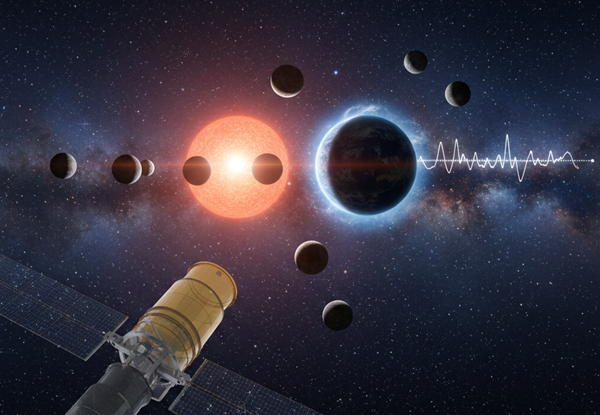
Did James Webb Detect an Earth-Like Atmosphere on TRAPPIST-1e? Or Is This Signal Just a Stellar Illusion That Science Can’t Solve?
Scientists continue to focus their attention on TRAPPIST-1e, an Earth-sized planet located in the habitable zone of the TRAPPIST-1 system. This exoplanet has long been considered a prime candidate in the search for life because its orbit lies in the so-called “Goldilocks zone”—a region where liquid water could exist if the planet has an atmosphere. Could this distant world hide oceans, weather, and perhaps biological activity?
TRAPPIST-1 System Overview: Earth-Sized Exoplanets Orbiting a Red Dwarf Star
The TRAPPIST-1 system, named after the Transiting Planets and Planetesimals Small Telescope survey, orbits a red dwarf star about thirty-nine light-years from Earth. It resembles a miniature solar system, so compact that the star and all seven planets could fit within the orbit of Mercury. A year on these planets lasts only a few days. This makes TRAPPIST-1e especially appealing: quick transits provide frequent opportunities for atmospheric analysis.
But can a tiny, ultracool red dwarf support potentially habitable worlds? Or does the star’s activity disrupt the atmospheres of its planets?
Atmosphere or Illusion? TRAPPIST-1e Under James Webb’s Near-Infrared Gaze
A research group recently used NASA’s James Webb Space Telescope (JWST) to observe TRAPPIST-1e with the powerful Near-Infrared Spectrograph (NIRSpec) instrument. During planetary transits, starlight filters through a planet’s atmosphere—if it has one—imprinting molecular fingerprints in the light. Each new transit adds clarity.
Across four transits, the team detected faint signals resembling methane. This raised immediate excitement: methane on a rocky planet in the habitable zone is a major clue. But what if the signal did not originate from the planet at all?
Methane Mystery: Planetary Atmosphere or Activity from an M-Dwarf Star?
TRAPPIST-1 is an ultracool M dwarf, roughly one-tenth the size of the Sun. Its cooler temperature allows gas molecules to exist in its own atmosphere, complicating JWST observations. Could the methane-like signature come from the planet—or from the star itself?
Researchers tested multiple atmospheric models for TRAPPIST-1e. The most plausible scenario likened the planet to Titan, Saturn’s methane-rich moon. Yet even this possibility appeared unlikely. According to the team’s latest analysis, the methane hint is more consistent with stellar “noise” rather than a planetary atmosphere.
This raises a deeper question: If TRAPPIST-1e does not show methane, does it mean the planet is truly airless—or simply harder to measure than expected?
Why TRAPPIST-1e Remains a Puzzle Despite James Webb’s Capabilities
JWST is transforming exoplanet science, but the telescope was not originally designed for studying small Earth-like planets. Only a handful of worlds are within its range for detailed atmospheric analysis. TRAPPIST-1e is one of those rare opportunities.
Still, challenges remain. A dim red dwarf emits less light, making atmospheric signatures harder to detect. Stellar activity can mimic planetary molecules. Observations are delicate. And one big question hangs in the air: How do we distinguish a planet’s atmosphere from its star’s interference?
Next Steps: Pandora Mission, Dual Transits and the Future of Exoplanet Atmosphere Research
New answers may come from NASA’s Pandora mission, launching in early two-thousand twenty-six. Pandora is designed to study exoplanet atmospheres by observing stars before, during, and after planetary transits, helping separate stellar activity from true atmospheric signals.
Another promising technique is dual transit observation. Researchers now aim to observe the star while TRAPPIST-1e and the inner, airless planet TRAPPIST-1b transit simultaneously. Comparing the two could help isolate what belongs to the star and what belongs to the planet.
If this method works, it may finally reveal: Does TRAPPIST-1e possess an atmosphere—or is the universe showing us a bare, rocky world circling a quiet red dwarf?
The Big Question: Could TRAPPIST-1e Still Host Life?
The latest studies do not eliminate the possibility of an atmosphere. They simply reveal that current data is inconclusive. As more observations accumulate, scientists may finally uncover the truth about this intriguing exoplanet. Could TRAPPIST-1e be a second Earth—or will future missions show us a barren surface exposed to starlight?
One thing remains certain: TRAPPIST-1e continues to challenge our expectations and deepen our curiosity. And for astronomers, that makes it one of the most exciting worlds in our galactic neighborhood.
Source: Did James Webb Detect an Earth-Like Atmosphere on TRAPPIST-1e? Or Is This Signal Just a Stellar Illusion That Science Can’t Solve?
What Did Voyager 2 Really See at Uranus—and Was It a Cosmic Coincidence?
What Did Voyager 2 Really See at Uranus—and Was It a Cosmic Coincidence?