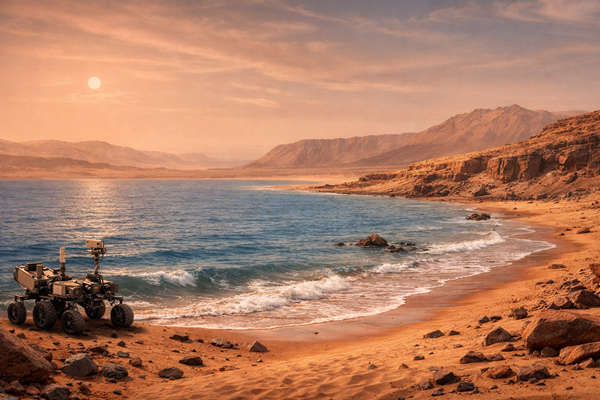
Did Mars Once Have Beaches Like Earth — and Could Life Have Walked Them?
When NASA’s Perseverance rover touched down in Jezero Crater in early two-thousand-twenty-one, scientists already suspected the site once held water. From orbit, the crater showed a faint “bathtub ring,” a geological clue hinting at an ancient shoreline. Still, debate lingered. Was it volcanic? Sedimentary? Or truly aquatic?
Now, nearly five years later, a new study led by Imperial College London PhD researcher Alex Jones has delivered clarity. According to the team’s analysis, part of Jezero Crater once hosted a Martian beach shaped by waves — not ice, not mudflows, but active, wind-driven water.
So what does a beach on Mars really mean for planetary history and the search for life?
Mars Water History and the Margin Unit Around Jezero Crater
The research focuses on a formation called the Margin Unit, a ring of olivine- and carbonate-rich rocks lining the inner rim of Jezero Crater. Scientists divided it into two distinct segments:
Western Margin Unit (WMU)
Eastern Margin Unit (EMU)
Each tells a very different story about Mars’ ancient environment. Together, they reveal how volcanic forces, water chemistry, and shoreline dynamics once reshaped the planet.
Importantly, this structure is not random. Instead, it preserves a timeline of Martian processes frozen in stone.
Western Margin Unit: Volcanic Rocks, Carbonates, and Hydrothermal Potential
The WMU lies closer to the crater rim and consists mainly of igneous rock. In other words, lava once flowed through this region. Over time, that rock reacted with carbon-dioxide-rich water, transforming olivine into carbonate and silica minerals.
Because of this alteration, scientists suspect the presence of hydrothermal fluids, similar to vents on Earth’s ocean floors. On our planet, such environments host some of the earliest life forms ever discovered.
While no one claims life definitely formed there on Mars, the WMU offers one of the best chemical settings to investigate the possibility.
After all, where heat, water, and minerals meet, biology often follows.
Eastern Margin Unit: Evidence of a Martian Beach and Ancient Shorelines
The real surprise, however, lies in the EMU.
Unlike its western counterpart, the EMU shows unmistakable signs of shoreline dynamics. Scientists identified cross-stratification, meaning sediment layers tilt at angles formed by moving liquid. Additionally, surfaces appear eroded, and sandstone grains look rounded — a signature of wave motion, not volcanic flow.
Simply put, this region behaves like a high-energy lacustrine shore zone.
In plain language:
Mars once had a lake here, and that lake had waves crashing onto a beach.
That alone reshapes how we imagine ancient Mars.
Martian Climate, Wind, and the Physics of Waves
Waves do not form in frozen water. They also do not form without wind. Therefore, this discovery carries deeper implications.
First, Jezero’s lake must have remained liquid for extended periods. Second, Mars must once have supported a thicker atmosphere than today. The modern Martian air is far too thin to generate meaningful wave energy.
Consequently, these rocks preserve evidence of a warmer, wetter, and more dynamic Mars — a planet capable of sustaining stable surface water instead of short-lived melt events.
In other words, Mars was not always the silent desert we see now.
Could it once have felt more like early Earth?
Astrobiology on Mars: Carbonates, Silica, and Fossil Preservation
The minerals discovered in both margin units matter greatly for astrobiology.
Carbonates and silica are excellent at trapping microscopic life. On Earth, they preserve bacteria inside rock for billions of years. If microbes ever lived in Jezero’s sands or waters, these minerals could still hold their fossilized signatures today.
Among Perseverance’s collected cores, one stands out: a sample nicknamed Comet Geyser, taken from the WMU. According to NASA, it has the highest potential for preserved biosignatures gathered during the mission so far.
It is, quite literally, a tiny time capsule from ancient Mars.
What secrets might it contain?
Mars Sample Return Cancellation and the Future of Perseverance’s Discoveries
Unfortunately, the excitement comes with frustration.
NASA’s planned Mars Sample Return mission, designed to retrieve Perseverance’s cached rocks, has been cancelled due to severe cost overruns. Even recent press releases still referenced it before funding disappeared.
As a result, the most promising samples remain sealed inside their titanium tubes on Mars, resting in what was once a living lakebed.
For now, no spacecraft is scheduled to bring them home.
Unless, of course, private space investment steps in.
Recently, billionaire Eric Schmidt announced private support for a flagship-class telescope. If private missions can fund astronomy, perhaps one day they can fund Mars retrieval as well.
After all, sitting on another planet is a small cylinder of stone that might answer humanity’s oldest question:
Are we alone in the universe — or did life once wash ashore on a Martian beach?
Source: Did Mars Once Have Beaches Like Earth — and Could Life Have Walked Them?
Webb Just Saw the Universe’s First Light — But Why Does It Break Everything We Thought We Knew?
Webb Just Saw the Universe’s First Light — But Why Does It Break Everything We Thought We Knew?
Did Mars Once Have Beaches Like Earth — and Could Life Have Walked Them