Did a Mysterious Interstellar Visitor Rewrite the Solar System’s History?
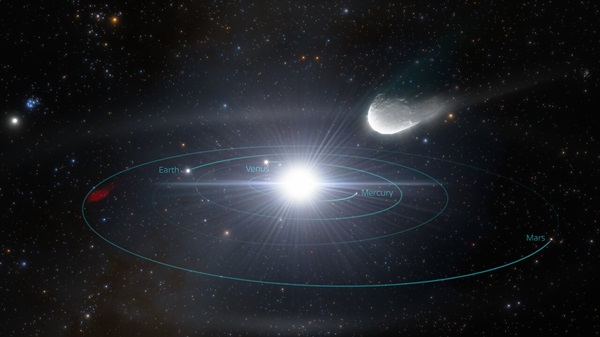
The orbits of planets around the Sun have long intrigued scientists, inspiring debates and theories about their evolution. While their current orbital dynamics are well understood, the story of how these orbits changed since the Solar System’s formation is far from simple. One dominant theory of recent decades is planetary migration, where young planets shifted positions due to interactions with each other and the surrounding protoplanetary disk. Now, a groundbreaking hypothesis suggests that an interstellar visitor, a massive object 2 to 50 times the mass of Jupiter, could have been the agent of change.
The Birth of Planetary Orbits: From Dust to Harmony
In the early days of the Solar System, planets emerged from a swirling disk of gas and dust encircling the young Sun. Conservation of angular momentum in this rotating disk caused the material to flatten into a plane, leading to the creation of circular orbits largely confined to this shared plane.
However, as these planets grew, their interactions with the protoplanetary disk and with one another altered their orbits significantly. This period saw dynamic migrations, where planets moved closer or farther from the Sun. Gravitational interactions played a crucial role, introducing eccentricities (deviations from perfect circles) and inclinations (tilts relative to the orbital plane). In extreme cases, such interactions even led to protoplanets being ejected entirely from the Solar System. Tidal forces from the Sun added further complexity, subtly reshaping orbits over millions of years.

Celestial Interlopers: Rare but Transformative
Protoplanet ejections were common during the Solar System’s chaotic youth. Yet, on rare occasions, visitors from beyond our stellar neighborhood entered the scene. The discovery of ‘Oumuamua in 2017 marked the first confirmed interstellar object. This elongated celestial body showcased unusual acceleration, likely driven by outgassing or other non-gravitational forces, hinting at the mysteries such visitors might carry.
A recent paper by a team led by Garett Brown from the University of Toronto proposes that an interstellar object could have caused significant changes in planetary orbits. This hypothesis addresses gaps in current explanations for the eccentricities observed in the gas giants—Jupiter, Saturn, Uranus, and Neptune.
How Could an Interstellar Visitor Influence Planetary Orbits?
The study explores the scenario of a massive object, 2 to 50 times Jupiter’s mass, passing through the Solar System. The team’s calculations focus on two critical parameters:
Perihelion Distance: The closest approach to the Sun, estimated to be under 20 astronomical units (AU).
Hyperbolic Excess Velocity: The speed at which the object moves relative to the Solar System, pegged at less than 6 km/s.
Such an interstellar visitor would have caused profound gravitational disturbances, enough to alter the gas giants’ orbits. Simulations run by the team reveal that such an encounter has a 1 in 100 probability of producing the orbital patterns we observe today—a likelihood significantly higher than alternative theories.
Simulations Support the Theory
Using computational models, Brown’s team tested the effects of this hypothetical visitor on the Solar System’s architecture. By inputting approximate values for the mass, velocity, and trajectory of the interstellar object, they recreated orbital dynamics that align with current observations. These simulations suggest that an encounter with such an object provides the most plausible explanation for the observed eccentricities in the gas giants’ orbits.

Bridging the Gap in Orbital Evolution Theories
The interstellar visitor theory represents a bold step forward in understanding the Solar System’s evolution. It complements existing ideas about planetary migration while addressing their shortcomings. By considering the role of external forces, the hypothesis offers a fresh perspective on the forces that shaped our cosmic neighborhood.
Future discoveries of interstellar objects, aided by next-generation telescopes, may offer further evidence to support or refine this theory. As astronomers continue to decode the Solar System’s history, the role of celestial visitors—rare but transformative—will remain a fascinating avenue of exploration.
Source: Did a Mysterious Interstellar Visitor Rewrite the Solar System’s History?
Is the Universe Designed for Us? New Research Could Answer This Age-Old Question
Is the Universe Designed for Us? New Research Could Answer This Age-Old Question