Deep Water Under The Colorado Plateau Reveals a Hidden Surprise
Earth’s deepest sources of water may not be as old as we once assumed.
Based on samples taken from deep below the Colorado Plateau, the briny remnants of ancient seas that make up the base of many groundwater systems might not be so perfectly isolated from the world above.
The fresh influx would have been delivered by rainfall, snow melt or natural aquifers as recently as between 400,000 and 1.1 million years ago.
While that might seem downright ancient on human timescales, it’s incredibly fresh considering the seawater at the base of the Paradox Basin has probably been trapped there for several hundred million years.
So how did a bunch of fresh, younger water seep so deep, so fast? By the looks of things, a whole lot of flushing, mixing and dissolving.
“[T]hings are more dynamic down there than we thought,” says geologist Grant Ferguson from the University of Saskatchewan.
The unexpected findings are based on a special form of isotope dating that can explore vast timescales, much greater than that of radiocarbon dating.
The isotope in question is radioactive krypton 81, and it takes longer to decay than carbon. Its half life can be used to estimate the age of 1.2-million-year-old water.
Specifically, the deepest waters contained relatively young water components that appear to have partially diluted the older, saltier water.
This might not be the case in other groundwater systems, but in the Paradox Basin, the topography is such that water can easily permeate downward.
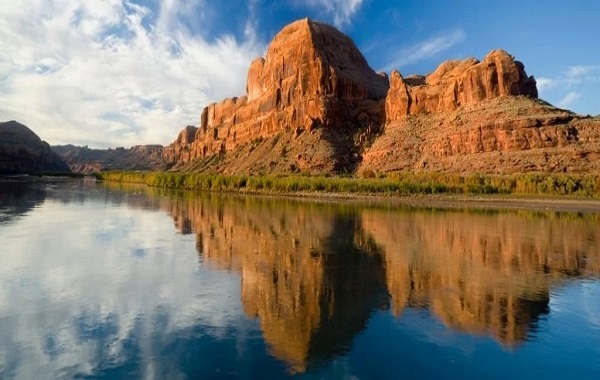
About 10 million years ago, the authors explain, the Colorado Plateau underwent a period of widespread erosion under its riverbed.
“Essentially, what the incision did was to create drains that let water from the surface to penetrate and flush the ancient highly saline waters in aquifers both above and below the salt deposits at the center of the deep groundwater system,” explains Ferguson.
The results suggest the United States needs to be much more cautious about how it treats its groundwater systems. If the Paradox Basin is so easily churned up, it means any contaminants from septic tanks, landfills, or agriculture could infiltrate to deep levels faster than assumed.
If too much of the system is exhausted, it takes a really, really long time to refill. The same can be said for diluting contaminants, which are already a problem.
A study from 2015 found one in five groundwater samples in the US contained a contaminant, either human-made or geological.
“[W]e are thinking about the different ways we use the subsurface, whether that’s in storing fluids from oil and gas, or carbon sequestration, we will have these legacies going forward,” says Ferguson.
“I don’t think we have really scrutinized these systems in ways that we could or should.”
Source: Science Alert
“Aurora Marijuanis?” Eerie Pink Glow Lights Up The Sky Above Australian Town
“Aurora Marijuanis?” Eerie Pink Glow Lights Up The Sky Above Australian Town
Deep Water Under The Colorado Plateau Reveals a Hidden Surprise