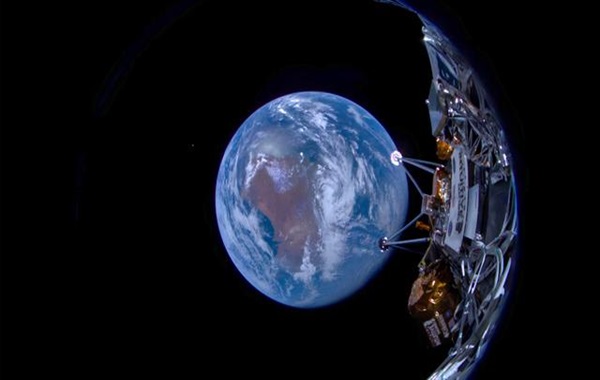
‘Dawn of astronomy’: Moon takes Earth selfie with radio waves
Astronomers attempted to measure Earth’s radio emissions from the moon.
This observation considered Earth an exoplanet, a planet that orbits a star other than our Sun. This unique perspective enables scientists to picture what our planet’s radio emissions might look like if they were seen from a faraway exoplanet with an alien civilization.
This experiment was carried out by the Odysseus lunar lander, which landed near the Moon’s south pole on February 22.
Odysseus was outfitted with cutting-edge antennas that recorded radio waves around the lunar surface.
The University of Colorado Boulder astrophysicist Jack Burns hailed this pivotal moment as the “dawn of radio astronomy from the Moon.”
The ROLSES instrument
Houston-based company Intuitive Machines built this lander that made a touchdown on the lunar surface after overcoming several technological challenges.
After the touchdown, the lander deployed Radio wave Observations at the Lunar Surface of the photo Electron Sheath (ROLSES) instrument.
“It was heroic for Intuitive Machines to land under these conditions, and to deploy our antennas, take some data, and get that data back to Earth,” said Burns, co-investigator of this radio experiment.
The setup included four antennas and a radio spectrometer device, which recorded a broad spectrum of radio emissions around the Moon and deep in space.
Despite obstacles such as one antenna overheating, the equipment collected data from both the lunar surface and while traveling to the moon.
NASA to send another private lunar lander in 2026
As per the press release, during Odysseus’ journey to the moon, one of the ROLSES antennas experienced a minor overheating issue. This resulted in the antenna protruding from the lander’s enclosure. Although originally a setback, this unexpected incident proved to be beneficial.
The team seized the opportunity to use this antenna to observe Earth and record its radio emissions for an extended period, roughly an hour and a half.
This unintentional observation provided valuable data on the radio waves released by human technology that emits radio radiation continuously, such as mobile phones and broadcast towers.
Burns suggested that scientists may be able to detect comparable fingerprints from exoplanets, which might indicate intelligent life.
Looking ahead, NASA has approved a second ROLSES experiment, slated to fly on another lunar lander in 2026.
“Because NASA is going to send two or three landers to the Moon every year, we have a way to upgrade our instruments and learn from what goes wrong in a way we haven’t been able to do since the early days of the space program,” Burns said in the press release.
This instrument called Lunar Surface Electromagnetics Experiment-Night (LuSEE-Night), will land on the far side of the Moon.
It will collect data on radio emissions from the universe’s earliest days.
Odysseus was part of NASA‘s Commercial Lunar Payload Services (CLPS) program, an effort to land robotic explorers designed and built by private businesses.
Burns will update the data collected and discuss the future of radio astronomy from the Moon at the 244th Meeting of the American Astronomical Society.
Source: Interesting Engineering
Wediscovered an Earth-sized exoplanet orbiting a red dwarf:Arewe alone?
‘Dawn of astronomy’: Moon takes Earth selfie with radio waves