Could Titan Hold the Clues to Life Beyond Earth?
Unexpected Discovery on Titan Challenges Core Chemistry Rules and Prebiotic Theories
Saturn’s Largest Moon Reveals Surprising Chemical Interactions
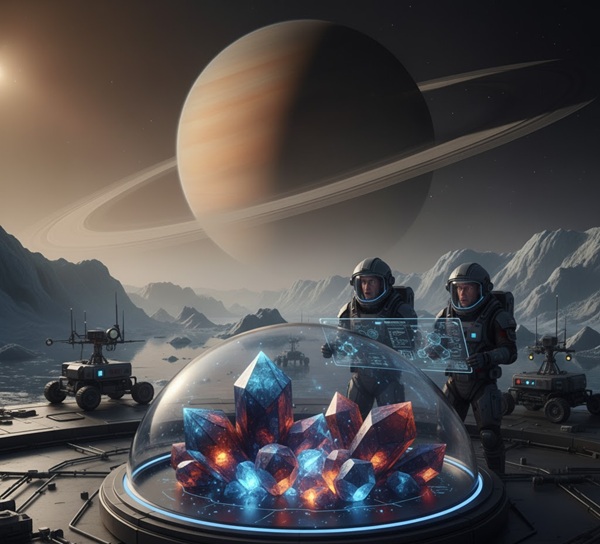
An unexpected discovery on Titan — the largest moon of Saturn — is rewriting what scientists thought they knew about basic chemistry before life emerged. Researchers at Chalmers University of Technology and NASA have found that in Titan’s extremely cold environment, substances that normally remain separate can mix and form new, stable crystal structures.
This breakthrough challenges a foundational rule in chemistry and may hold crucial clues about how life’s building blocks formed billions of years ago. Could Titan’s freezing landscape mirror Earth’s earliest steps toward life?
Titan’s Cold Atmosphere Offers a Window Into Earth’s Distant Past
With its thick nitrogen–methane atmosphere and extremely low temperatures, Titan resembles the primordial Earth. For decades, scientists have studied this orange-hued world, hoping it might reveal how chemistry set the stage for biology.
“Titan can teach us something on a very large scale, on a moon as big as Mercury,” explains Martin Rahm, Associate Professor at Chalmers. His team’s research reveals that polar molecules, such as hydrogen cyanide, can combine with nonpolar substances like methane and ethane — a phenomenon long thought impossible under conventional chemical rules.
Breaking “Like Dissolves Like”: How Hydrogen Cyanide Defies Expectations
At the heart of this discovery is hydrogen cyanide, a molecule critical to prebiotic chemistry. Under Titan’s conditions — around ninety Kelvin (minus one hundred eighty degrees Celsius) — hydrogen cyanide exists as a solid crystal, while methane and ethane remain liquid.
When NASA’s team at Jet Propulsion Laboratory conducted laser spectroscopy experiments, they found that although the molecules remained intact, new interactions had formed. This led to a cross-Atlantic collaboration with Rahm’s group to explore the molecular puzzle further.
Could such unexpected interactions be the missing link in how life’s chemistry began in the cold darkness of the early solar system?
Co-Crystals on Titan: Expanding the Boundaries of Chemistry
Using advanced computer simulations, the Chalmers researchers tested thousands of molecular structures. Their results showed that hydrocarbons had entered the crystal lattice of hydrogen cyanide, forming co-crystals stable at Titan’s low temperatures.
This finding contradicts the traditional “like dissolves like” principle, where polar and nonpolar substances remain separate, much like oil and water. But on Titan, these boundaries blur.
“Our calculations not only showed that these mixtures are stable under Titan’s conditions,” Rahm notes, “they also matched NASA’s observed light spectra perfectly.”
Implications for Titan’s Landscapes and the Origin of Life
This chemical surprise could reshape our understanding of Titan’s lakes, dunes, and geological features. More importantly, hydrogen cyanide is believed to play a central role in creating amino acids and nucleobases, key ingredients for proteins and genetic material.
Could such processes be occurring right now on Titan’s surface — hidden beneath its icy orange skies?
Dragonfly Mission: A New Chapter in Prebiotic Chemistry Research
In two thousand twenty-eight, NASA will launch Dragonfly — a revolutionary rotorcraft lander — toward Titan. Expected to arrive in two thousand thirty-four, its mission is to probe the moon’s surface and search for prebiotic chemical signatures.
Until then, Rahm and his colleagues plan to deepen their research, exploring how hydrogen cyanide behaves with other nonpolar molecules. Their findings may have far-reaching implications beyond Titan — from distant dust clouds to other frozen worlds in the cosmos.
Rethinking Universal Chemistry: What Else Is Possible?
“Hydrogen cyanide is found in many places in the universe — in comets, dust clouds, and planetary atmospheres,” Rahm says. “If these kinds of molecular interactions occur elsewhere, we might be looking at a universal chemical pathway to life.”
The discovery doesn’t rewrite the chemistry books — but it redefines their margins, proving that rules can bend in extreme environments.
So, what other hidden chemistries might be waiting to be discovered in the cold corners of our solar system?
Key Takeaways
Titan’s polar–nonpolar co-crystal formation defies long-standing chemical principles.
Hydrogen cyanide interactions could shed light on prebiotic chemistry and life’s origins.
The upcoming Dragonfly mission may provide groundbreaking in situ evidence.
This research broadens the chemical playbook for understanding extraterrestrial environments.
Source: Could Titan Hold the Clues to Life Beyond Earth?
This Humble Yeast Just Survived Conditions That Kill Most Life — But How?
This Humble Yeast Just Survived Conditions That Kill Most Life — But How?