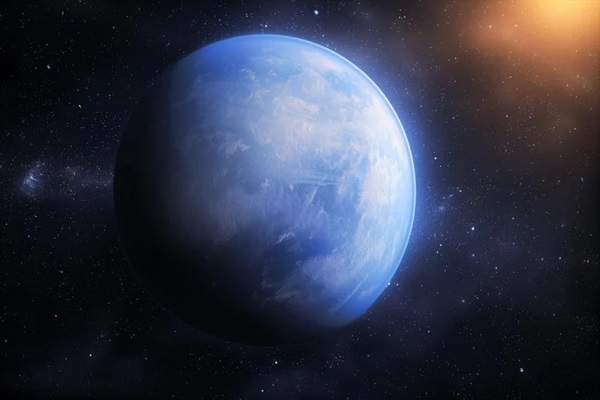
Could This Discovery of Two Sub-Neptune Types Change Our Understanding of Planets?
Scientists from UNIGE, UNIBE, and NCCR PlanetS have resolved a long-standing debate by demonstrating that sub-Neptunes belong to two distinct populations, providing a breakthrough in planetary science.
Sub-Neptunes: The Most Common Planets in Our Galaxy
Sub-Neptunes, planets sized between Earth and Neptune, are the most prevalent planets found around sun-like stars in our galaxy. These planets range in radius from Earth’s 6,400 km to Neptune’s 25,000 km. Remarkably, 30% to 50% of these stars host at least one sub-Neptune.
Challenges in Measuring Sub-Neptune Densities
Calculating the density of sub-Neptunes presents a significant challenge for astronomers. Scientists use two primary methods to measure their mass: the Transit-Timing Variation (TTV) and radial velocity methods. TTV-measured planets appear less dense, while those measured using radial velocity are denser. This discrepancy raised questions about whether the difference was due to observational bias or if two physically distinct populations of sub-Neptunes exist.
Resolving the Mystery: The Role of Resonance in Planetary Systems
Recent studies led by NCCR PlanetS, UNIGE, and UNIBE reveal that the difference is not due to bias but physical characteristics. In systems where planets are in resonance, their density tends to be lower. Planetary resonance occurs when the orbital periods of two planets follow a rational number relationship, such as one planet completing two orbits while another completes one.
Statistical Analysis Confirms Two Sub-Neptune Populations
Through rigorous statistical analysis, researchers ruled out observational biases, proving that sub-Neptunes in resonant systems are indeed less dense than those in non-resonant systems. These findings suggest that planetary density is intrinsically linked to their orbital configuration.
Planetary Collisions: The Key to Density Variations
The formation of planetary systems may hold the answer. According to models developed over two decades, only about 5% of planetary systems remain in a stable resonant state. The remaining 95% experience “catastrophes,” such as planet-planet collisions, which increase planetary density as the system stabilizes into non-resonant orbits.
Sub-Neptunes: A Glimpse into Planetary System Evolution
These collisions create two distinct populations of sub-Neptunes: denser planets in non-resonant systems and less dense planets in resonant ones. This process mirrors the violent collisions that shaped our own solar system, such as the one that formed Earth’s Moon.
Source: Could This Discovery of Two Sub-Neptune Types Change Our Understanding of Planets?
NASA Reveals Incredible Image of Star Cluster Shining in Ultraviolet
NASA Reveals Incredible Image of Star Cluster Shining in Ultraviolet