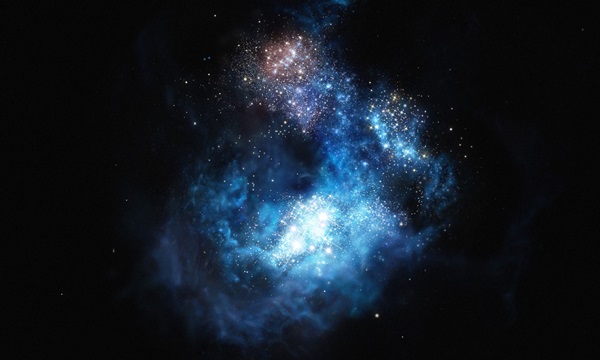
Could the Secrets of Life Lie in the Water Formed by the First Stars?
Water is the essence of life, and its abundance on Earth is one of the key reasons our planet teems with living organisms. Every living thing on Earth contains water, a molecule that is simple yet extraordinarily essential. The connection between water and life lies not only in its unique properties but also in its cosmic abundance. Composed of one oxygen atom and two hydrogen atoms, water owes its existence to the Universe’s earliest processes. Hydrogen, the simplest and most abundant element, was forged in the primordial fire of the Big Bang, while oxygen, along with elements like carbon and nitrogen, was produced later in the hearts of massive stars through the CNO fusion cycle.
The Origins of Water in the Universe
Historically, astronomers have believed that oxygen—and consequently water—grew more abundant as the Universe aged. This view posits that as successive generations of stars formed, lived, and died, they released oxygen into space during their explosive ends, steadily increasing the Universe’s capacity for water formation. Early in the Universe’s history, water was thought to be rare, but its prevalence has grown to make it a cornerstone of modern cosmic chemistry. However, new research challenges this long-standing assumption, suggesting that water’s cosmic abundance may have started much earlier than previously thought.
Star Populations and Their Role in Element Creation
Astronomers categorize stars into three populations based on their age and metallicity—the abundance of elements heavier than hydrogen and helium. The youngest and most metal-rich stars, like our Sun, belong to Population I. Population II stars are older and contain fewer metals, while Population III stars represent the Universe’s very first generation of stars. Population III stars, yet to be observed directly, were composed almost entirely of hydrogen and helium, as no heavier elements had been synthesized at the time.
Despite their ephemeral nature, these massive Population III stars played a pivotal role in shaping the cosmos. The first seeds of all the elements that would later form oceans, forests, and even human beings were forged within these primordial giants. A groundbreaking study now suggests that Population III stars may also have been responsible for flooding the early Universe with water.
Simulating Supernova Explosions to Study Water Formation
In their research, a team of astronomers modeled the explosive deaths of early stars to estimate how much water these events could have created. The simulations focused on two types of stars: smaller stars with a mass of about 13 times that of the Sun and massive stars with a mass of around 200 times the Sun’s mass. While the smaller stars exploded as typical supernovae, the larger stars ended their lives in spectacular pair-instability supernovae, which release vast amounts of energy.
These simulations revealed that the remnants of such supernovae enriched the surrounding molecular clouds with significant amounts of water. The molecular clouds formed from these explosions contained 10 to 30 times more water than the diffuse molecular clouds currently observed in the Milky Way. This indicates that, even within the first 100 to 200 million years after the Big Bang, there was already an abundance of water in the Universe’s molecular clouds.
Implications for Early Life in the Universe
The presence of water so early in the Universe’s history raises tantalizing questions about the potential for early life. If molecular clouds contained sufficient water and other elements necessary for life, could primitive life forms have emerged just a few hundred million years after the Big Bang? While this remains speculative, the study underscores the possibility that the ingredients for life were available far earlier than previously believed.
However, the early Universe was a turbulent place. Ionization and other astrophysical processes could have disrupted water molecules, breaking them apart before they could coalesce into stable reservoirs. Thus, while water may have been plentiful initially, the Universe likely experienced a “dry period” before the formation of Population II and Population I stars, which rejuvenated the cosmos with water.
A Cosmic Legacy of Water
The findings of this study highlight the profound influence of the first stars on the chemical evolution of the Universe. The water we see around us today—in oceans, clouds, and even within ourselves—may trace its origins back to the earliest stellar explosions. These Population III stars not only seeded the Universe with the heavy elements needed to form planets and life but also laid the foundation for water, the molecule that makes life as we know it possible.
Whether life emerged in those ancient, water-rich clouds remains an open question, but the possibility invites us to reconsider our understanding of life’s potential timeline in the cosmos. As astronomers continue to study the earliest epochs of the Universe, the story of water and its role in shaping the cosmos promises to reveal even more fascinating insights.
Source: Could the Secrets of Life Lie in the Water Formed by the First Stars?
Could Primordial Black Holes Be the Missing Link to Dark Matter?
İlkel Kara Delikler Karanlık Maddenin Eksik Halkası Olabilir mi?
Could the Secrets of Life Lie in the Water Formed by the First Stars?