Could ‘Oumuamua Be Evidence of Interstellar Life? Exploring the Panspermia Hypothesis
The idea of panspermia, first proposed by the Greek philosopher Anaxagoras, suggests that the Universe is filled with life, and some of it has fallen to Earth. Though it remains on the fringes of science due to its inability to explain the origins of life and its lack of testability, panspermia endures.
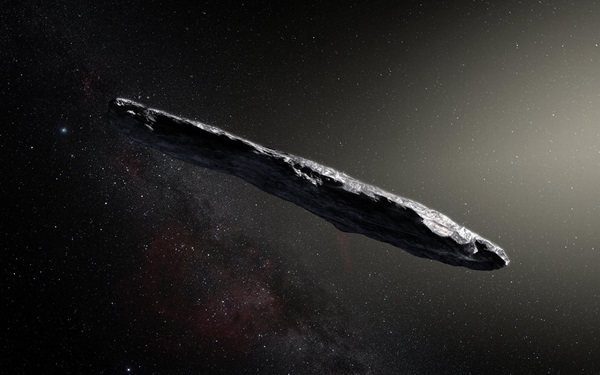
The appearance of ‘Oumuamua in 2017 reignited interest in panspermia. This interstellar object (ISO) traveled through our Solar System, prompting scientists to speculate about its nature—whether it was a comet, an asteroid, or something else entirely.
From the perspective of panspermia, ‘Oumuamua’s classification is less critical than its status as an interstellar visitor. A new paper titled “The Implications of ‘Oumuamua on Panspermia,” led by high school student David Cao and his team, explores how such objects might transport life across the galaxy.
The paper defines panspermia as the hypothesis that life on Earth originated from interstellar ejecta containing extremophiles. By examining ‘Oumuamua’s properties, the researchers estimate the mass and number density of such ejecta in the interstellar medium (ISM).
The authors acknowledge the challenges in quantitatively modeling and assessing panspermia but argue that ‘Oumuamua provides a valuable reference. They assess the minimum size required for ejecta to shield extremophiles from radiation, particularly gamma rays from supernovae. This size varies depending on the composition of the ejecta, such as silicate, nickel, iron, or water-ice. Nickel offers the highest protection with the smallest size, while water-ice requires the largest.
Assuming interstellar ejecta mirrors the composition of minor bodies in our Solar System, the researchers suggest a minimum size of 6.6 meters for effective protection. They estimate that about 40,000 objects of at least 10 meters in diameter could have impacted Earth within its first 800,000 years.
Using estimates of Earth-like planets in the Milky Way, the researchers suggest that panspermia could be a plausible mechanism for seeding life on up to 100,000 of the billion Earth-sized habitable zone worlds in our galaxy. However, the likelihood of Earth being seeded by panspermia is extremely low, less than 0.001%.
The idea of panspermia remains compelling, though difficult to test. It also raises the possibility that Earth could serve as a source of panspermia rather than a recipient. The study implies that up to 10,000 rocky planets could potentially be populated by life transported via panspermia, assuming they have the right conditions.
Other factors, such as the number of rogue or free-floating planets (FFPs) and historical impact events like the Late Heavy Bombardment, could influence the panspermia hypothesis. The increased star formation rate could also affect ISM ejecta density.
With ongoing advancements and the anticipated launch of the Rubin Observatory Large Synoptic Survey Telescope in early 2025, more data on ISOs and FFPs will likely refine our understanding of panspermia.
Source: Could ‘Oumuamua Be Evidence of Interstellar Life? Exploring the Panspermia Hypothesis
Are Genetically Enhanced Humans the Key to Conquering Space?
Are Genetically Enhanced Humans the Key to Conquering Space?