Could Life Exist on a Planet Full of Steam? Webb’s Latest Discovery Raises Questions
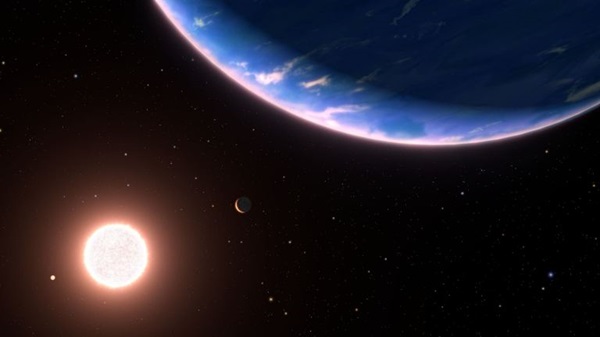
The James Webb Space Telescope (JWST) has unveiled an extraordinary exoplanet, GJ 9827 d, with an atmosphere almost entirely made of water vapor. This discovery, a first for astronomers, confirms the existence of a theoretical “steam world”—an exoplanet with an environment rich in heavy molecules. JWST’s observations of GJ 9827 d mark a monumental step in the exploration of sub-Neptune planets and fuel the search for life beyond Earth.
A Unique World Confirmed by Observational Evidence
GJ 9827 d, discovered initially by the Kepler Space Telescope, sits about 100 light-years away. With a mass three times that of Earth and about twice the size, this sub-Neptune orbits a K-type red dwarf. Following its discovery, hints of water vapor were detected using the Hubble Space Telescope in 2023. Now, the JWST has verified the composition of this “steam world” atmosphere, providing unprecedented insights into its makeup.
Can Life Thrive in a “Steam World” Atmosphere?
The question of life on such planets has long intrigued scientists. Some speculate that life might exist in the cooler, upper layers of steam atmospheres, while others remain skeptical. Although GJ 9827 d is likely inhospitable to Earth-like life due to its intense heat and water vapor-dominated atmosphere, it offers valuable data for exoplanet research. As Eshan Raul, a University of Michigan researcher who analyzed JWST data, noted, this discovery reshapes our understanding of what kinds of worlds might exist in the cosmos.
Decoding the Atmosphere with Transmission Spectroscopy
Astronomers used JWST’s Near-Infrared Imager and Slitless Spectrograph (NIRISS) to observe GJ 9827 d during two transits. Transmission spectroscopy enabled scientists to study the light passing through the planet’s atmosphere, revealing distinct wavelengths absorbed by different chemicals. These measurements showed that GJ 9827 d’s atmosphere is over 31% water vapor, with notable levels of metallicity—a term describing the presence of heavier elements.
Breaking New Ground in Exoplanet Atmosphere Studies
One of the biggest challenges in studying exoplanet atmospheres is the “clouds-metallicity degeneracy.” High metallicity can lead to smaller spectral features, while clouds can flatten them, making it hard to determine if an exoplanet has a metal-rich atmosphere or is obscured by clouds. The JWST’s observations have broken this ambiguity for the first time, showing a clear high-metallicity atmosphere without clouds—a major milestone for atmospheric analysis.
Sub-Neptunes: Common Yet Enigmatic Worlds in Our Galaxy
GJ 9827 d belongs to the category of sub-Neptunes, a type of exoplanet larger than Earth yet smaller than Neptune. Sub-Neptunes are the most common exoplanets in the Milky Way, yet our Solar System lacks an equivalent, making their composition and structure mysterious. This discovery provides a new window into understanding these abundant worlds and what they might reveal about planet formation.
From Theory to Reality: Proving the Existence of Steam Worlds
Determining an exoplanet’s atmosphere involves complex atmospheric retrieval, a process that requires vast datasets and advanced modeling techniques. Ryan MacDonald, a NASA Sagan Fellow, developed software for atmospheric analysis used in this research. Raul generated millions of potential atmospheric models for GJ 9827 d, finally settling on a “steam world” model. The confirmation of this type of planet signifies a leap forward, validating previous theoretical models and challenging our knowledge of planetary environments.
What Does This Mean for the Search for Habitable Exoplanets?
The unique atmosphere of GJ 9827 d, composed of heavy molecules similar to those found on terrestrial planets, represents an exciting step forward in identifying potentially habitable exoplanets. Although GJ 9827 d itself is inhospitable, its discovery underscores the JWST’s ability to analyze diverse exoplanet atmospheres with precision. As research advances, scientists are hopeful that steam worlds like GJ 9827 d will guide us toward discovering life-supporting planets in the future.
In summary, GJ 9827 d exemplifies a new type of exoplanet, setting the stage for future research into exoplanet atmospheres and the possibility of life beyond Earth. With every discovery, the JWST brings us closer to understanding our place in the universe.
Source: Could Life Exist on a Planet Full of Steam? Webb’s Latest Discovery Raises Questions
As The Sun Officially Hits Solar Maximum, We Are Studying Our Star Like Never Before
As The Sun Officially Hits Solar Maximum, We Are Studying Our Star Like Never Before
Could Life Exist on a Planet Full of Steam? Webb’s Latest Discovery Raises Questions