Could a Hidden Volcano Hold the Key to Ancient Martian Life?
Is Jezero Crater’s Mystery Volcano Rewriting Mars’s History?
On February 18, 2021, NASA’s Perseverance rover touched down in Jezero Crater, selected for its ancient lake delta and tantalizing signs of long-ago water flows. Since then, Perseverance has meticulously examined the crater’s sedimentary fans and collected rock samples destined for Earth-based laboratories. These samples promise fresh insights into Mars’ warm, wet past—and perhaps, evidence of ancient life.
Perseverance Rover Geological Discoveries and Sample Collection
Perseverance has already analyzed delta deposits at Jezero’s western margin, confirming clay and carbonate minerals formed in water roughly 3.8–3.5 billion years ago. But early rover traverses across the crater floor revealed unexpected igneous rocks, prompting scientists to reconsider Jezero’s geological story.
Jezero Mons: Composite Volcano Near the Landing Site
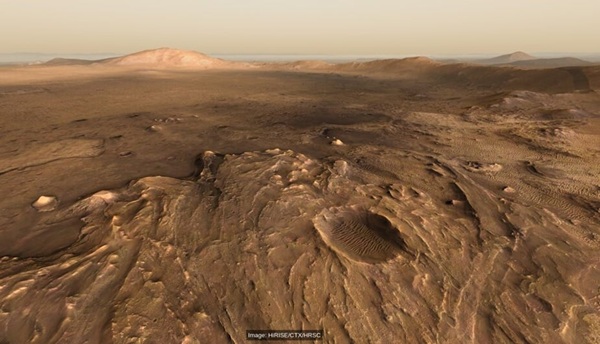
New research led by PhD candidate Sara C. Cuevas‑Quiñones (Georgia Tech & Brown University) and colleagues identifies Jezero Mons—a prominent peak on the crater’s southeastern rim—as a likely composite volcano. High-resolution imagery from Perseverance, combined with remote sensing by THEMIS, MOLA, and HiRISE, shows lava flows cascading from the mountain’s flanks and pyroxene-rich materials scattered across the crater floor.

Evidence of Past Volcanic Activity: Spectral and Morphometric Analysis
Spectral data reveal olivine [(Mg,Fe)₂SiO₄], magnesium carbonate (MgCO₃), and hydrated minerals within Jezero’s basin. Infrared mapping on Jezero Mons highlights both low- and high‑calcium pyroxenes at its summit, while visible morphometry aligns the mountain’s stature with Earth analogs such as Antarctica’s Mt. Sidley. Could these volcanic deposits—and their interleaving with ancient river channels—explain Mars’ early habitability?

Interplay of Water and Volcanism: Implications for Habitability
Volcanoes sculpt landscapes with dramatic eruptions, yet they also release heat and nutrients that foster ecosystems on Earth. If Jezero Mons once spewed lava beside a paleolake, its subsurface heat might have extended the lifetime of liquid water, creating a pocket of habitable conditions on a planet 50% farther from the Sun than Earth.

Open Questions and Future Missions: What Lies Between the Mountain and the Crater Floor?
Despite powerful orbital datasets and rover-based observations, the timing of Jezero Mons’s eruptions remains uncertain. Will sample returns dated by precise isotope analysis unlock the sequence of volcanic and aqueous events? Or could a future rover—or even a crewed mission—touch down between Jezero Mons and the crater floor, directly probing volcanic strata? What other surprises does the eastern side of Jezero hold, waiting to be revealed by advanced orbital mapping or ESA’s proposed LightShip/SpotLight mission?
Source: Could a Hidden Volcano Hold the Key to Ancient Martian Life?
Why Is the Cosmos So Quiet? The Shocking Truth Behind Our Alien Silence
Why Is the Cosmos So Quiet? The Shocking Truth Behind Our Alien Silence