Chinese scientists build a nuclear battery that lasts thousands of years
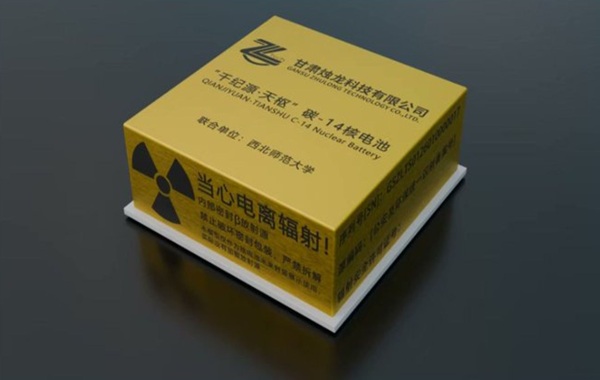
Researchers at the Northwest Normal University, along with those at the Gansu Zhulong Technology in China, have built a new-generation nuclear battery using carbon-14 isotope and a silicon carbide (SiC) transducer. The new nuclear battery is a major improvement from its predecessor not just in terms of capacity but also since it was developed indigenously.
A nuclear battery, also known as radioisotope or atomic battery uses energy from the decay of the radioactive isotope inside it to generate electricity. Since half life of radioactive isotopes can run into few decades, if not centuries, a nuclear battery can remain active for much longer than its chemical counterparts.
This makes them ideal for deployment in spacecraft and remote environmental sensors, while also beneficial in medical implants, when suitable radioactive material can be used. Nuclear batteries have been deployed in deep space missions by NASA in its Voyager probes in 1977 and Mars Curiosity rover in 2012. China, too, has used nuclear batteries in its lunar mission rovers, Chang’e-3 and Chang’e-4.
Its recent success is a part of its strategy to build smaller, more powerful nuclear batteries that can serve industrial applications.
Better than its predecessor
The research team at Northwest Normal University had previously built a carbon-14 nuclear battery in 2024 and dubbed it Candle Dragon‑I, or Zhulong-1. The new-generation battery called Qianjiyuan Tianshu, features radioactive material use limited to 22 percent, while maximizing power to 2.6 times without changing voltage or stability.
“Earlier versions suffered from low power, poor integration and high costs, so the team focused on making the device compact, powerful, affordable and fully domestically produced,” explained Su Maogen, project lead at Northwest Normal University.
The research team counted five major upgrades that Qianjiyuan Tianshu has over Zhulong-1, which include a better-matched radioactive source and a three-dimensional stacked design that saves space and improves integration. Additionally, a micro-power management system and built-in sensors allow for self-powered operation.
An increase in efficiency for the battery has been achieved by using the silicon carbide transducer, which was built in China.
Capabilities of Qianjiyuan Tianshu
The new-generation battery measures just a little over a cubic inch (16.8 cubic cm). Using 129 millicuries of carbon-14, it can deliver a current of 0.713 microamperes, a voltage of 2.06V, and a maximum output of 1.13 microwatt.
The conventional approach in nuclear batteries is to use thermoelectric materials to turn decay heat into power. However, systems used in these batteries are bulky in nature and need high temperatures to operate. Qianjiyuan Tianshu, on the other hand, turns the electrons or beta particles from the decay onto the silicon carbide semiconductor, where they are used to produce a current directly.
In effect, the researchers say, the battery is much like a solar panel. Instead of working on light, it works on radiation. While the researchers shrank the volume of the battery by just 17 percent, they were successful in increasing the volumetric power density by about 15-fold.
Moreover, since the half-life of carbon is 5,730 years, the nuclear battery effectively has a lifespan of thousands of years, the South China Morning Post, said in its report.
Source: Interesting Engineering
AI Learned the Rules of the Universe and That Became a Problem
Chinese scientists build a nuclear battery that lasts thousands of years