Case of mistaken identity: the “horse” at Hohle Fels was not a horse
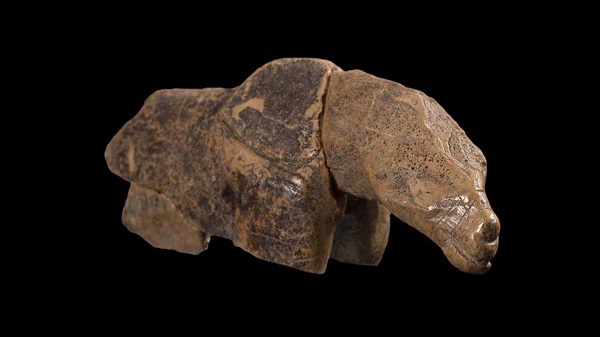
The first ancient ivory work excavated from the World Heritage Cave Hohle Fels in southwestern Germany was part of a broken figurine in the shape of a horse’s head.
In the 24 years since the ivory head was discovered in a Late Paleolithic excavation layer, no one had questioned this conclusion. However, during a recent excavation at Hohle Fels, researchers discovered another part of a small ivory figure. After matching the ivory figure’s head with fragments of other animal sculptures found over the years, researchers realized that the ivory figure did not represent a horse.
The animal found at Hohle Fels remains unknown.
The team of archaeologists responsible for this remarkable find was led by Professor Nicholas Conard, who is affiliated with the Department of Prehistory and Quaternary Ecology at the University of Tübingen and has participated in many excavations at Hohle Fels. We cannot yet identify with certainty the type of animal depicted, but it could be a cave lion or a cave bear,” Professor Conard told the media at a press conference at the University of Tübingen, where his team announced their history-changing discovery.
Whatever the animal is, the people who carved this figurine are incredibly ancient,” he said. The archaeologists unearthed the new piece from deep layers associated with the Aurignacion Paleolithic culture, which dominated the area of southwestern Germany where Hohle Fels is located about 35,000 years ago (around a few thousand years ago).
The cave is located in the Swabian Jura Biosphere Reserve near the village of Scherklingen, Baden-Württemberg, Germany. After decades of excavation, archaeologists have discovered artifacts from a variety of ancient cultures in this once-popular underground lair.
The Hohle Fels artifact has a horse-shaped head and a bear-shaped torso.
When the smooth, intricately crafted figurine was first excavated at Hohle Fels in 1999, it was identified as a horse based on the elongated shape of its head. Several fragments of this figurine were subsequently unearthed, but they did not have features that were inconsistent with the horse’s anatomy.
All that changed, however, when Professor Conard’s team dug up a piece of broken ivory from an apparently large carving during a recent excavation. The curved shell-like artifact is about 1.5 inches long, 1 inch high, and a fifth of an inch thick (3.99 x 2.49 x 0.55 cm). There are several finely engraved lines on one side. Based on the decoration and overall shape, the Hore Fels figurine was identified as the right shoulder and chest of the animal.
The newly discovered pieces were taken from the same excavation layer as the original ivory figurine from the Aurignacion period. It was therefore inevitable that archaeologists would try to match the newly discovered fragment with the figurine. The result was a perfect match.
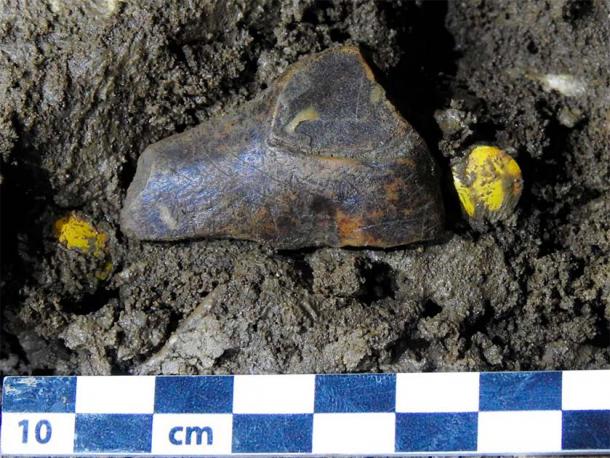
What is particularly significant about the recently discovered figurine is its shape and size. It is particularly significant because it clearly shows the characteristics of a thick, rounded torso that bears no resemblance to the shape of a horse’s torso. Archaeological Investigation of Hohle Fels
The archaeologists were curious to see if other pieces of the original ivory of the Hore Fels statue had been found, so they carefully sorted through the box containing the ivory pieces. Eventually, they found a small piece that fit on the right side of the body.
The archaeologists also found another small ivory piece that they believe was once part of the figurine, but they are not completely certain because it is a leg piece and not directly connected to the body of the current figurine.
While archaeologists are keeping their options open, Professor Conard has his own theory as to which animal the figurine really represents. The figurine now has a massive torso, with the typical bear hump prominently visible at shoulder level, in a posture that mimics the bear’s prancing gait. He admitted, however, that some of his colleagues are leaning toward the opinion that it may be a cave lion.
Professor Conard admitted, “It is not always easy to determine with certainty what was painted during the Ice Age, especially when it is preserved in fragmentary form.” So it makes sense to look carefully for the missing pieces of this animal in the coming years”. “
Archaeologists’ work is never done.
A total of five connectable statue fragments have now been found at Hohle Fels. However, several more fragments still need to be recovered to complete the ivory artifact.
With the addition of the newly recovered fragments, the ivory statues will be returned to the nearby Blaubühren Museum of Prehistory. When the exhibit reopens, however, it will no longer be labeled as a horse. The figures tell us and our visitors that the work of archaeology is never done,” said museum director Dr. Stefanie Kölbl.
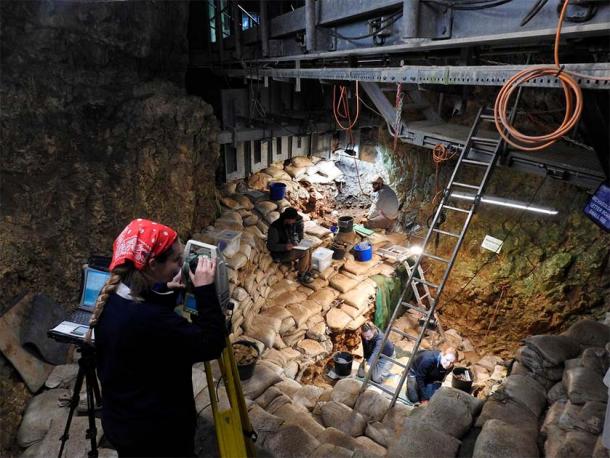
Archaeologists and technicians sort through the various artifacts removed from Hohle Fels. They are not only looking for fragments of ivory animal figurines.
Dr. Körble said, “And somehow nothing seems to have been lost in all this long, long time, so we are hopeful that one day we will be able to complete this figurine.”
Source: Case of mistaken identity: the “horse” at Hohle Fels was not a horse
World’s Oldest Genome Sequence Decoded Reconstructs Face of Woman ‘Zlati Kuni’