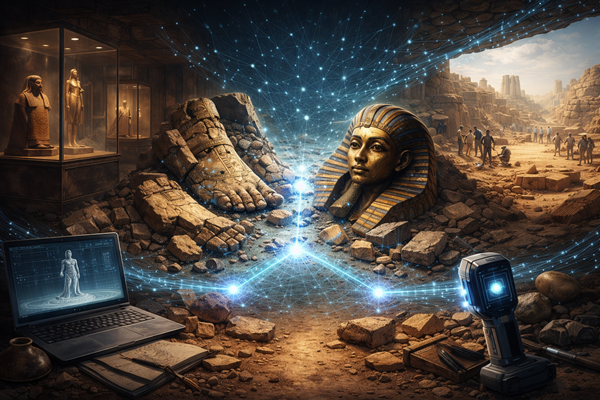
Can Geometric Fingerprints Reunite Lost Histories? How 3D Scanning and Shape Analysis Reveal Hidden Connections Between Excavation Finds and Museum Collections Across Space and Time?
Today, Egyptology faces a quiet but profound crisis. It is not only about looting, although that remains a factor. Instead, it is about disconnection.
Walk into major museums—from Copenhagen to California—and you encounter extraordinary objects displayed behind glass. You see a painted mummy’s foot case. You see a gilded funerary mask. Yet one essential element is missing: context. Where were these objects found? Who used them? What assemblage did they once belong to?
They are visually stunning. However, historically, they are silent.
For decades, artifacts were excavated and distributed under practices that prioritized acquisition and display. Documentation was often secondary. As a result, connections between fragments and complete objects were gradually lost. Today, institutions around the world hold artifacts whose stories are fragmentary, speculative, or entirely absent.
So the question becomes unavoidable: Can modern digital archaeology repair these broken historical links?
Digital Archaeology Crisis: Fragmented Museum Collections and Lost Context
Archaeology is inherently fragmentary. Objects decay. They break. They are displaced. Over centuries, disturbance becomes the norm rather than the exception.
Traditionally, archaeologists relied on visual comparison, stylistic parallels, and archival research. These tools remain essential. However, they have limitations. Visual judgment can be subjective. Archival records may be incomplete or inconsistent.
Consequently, many potential relationships between museum artifacts and excavated fragments were never tested systematically. Some were never even proposed. A museum object may appear complete, yet its biography may be fractured.
More than a century ago, Flinders Petrie argued that an artifact’s value lies not in its beauty but in its information. A modest fragment with known provenance, he insisted, can outweigh a magnificent object without context.
Today, digital methodologies are transforming that principle into measurable practice.
3D Scanning and Computational Shape Analysis in Archaeology
First, objects must be digitized. Portable 3D scanners now capture surface geometry with remarkable precision. Every contour, curvature, and thickness variation can be recorded. Importantly, the process is noninvasive. Fragile artifacts remain untouched and unmoved.
Once scanned, an object becomes more than a visual representation. It becomes structured data. Researchers can rotate it, measure it, and compare it at micron-level resolution.
However, scanning alone is insufficient. The real analytical shift occurs during comparison. Instead of asking whether two fragments “look similar,” computational shape analysis asks a more rigorous question:
How similar are their geometries, quantitatively and reproducibly?
Using curvature mapping, thickness analysis, and spatial alignment algorithms, researchers compare surfaces point by point. In essence, a geometric fingerprint is generated.
This approach does not replace expert judgment. Rather, it strengthens it. Intuition becomes testable. Hypotheses become measurable.
Digital Reconnection of Graeco-Roman Egyptian Cartonnage Through 3D Shape Comparison
In research published in the journal Heritage Science, these methods were applied to Graeco-Roman Egyptian funerary artifacts made of cartonnage—a composite material of linen, plaster, and paint.
High-resolution 3D scans were created from excavated fragments. These digital models were then compared to an intact funerary mask preserved in a museum collection. The goal was analytical, not reconstructive.
Cartonnage masks were often shaped in molds. Therefore, objects produced from the same mold share consistent curvature and thickness patterns, even when decorative paint differs.
A deviation mapping technique was employed. After precise digital alignment, thousands of surface points were measured. Distances between surfaces were calculated.
Where deviations remained below a millimeter, geometric compatibility was demonstrated. In this case, differences were generally less than one millimeter—strong evidence of production within the same mold.
This was not about visual resemblance. It was about measurable geometric correspondence.
Yet an even deeper question emerges: How many museum artifacts worldwide share similar hidden relationships waiting to be discovered?
Cross-Institutional Digital Collaboration in Museum and Excavation Archives
One of the most powerful implications of 3D shape analysis lies in its ability to transcend geography. Digital models can be shared instantly. Fragile objects do not need to travel.
Excavation archives, museum collections, and research institutions can interact within a shared digital framework.
Thus, disconnected fragments can be evaluated against distant museum holdings. Long-separated materials can “meet” again in digital space.
This approach fosters transparency. It also ensures reproducibility. Independent researchers can replicate comparisons using identical datasets.
As a result, archaeological interpretation shifts from speculative alignment toward data-supported verification.
Artificial Intelligence, Machine Learning, and the Future of Digital Archaeology
Although the described research relied on computational geometry rather than artificial intelligence, it aligns with broader developments in heritage science.
For example, the EU-funded RePAIR project integrates AI and robotics to assist in reconstructing fragmented artifacts. Similarly, institutions such as the Smithsonian Institution are exploring AI-driven analysis of extensive 3D collections.
Digital archaeology is often associated with immersive reconstructions or virtual exhibitions. However, its deeper value lies in analytical reconstruction.
Fragments, once sidelined, are reactivated as primary sources of information. Digital tools allow archaeologists to test relationships that were once assumed irretrievable.
Could entire object biographies be reconstructed through shared geometric datasets? Could museums transform from static display spaces into dynamic nodes of digital research?
3D Scanning and Shape Analysis as Tools for Recovering Lost Histories
Ultimately, this methodology reaffirms a foundational archaeological principle: context is everything.
Fragments are not secondary. They are evidentiary anchors. When digitally analyzed, they can clarify origins, manufacturing processes, and distribution networks.
Moreover, they can reconnect objects with their archaeological narratives.
Digital methodologies do not replace fieldwork. They extend it. They do not diminish museum collections. They deepen them.
The silent artifacts in glass cases may not speak on their own. Yet through 3D scanning and shape analysis, their geometry begins to testify.
If modest fragments can restore historical continuity, what other lost connections remain hidden in plain sight—waiting to be measured, mapped, and understood?
Source: Can Geometric Fingerprints Reunite Lost Histories? How 3D Scanning and Shape Analysis Reveal Hidden Connections Between Excavation Finds and Museum Collections Across Space and Time?
Did Archaeologists Really Find Alexander the Great’s Lost City on the Tigris?
Did Archaeologists Really Find Alexander the Great’s Lost City on the Tigris?
Can Geometric Fingerprints Reunite Lost Histories? How 3D Scanning and Shape Analysis Reveal Hidden Connections Between Excavation Finds and Museum Collections Across Space and Time?
Sources:
Petrie, W. M. F. (1904). Methods and Aims in Archaeology.
Recent research published in Heritage Science on computational shape comparison of Egyptian cartonnage artifacts.
RePAIR project – EU-funded initiative on AI-assisted artifact reconstruction.
Smithsonian Institution – Digital 3D collection and AI research initiatives.
Can Geometric Fingerprints Reunite Lost Histories? How 3D Scanning and Shape Analysis Reveal Hidden Connections Between Excavation Finds and Museum Collections Across Space and Time?