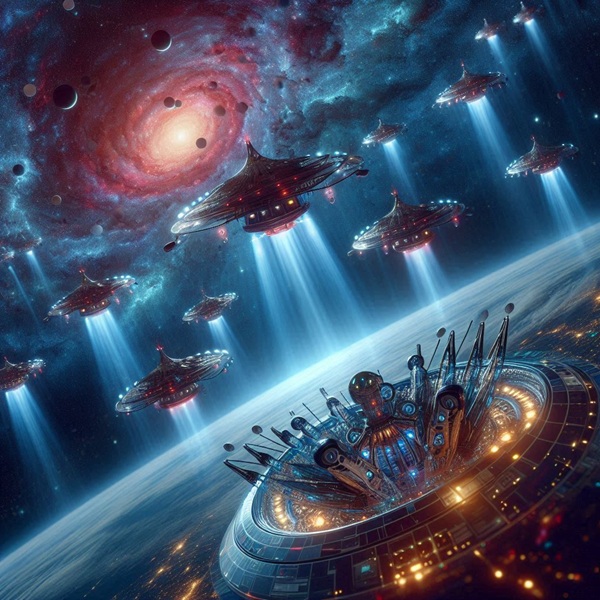
Can AI-Powered Spacecraft Swarms Unlock the Secrets of Interstellar Visitors?
Interstellar Mysteries: Will Smart Spacecraft Swarms Capture the Unseen?
Interstellar objects (ISOs) are among the last unexplored classes of celestial bodies, offering unique insights into exoplanetary materials. However, their rapid passage through our solar system—at speeds of tens of kilometers per second—makes them elusive and difficult to study.
AI-Driven Breakthrough: Neural-Rendezvous
To tackle this challenge, Hiroyasu Tsukamoto, a faculty member in the Department of Aerospace Engineering at the University of Illinois Urbana-Champaign, has developed Neural-Rendezvous—a deep-learning-driven guidance and control framework designed to autonomously encounter these fast-moving objects. This research is published in the Journal of Guidance, Control, and Dynamics and on the arXiv preprint server.
How Does Neural-Rendezvous Work?
Neural-Rendezvous operates by creating a specialized AI brain dedicated to space exploration. Tsukamoto explains, “A human brain has many capabilities—talking, writing, etc. Deep learning creates a brain specialized for one of these capabilities with domain-specific knowledge. In this case, Neural-Rendezvous learns all the information needed to encounter an ISO while considering the safety-critical, high-cost nature of space exploration.”
The framework is based on contraction theory for data-driven nonlinear control systems, a concept Tsukamoto developed during his Ph.D. at Caltech. His postdoctoral collaboration with NASA’s Jet Propulsion Laboratory (JPL) further shaped this project, ensuring that Neural-Rendezvous is mathematically proven to work.
Overcoming the Challenges of High-Speed Encounters
Studying ISOs presents two major hurdles:
Extreme Speeds: ISOs move at tens of kilometers per second, making timely interception difficult.
Unpredictable Trajectories: The timing and path of an ISO’s visit are highly uncertain, requiring real-time adaptability.
Traditional space missions rely heavily on pre-launch calculations, but ISO encounters demand onboard decision-making akin to human reflexes. Neural-Rendezvous enables spacecraft to autonomously determine the best actions in real time, with formal probabilistic bounds on the distance to the target.

Simulating Spacecraft Swarms for Maximum Data Collection
Even with AI assistance, capturing a clear view of an ISO during a high-speed flyby is challenging. Recognizing this, Tsukamoto collaborated with Illinois aerospace undergraduate students Arna Bhardwaj and Shishir Bhatta to test Neural-Rendezvous in a multi-spacecraft scenario.
Using M-STAR multi-spacecraft simulators and Crazyflies drones, they demonstrated how a spacecraft swarm could maximize information capture from an ISO encounter. Their approach involved optimally distributing spacecraft across the most probable region of the ISO’s trajectory—driven by Neural-Rendezvous’ predictions.
What’s Next for ISO Missions?
This research marks a critical step toward practical ISO exploration. While Neural-Rendezvous remains a theoretical concept, integrating it with multi-spacecraft strategies makes it far more applicable.
Tsukamoto praised Bhardwaj and Bhatta’s contributions: “The topics explored in Neural-Rendezvous are advanced—even for Ph.D. students. Their work is our first attempt to make it much more useful and practical.”
As the hunt for interstellar objects continues, one key question remains: Will AI-powered spacecraft swarms unlock the secrets of the universe’s most elusive visitors?
Source: Can AI-Powered Spacecraft Swarms Unlock the Secrets of Interstellar Visitors?
Quantum Breakthrough: Scientists Create Schrödinger-Cat State With Record-Long Lifetime
Quantum Breakthrough: Scientists Create Schrödinger-Cat State With Record-Long Lifetime