By measuring helium in distant galaxies, physicists may be able to figure out why the universe exists.
When a theoretical physicist like myself says, “I study why the universe exists,” I sound like a philosopher. But new data collected by researchers using the Subaru telescope in Japan have revealed insights into that very question.
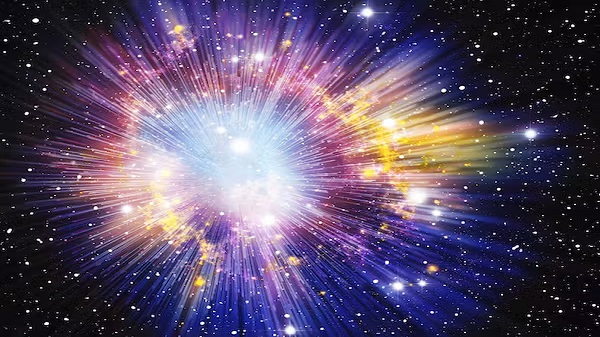
The Big Bang created the universe as we know it 13.8 billion years ago. Many theories of particle physics suggest that antimatter must have been created along with the same amount of matter that was created when the universe was born. Antimatter, like matter, has mass and occupies space. However, antimatter particles exhibit the opposite properties of their corresponding matter particles.
When matter and antimatter collide, they disappear in a powerful explosion, leaving only energy behind. The puzzling aspect of the theory that matter and antimatter exist in equal balance is that if this were true, they would both disappear completely and the universe would be empty. This is because the universe is not empty, it is full of things made of matter, like galaxies, stars, and planets. There is a little antimatter around us, but it is very rare.
As a physicist studying data from the Subaru telescope, I am interested in this so-called matter-antimatter asymmetry problem. In a recent study, my collaborators and I discovered that the Subaru Telescope has the potential to solve this long-standing mystery by providing new measurements of the amount and type of helium in distant galaxies.
After the Big Bang
In the first few milliseconds after the Big Bang, the universe was hot and dense, with subatomic particles like protons, neutrons, and electrons swimming around in plasma. Within this particle pool were also neutrinos, very small, weakly interacting particles, and their antimatter, antineutrinos.
Physicists believe that just one second after the Big Bang, nuclei of light elements such as hydrogen and helium began to form. This process is known as Big Bang nucleosynthesis. The nuclei formed were about 75% hydrogen nuclei, 24% helium nuclei, and a small amount of heavier nuclei.
The most widely accepted theory in the physics community regarding the formation of these nuclei is that neutrinos and antineutrinos played a fundamental role in the formation of the helium nuclei in particular.
The formation of helium in the early universe occurred in a two-step process. First, a series of processes involving neutrinos and antineutrinos converted neutrons and protons from one to the other. As the universe cooled, these processes ceased and the proton/neutron ratio set.
As theoretical physicists, we can model how the proton/neutron ratio depends on the relative number of neutrinos and antineutrinos in the early universe. If more neutrinos exist, our model will show that more protons and fewer neutrons will result.
As the universe cooled, hydrogen, helium, and other elements formed from these protons and neutrons. Helium is made of two protons and two neutrons, while hydrogen has one proton and no neutrons. Therefore, the fewer neutrons there were in the early universe, the less helium was formed.
Because nuclei formed during the Big Bang nucleosynthesis can still be observed today, scientists can estimate how many neutrinos and antineutrinos existed in the early universe. They do this by specifically examining galaxies rich in light elements such as hydrogen and helium.
Helium Clues
Last year, the Subaru Collaboration, a group of Japanese scientists studying the Subaru Telescope, released data on 10 galaxies far from our own Milky Way Galaxy that are almost entirely composed of hydrogen and helium.
Using a technique that can distinguish different elements from the wavelengths of light observed by the Subaru Telescope, the Subaru scientists measured exactly how much helium is present in each of these ten galaxies. Importantly, they found that there is less helium than previously accepted theories predicted.
With these new results, my collaborators and I worked backwards to determine the number of neutrinos and antineutrinos needed to produce the amount of helium present found in the data. You may recall our third grade math class when we solved the problem to find “X” in the equation. What my team did was essentially an advanced version of that, and our “X” was the number of neutrinos and antineutrinos.
The previously accepted theory predicted that there should be the same number of neutrinos and antineutrinos in the early universe. However, when the theory was tweaked to produce predictions consistent with the new data set, it was found that the number of neutrinos was greater than the number of antineutrinos.
What does this mean?
They can be used to explain the matter-antimatter asymmetry. The Subaru data point directly to neutrinos as the cause of the imbalance. In this study, my collaborators and I have demonstrated that this new measurement of helium is consistent with the abundance of neutrinos and antineutrinos in the early universe. Through known particle physics processes, neutrino asymmetry can propagate to all matter asymmetries.
The result of our study is a common type of result in theoretical physics. Basically, it means that we have found a viable way in which matter-antimatter asymmetry can arise, but that does not mean that it is certain to occur that way. The fact that the data are consistent with our theory is a hint that our proposed theory may be correct, but this fact alone does not mean that it is correct.
Then, this tiny little neutrino is the key to the age-old question, “Why does something exist?” is the key to answering the age-old question, “Why does something exist? According to this new study, they might be.
Source: By measuring helium in distant galaxies, physicists may be able to figure out why the universe exists.
Ancient helium leaking from core offers clues of Earth’s formation
By measuring helium in distant galaxies, physicists may be able to figure out why the universe exists.