British baby girl becomes world’s first to regain hearing with gene therapy
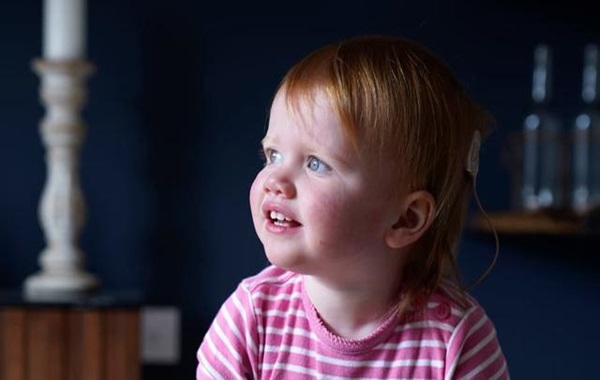
18-month-old Opal Sandy, a British girl who was born deaf, has regained her hearing. Thanks to gene therapy she received at Addenbrooke’s in Cambridge, she can now hear without relying on an external device.
She has become the first and youngest person in the world to undergo this innovative treatment. This represents a promising advance in the treatment of deafness.
The CHORD trial
The CHORD trial began in May of last year. The goal was to examine whether gene therapy called DB-OTO helps in cases with OTOF mutations. As well as, among other things, safe and tolerable. Opal received an infusion containing the harmless AAV1 virus.
This was performed operatively under general anesthesia by injection into the cochlea. This virus serves to release the genetic material and is later naturally removed from the body. It delivers a copy of the gene material to cells that help restore functions. Opal received therapy in her left ear, while a cochlear implant was fitted in her left ear.
Opal’s experience marks a new era
As Manohar Bance said in the statement this marks a new era in the treatment for deafness. “Also supports the development of gene therapies that may prove to make a difference in other hearing conditions,” he added.
The trial consists of three parts with three children including Opal. They received only a small dose of gene therapy and only one ear. As Richard Brown pointed out, this is good because large doses are not given to the rest of the body, but where it is needed, in the cochlear. This is important because there are fewer side effects. The procedure lasted less than 20 minutes.
After about 4 weeks, Opal started to react to sounds, even when the cochlear implant in the left ear was switched off. The doctors monitored the further condition and found significant improvements. Which was confirmed at 24 weeks, when she could hear, for example, whispering.
Her parents, Jo and James Sandy are excited about the success of the therapy. The fact that their baby can hear even quieter sounds gives makes them proud. They also hope that this will help other children and their families because it makes a difference in everyday life. Also in activities when, for example, a child is bathing and cannot wear a cochlear implant.
Born with auditory neuropathy
Opal was born completely deaf because of a rare genetic condition, auditory neuropathy. Auditory neuropathy spectrum disorder causes the ear to detect sound normally but have trouble sending it to the brain. Besides deafness, it can also lead to problems with distinguishing sounds, as well as clarity.
According to the data, this can vary over time and can lead to problems in making a diagnosis. It is relatively rare and it affects about one to two babies in every 10,000 born. As explained, this condition can be due to a variation in a single gene, known as the OTOF gene.
The OTOF gene produces a protein called otoferlin. The protein plays a role in hearing, it enables communication with the inner hairs in the ear and the auditory nerve. Deafness caused by mutations has caused deafness in about 20,000 people across the UK, Germany, France, Spain, and Italy.
The future
Patients in the first phase of the study receive a small dose in one ear. Then in the second phase, a higher dose of gene therapy is used in only one ear. The proven safety of the initial dose is important here. The third phase refers to gene therapy in both ears with a dose selected after ensuring safety and efficacy. Follow-up examinations will continue for five years for the included patients.
Source: Interesting Engineering
Psychedelics found in toad venom could treat anxiety, depression
British baby girl becomes world’s first to regain hearing with gene therapy