Astronomers Discover Another Galaxy With No Dark Matter: A New Cosmic Mystery That Could Change Our Understanding of the Universe
For decades, Dark Matter has stood at the center of modern cosmology. Although no telescope has ever directly observed it, scientists believe this invisible substance shapes the structure of the Universe itself. It influences how galaxies form, how they evolve, and even how they remain intact over billions of years. Yet what happens when astronomers discover a galaxy that appears to contain no Dark Matter at all?
That question has become even more intriguing following the discovery of DF9, a faint dwarf galaxy that seems to lack Dark Matter entirely. Even more remarkably, DF9 joins two previously discovered galaxies—DF2 and DF4—which exhibit the same unusual characteristic. Together, these galaxies are forcing scientists to reconsider long-standing assumptions about how galaxies are born and how the Universe truly works.
Could these rare objects reveal a hidden process of galaxy formation? Or could they provide new clues about the true nature of Dark Matter itself?
Dark Matter and Galaxy Formation: Why Scientists Believe Most Galaxies Need It
The story begins in the nineteen seventies when astronomer Vera C. Rubin provided groundbreaking evidence that galaxies were rotating far too quickly to be held together by visible matter alone.
According to the laws of gravity, galaxies should have torn themselves apart long ago. However, observations revealed something unexpected. Stars at the outer edges of galaxies were moving just as fast as stars closer to their centers.
Consequently, scientists proposed the existence of a hidden form of matter. This invisible substance became known as Dark Matter.
Since then, evidence for Dark Matter has accumulated from many different directions. Astronomers have observed gravitational lensing effects, galaxy clusters behaving in unusual ways, and enormous invisible halos surrounding galaxies. Together, these observations suggest that Dark Matter accounts for approximately eighty-five percent of all matter in the Universe.
As a result, the standard model of galaxy formation assumes that nearly every galaxy forms inside a massive Dark Matter halo. Without such a halo, galaxies should struggle to form and survive.
Yet recent discoveries are challenging that assumption.
The Discovery of DF9: Another Galaxy Without Dark Matter
Using the powerful instruments of the W. M. Keck Observatory, a team of Yale-led astronomers identified DF9 as the third known galaxy that appears to contain little or no Dark Matter.
Located approximately forty-five million light-years from Earth, DF9 is an extremely faint dwarf galaxy. Initially, some researchers believed it might actually be a black hole. However, detailed observations revealed something far more surprising.
When astronomers carefully measured the motion of stars inside DF9, they found that the galaxy’s total mass closely matched the amount of visible matter it contained. In other words, the stars, gas, and dust accounted for nearly all of its gravitational influence.
Normally, Dark Matter would increase a dwarf galaxy’s mass dramatically—sometimes by a factor of one hundred or more. However, that expected increase was nowhere to be found.
Therefore, DF9 emerged as one of the strongest examples yet of a galaxy apparently existing without Dark Matter.
But why would such a galaxy exist in the first place?
The Strange Connection Between DF9, DF2, and DF4
The mystery deepens when DF9 is viewed alongside DF2 and DF4.
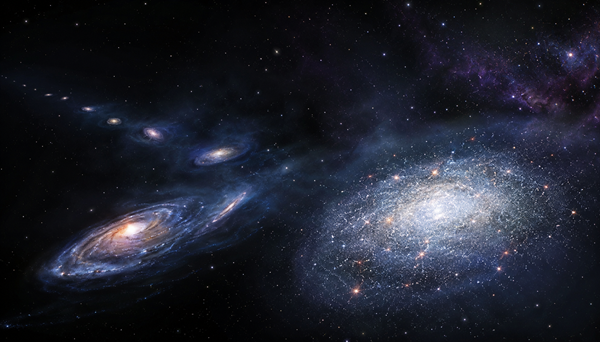
These three galaxies are not isolated objects scattered randomly across space. Instead, they appear to belong to a larger linear arrangement of seven galaxies. This structure stretches across intergalactic space and seems to have formed during a single dramatic event.
Such an alignment is extremely unusual.
Because of this configuration, astronomers suspect that DF9, DF2, and DF4 may share a common origin. Rather than forming independently over billions of years, they may have emerged simultaneously during a violent cosmic encounter.
This possibility raises a fascinating question.
Could a catastrophic collision between galaxies create entirely new galaxies that lack Dark Matter?
High-Speed Galactic Collisions: A New Theory for Dark Matter-Free Galaxies
Researchers believe the answer may lie in an extraordinary collision that occurred millions of years ago.
According to their hypothesis, two massive galaxies passed through one another at extremely high speeds. During this event, enormous clouds of gas may have been torn away from their surrounding Dark Matter halos.
Normally, gas and Dark Matter remain gravitationally linked. However, under rare and extreme conditions, the visible gas could become separated from the invisible Dark Matter.
If that happened, the displaced gas clouds might have collapsed and formed new galaxies composed almost entirely of ordinary matter.
Consequently, DF9, DF2, and DF4 may represent the products of this unusual process.
If confirmed, this mechanism would reveal a previously unknown pathway for galaxy formation.
Furthermore, it would explain why these galaxies appear to violate the traditional model that has dominated astronomy for decades.
How Scientists Measured DF9’s Mass With Exceptional Precision
A key factor behind this discovery was the use of the Keck Cosmic Web Imager, often abbreviated as KCWI.
This advanced instrument specializes in studying faint sources of light that are difficult to analyze using conventional methods.
By examining the movement of stars within DF9, researchers were able to calculate the galaxy’s mass with extraordinary precision.
The results consistently pointed toward the same conclusion.
DF9 possesses far less mass than expected if Dark Matter were present.
Because the measurements are so precise, astronomers now consider DF9 one of the most convincing examples of a Dark Matter-deficient galaxy ever observed.
Nevertheless, extraordinary claims require extraordinary evidence.
Therefore, scientists continue to test every possible alternative explanation.
What Do These Galaxies Reveal About the Nature of Dark Matter?
The implications of this discovery extend far beyond a single dwarf galaxy.
For years, some researchers have proposed alternatives to Dark Matter. These theories suggest that gravity itself may behave differently on galactic scales.
However, galaxies like DF9 present a challenge to many alternative gravity models.
If some galaxies contain Dark Matter while others appear to lack it, Dark Matter begins to look less like a mathematical illusion and more like a genuine physical substance that can be separated from ordinary matter under specific circumstances.
This distinction is crucial.
If future observations support the current findings, they could strengthen the argument that Dark Matter exists as a real component of the cosmos rather than as a modification of gravity.
At the same time, these galaxies may offer an unprecedented laboratory for studying Dark Matter’s fundamental properties.
After all, what better way to understand something than by examining places where it appears to be missing?
Could Dark Matter-Free Galaxies Rewrite Cosmic History?
Scientific revolutions often begin with anomalies.
Many of the greatest breakthroughs in astronomy emerged when observations refused to fit accepted theories.
The discovery of DF9 may represent another such moment.
Although three galaxies do not overturn decades of cosmological research, they do raise important questions. How common are Dark Matter-free galaxies? Have astronomers overlooked similar systems elsewhere in the Universe? Could many galaxies have formed through mechanisms that scientists have not yet recognized?
Each new observation adds another layer to the mystery.
As telescopes become more powerful, researchers will continue searching for additional examples. Every discovery has the potential to reshape our understanding of how galaxies form and evolve.
Perhaps these galaxies are rare exceptions.
Or perhaps they are the first visible clues pointing toward a much larger cosmic story.
Future Observations Could Confirm a New Model of Galaxy Formation
Astronomers are already planning follow-up studies using multiple observatories.
Among them is the new Mothra Telescope project, co-founded by Yale astronomer Pieter van Dokkum and Roberto Abraham. Researchers are searching for leftover gas streams and other evidence that could confirm the collision scenario.
In addition, future-generation observatories will provide even deeper observations of these unusual systems.
If remnants of a past galactic collision are discovered, the case for the proposed formation mechanism will become significantly stronger.
Such evidence could reveal an entirely new chapter in the history of galaxy formation.
More importantly, it could bring scientists one step closer to solving one of the greatest mysteries in modern physics.
Conclusion: A Discovery That Raises More Questions Than Answers
The discovery of DF9 has transformed an astronomical curiosity into a growing scientific puzzle.
Alongside DF2 and DF4, it provides compelling evidence that some galaxies may exist with little or no Dark Matter. Consequently, these objects challenge traditional theories of galaxy formation while offering a rare opportunity to investigate the true nature of the invisible substance believed to dominate the Universe.
Yet many questions remain unanswered.
What forces separated ordinary matter from Dark Matter? How many similar galaxies are waiting to be discovered? Could these systems ultimately reveal what Dark Matter really is?
For now, the mystery continues.
However, one thing is certain. Every time astronomers look deeper into the cosmos, the Universe proves far stranger—and far more fascinating—than anyone imagined.
Source: Astronomers Discover Another Galaxy With No Dark Matter: A New Cosmic Mystery That Could Change Our Understanding of the Universe
NASA’s James Webb Discovers Bizarre Salt Clouds on the Pink Planet
NASA’s James Webb Discovers Bizarre Salt Clouds on the Pink Planet
Sources
The Astrophysical Journal (June publication describing DF9 observations)
Yale University Department of Astronomy research release
W. M. Keck Observatory observational data
NASA Hubble Space Telescope archival observations
Research contributions by Michael Keim and Pieter van Dokkum
Modern cosmological studies on Dark Matter and dwarf galaxy formation
Astronomers Discover Another Galaxy With No Dark Matter: A New Cosmic Mystery That Could Change Our Understanding of the Universe