Astronomers Detect Extremely Rare ‘Undead’ Star, Born in a Fantastical Collision
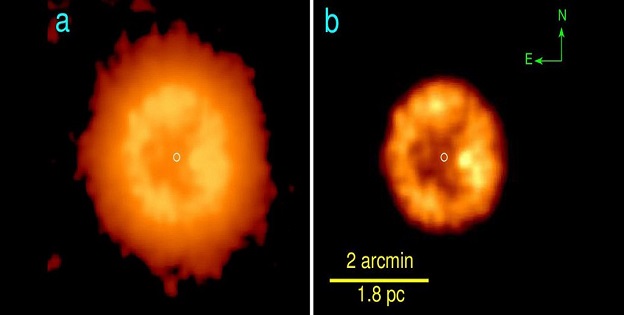
Death, for stars, isn’t always a straightforward affair. In fact, it can get downright weird. Astronomers have just identified a star made from the remnants of two dead stars that fused together, which reignited fusion in the core – bringing the new star back to life.
Death, for stars, isn’t always a straightforward affair. In fact, it can get downright weird. Astronomers have just identified a star made from the remnants of two dead stars that fused together, which reignited fusion in the core – bringing the new star back to life.
But J005311 is shining too brightly for a single white dwarf – it’s about as bright as 40,000 Suns.
We do know, however, that most of the stars in the sky are at least in binary systems. And, as data from the LIGO-Virgo collaboration is now revealing, mergers between dead stars may not be all that uncommon.
The astronomers believe that J005311 is the product of a merger between two white dwarfs. Over the course of millions of years, the two stars orbited each other in a closer and closer spiral, inexorably drawn together, until plif! They unite and become one star.
“Such an event is extremely rare,” said astronomer Götz Gräfener from the Argelander Institute for Astronomy (AIfA) at the University of Bonn. “There are probably not even half a dozen such objects in the Milky Way, and we have discovered one of them.”
This one star has the mass of two stars combined. Which means it would now have enough mass to fuse elements heavier than hydrogen or helium – and, as follow-up spectroscopy revealed, J005311 is rich in both carbon and oxygen.
It also has an extremely powerful stellar wind of 16,000 kilometres per second, a stream driven by the radiation generated by nuclear fusion.
Fusion alone can’t account for the power of this wind, but the product of a white dwarf merger is expected to have an extremely powerful magnetic field. This magnetic field would then accelerate the stellar wind, producing an effect like that seen in J005311.
When white dwarfs wind down, they – theoretically at least – turn into cold lumps in space, called black dwarfs. This process is thought to take a very long time, and astronomers believe it hasn’t actually happened yet.
But such a quiet fate is not in store for J005311. That’s because its new combined mass probably puts it over something called the Chandrasekhar limit, which is the maximum mass for a stable white dwarf.
Its temperature and wind speed indicate that the star is near the endpoint of the current stage of its evolution. When it runs out of material to burn, in a few thousand years it will likely collapse under its own gravity, the electrons and protons fusing into neutrons, turning the Frankenstar into a low-mass neutron star.
This event, the researchers said, will also produce a neutrino flash and a gamma-ray burst, and a very faint Type Ic supernova.