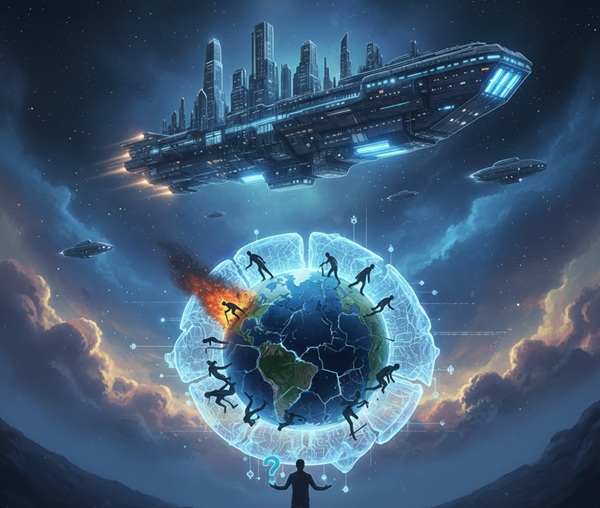
Are We Technologically Ready for Interstellar Travel—but Psychologically Unfit to Leave Earth?
Interstellar travel has long symbolized humanity’s ultimate ambition: escaping planetary limits and ensuring long-term survival beyond Earth. As existential threats such as asteroid impacts, climate instability, and artificial intelligence failures move from fiction toward plausibility, scientists increasingly ask a stark question: can humanity survive if it stays confined to one planet?
At first glance, the answer appears technical. We lack propulsion systems capable of crossing interstellar distances within a human lifetime. Yet some scientists argue the real barrier is not physics or engineering—but human evolution itself.
The Interstellar Travel Problem: Distances That Outrun Human Lifetimes
The closest star system to Earth, Alpha Centauri, lies approximately four and a third light-years away. With today’s propulsion technology, a spacecraft would need tens of thousands of years to arrive. Even theoretical breakthroughs—laser-driven sails or fusion propulsion—would still require journeys spanning multiple generations.
Such distances force us to confront a deeper issue. Interstellar travel is not a voyage; it is a civilization-long commitment. It would require sustained cooperation across centuries, possibly millennia. That scale challenges not just our machines, but our minds.
Human Evolution and the Brain: Why We Struggle With Long-Term Survival Planning
According to evolutionary anthropologist Kathleen Bryson, PhD, the greatest obstacle to interstellar travel lies in the way human brains evolved. For hundreds of thousands of years, survival depended on immediate concerns: food, safety, kin, and short-term alliances.
“Our brains are optimized for the present,” Bryson explains. “That wiring makes it extraordinarily hard to commit to projects whose rewards arrive long after we are gone.”
From an evolutionary perspective, this makes sense. Natural selection favored individuals who prioritized near-term survival, not abstract futures involving unborn descendants. An interstellar mission, however, demands exactly that kind of thinking.
So how do we persuade generations of people to sacrifice comfort, autonomy, and even choice for a destination they will never see?
Long-Term Cooperation in Nature: Evolutionary Blueprints Beyond Humans
Although humans struggle with extreme long-term planning, nature offers intriguing examples of sustained cooperation. Ants and bees operate within rigid systems of division of labor. Salmon migrate across vast distances guided by inherited instincts. Fungal networks span continents, sharing resources without centralized control.
More relevant are species that cooperate beyond kinship. Elephants, dolphins, wolves, corvids, and certain primates practice delayed reciprocity—a form of cooperation where benefits arrive much later and often from unrelated individuals.
Humans already use this strategy. We invest in education, infrastructure, and institutions that serve people we will never meet. The question is whether we can extend delayed reciprocity across centuries, rather than decades.
Generation Ships and Human Biology: Can a Society Survive the Journey?
Even if engineers solved propulsion, a generation ship would raise profound biological and social challenges. Maintaining genetic diversity within a closed population would require careful planning. Microbiomes—essential to human health—would need to survive long periods of dormancy.
Social stability presents an even greater risk. How would a mission prevent rebellion among descendants who never consented to the journey? How would leadership adapt to cultural drift, resource scarcity, or psychological fatigue?
“One dysfunctional generation could collapse the entire mission,” Bryson warns. Interstellar travel tolerates no prolonged failure.
Historical Precedents for Extreme Cooperation: Lessons From Earth
Despite these challenges, humans have achieved long-term coordination before. Medieval cathedrals took centuries to complete. Global vaccination campaigns eliminated smallpox. The Human Genome Project required sustained international collaboration.
These examples prove that humans can cooperate beyond individual lifespans—but only with strong institutions, shared narratives, and constant reinforcement. Interstellar travel would require all three, amplified to an unprecedented degree.
Social Engineering for the Stars: Rules, Rituals, and Meaning
Bryson argues that success would depend less on technology and more on social design. Clear rules, transparent governance, and shared rituals could keep the mission’s purpose alive. Education would need to reinforce not just technical skills, but meaning.
People aboard a generation ship would need to believe their lives mattered—even if the destination lay centuries away. Without that belief, cooperation would fracture.
So the real question becomes: can we engineer cultures as carefully as we engineer spacecraft?
Interstellar Travel and the Human Future: Are We Willing to Change Ourselves?
Ironically, the technology required for interstellar travel may arrive before the psychology to support it. Rewiring human instincts—toward patience, collective identity, and long-term responsibility—may prove harder than building fusion engines.
Would Bryson herself join such a mission? She laughs and declines, citing a fear of flying. Her hesitation reflects a broader truth. Earth, for all its flaws, still feels safer than the void.
Yet if survival demands that we leave, we may have no choice but to evolve again—this time consciously.
If the key to interstellar travel already exists within us, are we ready to unlock it—or will our ancient instincts keep us forever grounded?
Derleyen: Deniz KAFKAS
Kaynak: Are We Technologically Ready for Interstellar Travel—but Psychologically Unfit to Leave Earth?
Why Do Some Planets Lose Their Atmospheres While Others Survive?
Why Do Some Planets Lose Their Atmospheres While Others Survive?
Are We Technologically Ready for Interstellar Travel—but Psychologically Unfit to Leave Earth?