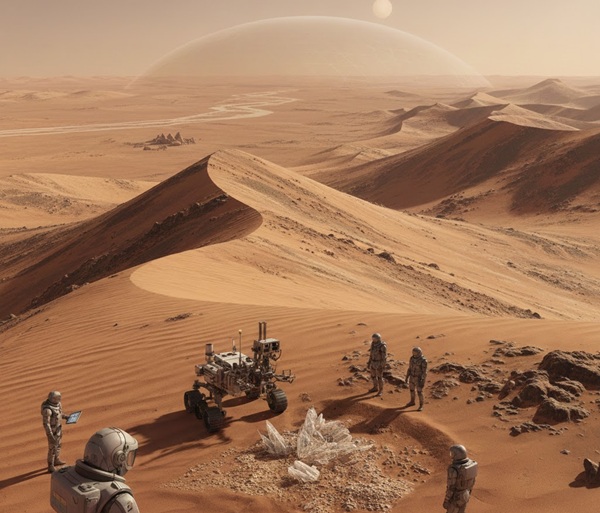
Are Ancient Martian Dunes Hiding Proof That Life Once Thrived There?
How Long Did Life Truly Have to Evolve on Mars—And What Remains?
For decades, scientists have agreed on one fundamental truth: Mars once hosted flowing water, a thicker atmosphere, and conditions suitable for life. Yet one question has persisted—how long did Mars remain habitable as its climate changed? While traditional models suggest that habitability ended over three billion years ago, new research is challenging that assumption and opening the door to a far more complex Martian past.
Long-Term Martian Habitability — New Clues from Gale Crater
It is well established that between four point two and three point seven billion years ago, Mars’ rivers, lakes, and vast oceans began to vanish as solar wind steadily stripped away the atmosphere. However, recent scientific work suggests that pockets of habitability may have lingered far longer than previously believed. This possibility raises an intriguing question: Could life have survived in isolated environments beneath the surface even as the planet dried out?
NASA’s Curiosity rover—still exploring the Gale Crater—continues to uncover evidence hinting at these extended habitable phases. According to recent findings from scientists at New York University Abu Dhabi (NYUAD), certain ancient sand dunes within the crater were gradually cemented into rock through prolonged interaction with underground water. Such activity would imply that Mars hosted subsurface water systems much later than expected.
Geological Evidence of Groundwater — What the Stimson Formation Reveals
The study, published in the Journal of Geophysical Research: Planets, was led by Dimitra Atri, Principal Investigator at NYUAD’s Center for Astrophysics and Space Science. Working with an interdisciplinary team, Atri analyzed dunes in the Stimson Formation, a region of wind-blown sand and sedimentary rock that Curiosity has photographed extensively.
Despite today’s harsh dryness in Gale Crater, these “lithified” formations likely originated during the Noachian Period, when flooding reshaped large sections of the Martian landscape. The presence of hardened dunes deeply surprised the researchers. After all, what type of persistent water source could have transformed desert-like dunes into solid rock?
Comparative Studies — Martian Dunes and Earth’s Desert Rock Formations
To interpret Curiosity’s data, the team turned to terrestrial analogues. Using the MSL Curiosity Notebook, they compared the Martian formations with rock structures found in the deserts of the United Arab Emirates, where dunes also became lithified after prolonged exposure to groundwater.
Their conclusion was striking: the Stimson Formation appears to have formed through late-stage aqueous activity, likely fed by groundwater flowing from a nearby mountain. This process left behind minerals such as gypsum, a calcium sulfate that forms in Earth’s deserts as well.
If similar groundwater systems once persisted on Mars, what else might they have preserved?
Reinforcing Evidence — Insights from the Greenheugh Pediment
This study builds on earlier work presented by Vignesh Krishnamoorthi and Atri at the Tenth International Conference on Mars. Their previous research examined Greenheugh Pediment, a nearby dune system that also shows signs of lithification.
In both regions, the pattern is consistent: ancient dunes interacted with underground water, solidifying into rock and trapping minerals in their layers. The recurrence of this phenomenon strengthens the case that subsurface water persisted long after Mars lost its global oceans.
Implications for Ancient Life — Could Microbial Fossils Be Hidden in Martian Sandstone?
On Earth, sandstone formations often preserve some of the oldest traces of life. Microbial communities can bind sediment grains together, triggering mineral precipitation and leaving behind detectable signatures.
Given these Earth analogues, the researchers propose a compelling possibility: lithified dunes in Gale Crater may contain preserved remnants of ancient Martian microorganisms. If true, these formations could be among the most promising targets in the search for fossilized life.
This leads to a haunting question: Could Mars still be hiding molecular or microbial fingerprints deep within its hardened sediments?
A New Perspective on Martian Evolution — And Future Exploration
Ultimately, this research reshapes our understanding of how Mars transitioned from a warm, water-rich world to the frozen desert we see today. The persistence of groundwater suggests that habitable conditions may have endured far longer—perhaps long enough for life to adapt, evolve, and leave behind evidence waiting to be discovered.
Moreover, these groundwater-altered dunes highlight prime locations for upcoming missions aimed at detecting ancient life. If future rovers or sample-return missions investigate these formations, what might they uncover about Mars’ forgotten past?
Source: Are Ancient Martian Dunes Hiding Proof That Life Once Thrived There?
Is Theia the Forgotten Planet That Built Both Earth and the Moon?
Is Theia the Forgotten Planet That Built Both Earth and the Moon?