Archaeologists uncover a witness to the Neolithic revolution
Radiocarbon dating and isotope analysis of an immaculately preserved skeleton from Mesolithic Denmark indicate that the individual lived through the introduction of agriculture and adapted his diet to the change, providing a unique “eyewitness account” of one of humanity’s most significant technological revolutions.
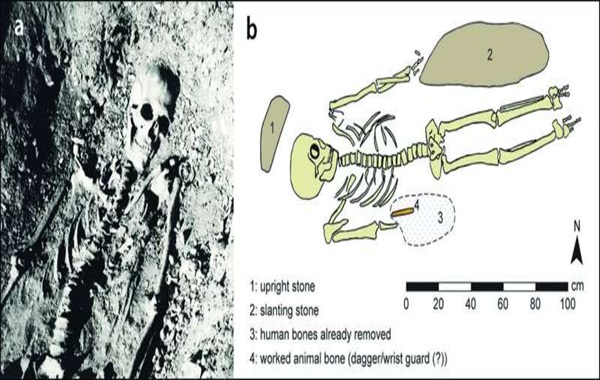
About 6,000 years ago, a biologically male individual died and was buried in a shell midden on the island of Sejerø, Denmark. Nicknamed “Rødhals Man,” he was one of the indigenous foragers who lived on the island, subsisting by fishing, hunting marine mammals and gathering marine resources such as shellfish.
However, this life was not to last, as irreversible change came with the arrival of Neolithic farmers from the south.
“Foragers seemed to have disappeared abruptly from the archaeological record just as the first farmers arrived,” says Dr. Anders Fischer from the University of Gothenburg, lead author of the research published in Antiquity. “What was it like to live through such a momentous, irreversible transition, seeing the archipelago where for centuries your ancestors had lived by fishing transformed by the arrival of a new group of people?”
“Was this a threat or an opportunity? What were the risks of engaging with the incomers, and the opportunity costs of not doing so? Was there any realistic alternative?” asks co-author Dr. John Meadows from the Leibniz Center for Archaeology.

To uncover how life for the foragers of Sejerø was affected by the arrival of Neolithic farmers, the research team used radiocarbon dates, ancient DNA and isotope analysis to investigate how Rødhals Man’s 40-year life changed over time.
Radiocarbon dating placed him well after the arrival of farming on nearby Zealand in about 3900 B.C., but ancient DNA shows that his ancestry was entirely indigenous (typical European Western Hunter-Gatherer).
Isotope analysis found that he ate significantly more terrestrial foods than other foragers and his burial shares more similarities with burials of Early Neolithic farmers than those of Late Mesolithic hunter-gatherers.
This indicates that Rødhals Man regularly interacted with farmers.
Importantly, the isotopes show that he was significantly more reliant on marine resources in childhood. While he never gave up his dependence on the sea for his diet, he ate significantly more terrestrial resources in adolescence and adulthood, suggesting that he was part of the first generation of foragers to live alongside incoming farmers.
This would make Rødhals Man a direct witness to, and potential participant in, the Neolithic revolution from the perspective of Mesolithic hunter-gatherers.
“It is only one person’s story, and only one generation,” states Fischer, “but the behavioral insights now accessible through a combination of ancient DNA, high-resolution sampling, and multi-isotope ecology give us hope that we will eventually understand the choices, or fate, of any children and grandchildren of Rødhals Man.”
These findings provide a unique glimpse into the arrival of farming through the eyes of an individual person experiencing the end of the Mesolithic firsthand.
“Rødhals Man is an incredibly rare find, the complete skeleton of someone who was an eyewitness to one of the most fundamental transformations in prehistory, the transition from foraging to farming,” Meadows concludes. “He did not fully embrace the farmers’ lifestyle, or run away from them, but adopted some components of farmer culture while maintaining the way of life of his indigenous ancestors.”
Source: phys.org
Archaeologists uncover a witness to the Neolithic revolution