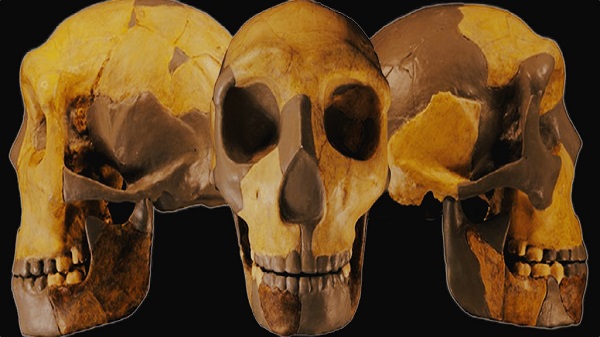
Ancient Skull Found in China Unlike Any Human Previously Discovered
An international team of scientists has published about an ancient human fossil found in China.
The fossil does not resemble Neanderthals, Denisowans, or any of us, suggesting that another branch of the current human family tree is needed.
Named HLD6, this as yet unclassified human jaw, skull, and leg bone was discovered in 2019 in Huarong Cave, East Asia. In the years since, experts at the Chinese Academy of Sciences (CAS) have struggled to match these remains to known lineages.
The hominin’s face is similar in structure to that of the lineage of extant humans that split off from Homo erectus 750,000 years ago. However, this individual lacks a chin and rather resembles a Denisowan (a type of ancient human extinct in Asia that diverged from Neanderthals more than 400,000 years ago). In collaboration with researchers from Xi’an Jiaotong University in China, the University of York in England, and the National Research Center for Human Evolution in Spain, CAS researchers believe they have discovered an entirely new lineage. It is a hybrid between the lineage that gave rise to modern humans and the lineage that gave rise to other ancient hominids in the region, such as the Denisovans.

Historically, many of the Pleistocene hominid fossils found in China do not fit into any one lineage. For example, they may be ancient examples of Homo sapiens or the evolutionary form of Homo erectus.
However, such linear and simplistic interpretations are controversial and not widely accepted. Homo erectus lived in Indonesia until about 100,000 years ago, but recently discovered remains in eastern China resemble other, more modern lineages of Homo sapiens.
Previous Neanderthal genome studies in Europe and western Asia have found evidence of a fourth lineage of humans that inhabited the Middle Pleistocene and Late Pleistocene.
However, this missing group has never been officially identified in the fossil record. Human bones recently discovered in China may be pieces of a puzzle.
The fossil jaw and skull are 12 or 13 years old, and while the face has modern human-like features, the limbs, cranium, and jaw “seem to reflect more primitive features,” the authors of the analysis write.

This result complicates the path to modern humans. The mosaic of physical characteristics found in these ancient humans confirms the coexistence of three lineages in Asia.
Homo sapiens emerged in China 120,000 years ago, but some of our “modern” features appear to have existed in China long before that. The last common ancestor of Homo sapiens and Neanderthals may have originated in Southwest Asia and then spread to all continents.
This theory needs to be confirmed by further archaeological research.
Source: Ancient Skull Found in China Unlike Any Human Previously Discovered
Ancient human genetic material found preserved in 2-million-year-old teeth