Ancient Papyrus Reveals Fraud, Slavery, And A Jewish Rebellion In Wild Roman Criminal Trial
For the first time in 1,900 years, humans have been able to read ancient text dating from the height of the Roman Empire.
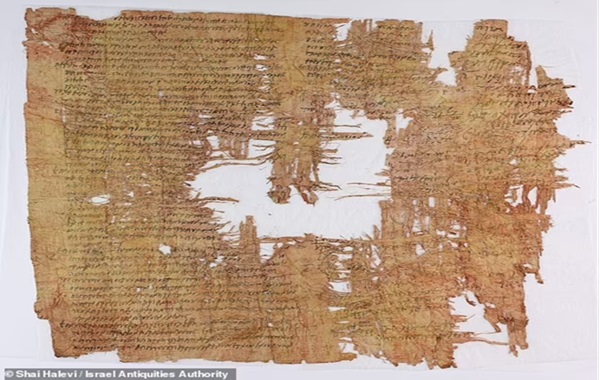
The historic text was written on a scroll of papyrus – a material similar to paper, made from the pith of the papyrus plant – found in the Judean desert.
Consisting of 133 lines of text in ancient Greek, it is a court document concerning a case of ‘sophisticated tax fraud’ by two Jewish men during the first half of the 2nd century AD.
The text makes reference to one of the defendants ‘who may be cheaply bought’ with a history of ‘committing violence and sedition and banditry’.
Meanwhile, his friend and accomplice is known to have ‘produced counterfeited coins’ – but large portions of the papyrus are missing or fragmented.
‘The document is very damaged at the end,’ Dr Anna Dolganov, historian at the Austrian Academy of Sciences, told MailOnline.
‘But we still get a clear idea of the criminal case from the perspective of the prosecution – and tax fraud was as old as taxation itself throughout human history.’
According to the researchers, this is the best-documented Roman legal case from Judea, other than the trial of Jesus.
The reddish-brown papyrus – about the size of A4 – was discovered in 2014 but the ‘complex decipherment’ of the text has taken just over a decade.
It is described as ‘one of the most comprehensive legal documents ever found from the period of Roman rule in the Land of Israel’.
‘This is the best-documented Roman legal case from Judea other than the trial of Jesus,’ said study author Dr Avner Acker at the Hebrew University.
Although it has a big hole in the middle, experts have been able to translate enough of the text to form a detailed reconstruction of events.
It concerns a court case involving two defendants named Gedaliah and Saul, who are accused of forging documents relating to the sale and release of slaves.
This sale was not only completely imaginary, with no money changing hands, but was also not properly declared.
‘We are told that Saulos arranged a fictive sale of slaves to an accomplice and later manumitted [released] one of them, all without paying the requisite Roman taxes,’ said Dr Dolganov.
‘Forging documents and tax evasion were considered serious crimes in the Roman Empire, punishable by hard labor and even execution.’


It seems the conspirators were well acquainted with Roman law and administration, which they exploited to their advantage.
The case is recorded in the papyrus from the perspective of Roman prosecutors, preparing for the trial and analyzing the strength of the evidence available to them, including the defendants’ histories.
Gedaliah, who was apparently from a respectable family and perhaps even a Roman citizen, was accused of other crimes such as violence, extortion and incitement to rebellion.
His ‘friend and collaborator’ Saulos, known for counterfeiting coins, may have been trying to evade taxes on his own slaves.
He could even have been trafficking young children born into slavery, or engaging in clandestine slave trade across imperial borders.
Or there may have been a more ‘straightforward explanation’, such as a desire for profit and tax evasion by hiding assets from the Romans.
When Roman officials became suspicious, the culprits allegedly tried to bribe a local city council to protect them.
Identities of the prosecutors remains unknown, but are likely to have been officials from the Roman fiscal administration, according to Dr Dolganov and colleagues.
‘The text also mentions an informer who denounced the defendants to Roman authorities,’ they say in their study, published in the journal Tyche.
Unfortunately there are details about the case that are lost, such as where it took place or the fate of Gedaliah and Saul, who blamed each other.
‘But the apparent fact that they were prosecuted by the Roman administration itself augurs badly for them,’ Dr Dolganov told MailOnline.
Tellingly, the court case happened not long after the Diaspora Revolt (AD 115-117), the violent Jewish uprisings in the eastern provinces of the Roman Empire, including including Egypt, Libya and Cyprus.
It also precedes the Bar Kokhba Revolt (AD 132-136), so a state of high alert among Roman officials at this time ‘does not seem surprising’, said Dr Dolganov.
Together, the two rebellions resulted in the loss of several Roman legions and the death of hundreds of thousands of people.
The trial may even have been interrupted by the outbreak of the Bar Kokhba revolt before it mysteriously ended up in a cave in the Judean desert.
Source: daily mail
Ancient Papyrus Reveals Fraud, Slavery, And A Jewish Rebellion In Wild Roman Criminal Trial/Ancient Papyrus Reveals Fraud, Slavery, And A Jewish Rebellion In Wild Roman Criminal Trial