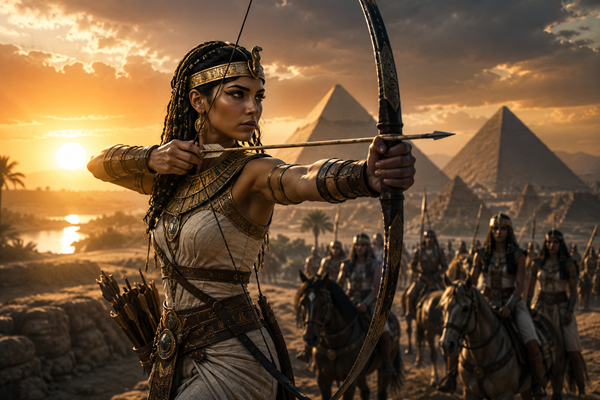
Ancient Egyptian Princesses Were Buried With Weapons for Thousands of Years—Did Their Bones Just Reveal the Secret History No One Expected?
For generations, archaeologists believed that the bows, arrows, daggers, and maces buried beside ancient Egyptian princesses were little more than symbols of royal status. These prestigious objects were often interpreted as ceremonial treasures placed in elite tombs to reflect power rather than practical skill. However, a remarkable scientific reexamination of royal skeletons from Dahshur is now overturning that long-standing belief.
What if these princesses were not simply members of the royal court? What if they were highly trained archers, skilled hunters, and women whose physical abilities shaped their daily lives? Could the bones themselves reveal a forgotten chapter of ancient Egyptian history?
A new study published in Frontiers in Environmental Archaeology suggests exactly that. Careful analysis of royal skeletons dating back approximately four thousand years indicates that several Egyptian princesses regularly used the very weapons buried beside them. Their bones preserve evidence of powerful muscle development, healed injuries, and years of demanding physical activity, offering one of the clearest windows yet into the lives of royal women during Egypt’s Middle Kingdom.
Ancient Egyptian Princesses Used Weapons: Why This Discovery Changes History
For decades, scholars debated whether the weapons discovered inside the burial chambers of royal women represented symbolic authority or genuine military and hunting experience. Until recently, there was little physical evidence capable of settling the argument.
That situation changed when researchers reexamined six royal mummies originally discovered during excavations at Dahshur in the late nineteenth century. These remarkable remains had disappeared into museum collections for decades before being rediscovered during a museum curation project in two thousand twenty.
Their rediscovery opened an unexpected scientific opportunity.
Using modern osteological techniques, researchers analyzed surviving bones to reconstruct the lives of these ancient royals. Although the skulls had unfortunately disappeared during the early twentieth century, the remaining skeletons preserved valuable clues about age, sex, health, physical activity, injuries, and lifestyle.
According to lead researcher Dr. Zeinab Hashesh, the evidence points toward an extraordinary conclusion.
Rather than living passive ceremonial lives, some royal women participated in physically demanding activities that required years of practice and exceptional strength.
Could these princesses have trained alongside elite warriors? Did hunting and archery form part of royal education rather than merely royal entertainment?
The evidence increasingly suggests they did.
The Royal Tombs of Dahshur Reveal More Than Beautiful Treasures
The royal cemetery at Dahshur has fascinated archaeologists for more than a century. Located south of modern Cairo, the site contains pyramids, underground chambers, and elaborate shaft tombs built during Egypt’s Middle Kingdom.
Among the rediscovered individuals were four sisters believed to be daughters of Pharaoh Amenemhat the Second.
Princess Ita rested beside Princess Khenmet.
Nearby lay Princess Itaweret together with another royal woman provisionally identified as Princess Sathathormeryt.
Researchers also examined Princess Noub-Hotep and King Hor, completing the group of six individuals.
Each burial contained objects reflecting extraordinary craftsmanship.
Beautiful jewelry glittered beside carefully crafted coffins.
Elegant ceremonial objects surrounded the deceased.
Most surprising, however, were the weapons.
Bows.
Arrows.
Daggers.
Maces.
For many years these discoveries puzzled archaeologists because such weapons traditionally appeared in male burials.
Were these simply symbolic gifts?
Or had these women actually mastered their use?
Their skeletons would eventually answer that question.
Bones Reveal Ancient Egyptian Princesses Were Skilled Archers and Hunters
Bones respond to physical activity throughout life.
Repeated movement strengthens the areas where muscles and ligaments attach to bone. Over many years these attachment points become larger and more pronounced, creating a permanent biological record of habitual activity.
This principle allowed scientists to reconstruct the physical lives of the Dahshur royals.
Princess Ita, estimated to have died between approximately twenty-eight and thirty-four years of age, possessed exceptionally strong muscle attachment sites in her upper body. These features suggest repeated use of weapons requiring powerful arm and shoulder movements, including daggers or maces.
Princess Khenmet, who likely died during her late thirties or forties, displayed signs of reduced bone density. Nevertheless, her ligament attachment points remained remarkably robust, indicating that she maintained considerable physical strength despite age-related skeletal changes.
Princess Itaweret presented perhaps the most fascinating evidence.
She survived fractured ribs and broken bones in one foot before eventually healing completely. Her upper limbs displayed anatomical adaptations commonly associated with repeated archery practice.
Researchers concluded that she almost certainly spent years drawing heavy bows.
Princess Noub-Hotep and King Hor demonstrated similar skeletal characteristics consistent with skilled archers.
Together, these findings transform isolated archaeological artifacts into evidence of real human behavior.
The bows buried inside these tombs were no longer silent symbols.
Instead, they became extensions of lives lived in motion.
Ancient Egyptian Princesses Lived Surprisingly Active Lives
The study paints an image that differs dramatically from traditional assumptions about royal women.
Rather than remaining isolated inside palace walls, these princesses appear to have engaged in activities demanding balance, endurance, coordination, and strength.
Hunting may have formed part of elite royal education.
Archery could have represented both practical training and political symbolism.
Military preparation may even have played a greater role among royal women than historians previously recognized.
Could these princesses have participated in ceremonial hunts alongside pharaohs?
Did they train for royal protection?
Were they demonstrating leadership through physical excellence?
Although definitive answers remain elusive, their skeletons strongly suggest lives far more dynamic than previously imagined.
Healed Injuries Reveal Advanced Ancient Egyptian Medical Knowledge
One of the study’s most remarkable findings involves evidence of survival after serious injuries.
Princess Itaweret’s broken ribs likely resulted from a heavy impact or fall from considerable height.
Her fractured foot also healed successfully.
These injuries would have caused significant pain and temporary disability.
Yet they recovered remarkably well.
Researchers believe such healing reflects access to skilled medical treatment available only to members of Egypt’s royal family.
Several individuals also displayed evidence of infections, nutritional stress, and other health challenges.
Interestingly, the four sisters shared rare spinal abnormalities that may point toward close familial relationships between their parents.
Royal marriages between relatives were not uncommon in ancient Egypt, often intended to preserve dynastic legitimacy.
Therefore, the skeletons reveal not only physical activity but also family structure, health conditions, and patterns of inherited anatomy.
Modern Science Is Giving Ancient Egyptian Princesses Their Voices Back
Although archaeology has traditionally focused on preserving magnificent jewelry, golden treasures, and monumental architecture, this research shifts attention toward the people themselves.
The scientists hope future investigations will include stable isotope analysis capable of reconstructing diet, childhood mobility, and nutritional history.
Ancient DNA studies may eventually clarify family relationships with greater precision.
Three-dimensional scanning could preserve every surviving bone digitally while allowing museums to create educational replicas for exhibitions around the world.
Imagine standing before a digital reconstruction of Princess Ita while simultaneously examining the dagger once placed beside her coffin.
Would visitors understand her differently?
Would they see not merely a princess but an accomplished athlete, hunter, or warrior?
Such technology could reshape public understanding of ancient Egyptian civilization.
What Does This Discovery Mean for Ancient Egyptian History?
Every archaeological discovery challenges assumptions.
This one challenges several.
For generations, many historians viewed elite Egyptian women primarily through political marriages, religious ceremonies, and family lineage.
Yet these skeletons suggest another dimension.
Strength.
Skill.
Training.
Resilience.
The physical evidence indicates that some royal women developed their bodies through years of demanding activity rather than ceremonial display alone.
Their weapons were likely tools of experience rather than decorative status symbols.
How many other royal tombs still hide similar evidence?
How many forgotten women shaped Egyptian history in ways that archaeology has only begun to recognize?
Could future discoveries reveal even more warrior princesses buried beneath Egypt’s ancient sands?
Every new excavation brings us closer to answering these fascinating questions.
The Lasting Legacy of Egypt’s Forgotten Warrior Princesses
The rediscovered Dahshur skeletons remind us that history constantly evolves as science advances.
Bones preserve stories that written records sometimes ignore.
Muscles leave signatures.
Healed fractures record survival.
Weapons become personal possessions rather than mysterious symbols.
Together, these details transform anonymous royal burials into vivid human biographies.
Perhaps the greatest achievement of this research is not proving that some ancient Egyptian princesses used weapons.
Instead, it restores individuality to women who lived four thousand years ago and whose remarkable lives nearly disappeared from history.
Their jewelry still dazzles modern audiences.
Their weapons still inspire curiosity.
Now, finally, their bones tell the rest of the story.
And perhaps the greatest question remains unanswered.
How many more forgotten voices are still waiting beneath Egypt’s sands, ready to rewrite everything we thought we knew about the ancient world?
Source: Ancient Egyptian Princesses Were Buried With Weapons for Thousands of Years—Did Their Bones Just Reveal the Secret History No One Expected?
A Lost Human Lineage May Have Left a Genetic Legacy in People Today
A Lost Human Lineage May Have Left a Genetic Legacy in People Today
Ancient Egyptian Princesses Were Buried With Weapons for Thousands of Years—Did Their Bones Just Reveal the Secret History No One Expected?
Sources
Hashesh, Z. et al. Frontiers in Environmental Archaeology (study on the Dahshur royal skeletons).
Frontiers Science News.
Egyptian Museum, Cairo (Dahshur Royal Mummy Curation Project).
Archaeological research on the Middle Kingdom royal cemetery at Dahshur.