An Ancient Wanderer Near Mars: What Secrets Does This Interstellar Comet Hide?
Older Than the Sun: Could This Comet Rewrite the Story of Our Solar System?
A cosmic traveler older than our Sun has swept past Mars — and this time, orbiters were watching. Scientists are turning their attention to 3I/ATLAS, a rare interstellar comet that may carry secrets from the birth of distant star systems. Could this icy wanderer rewrite what we know about the galaxy’s hidden history?
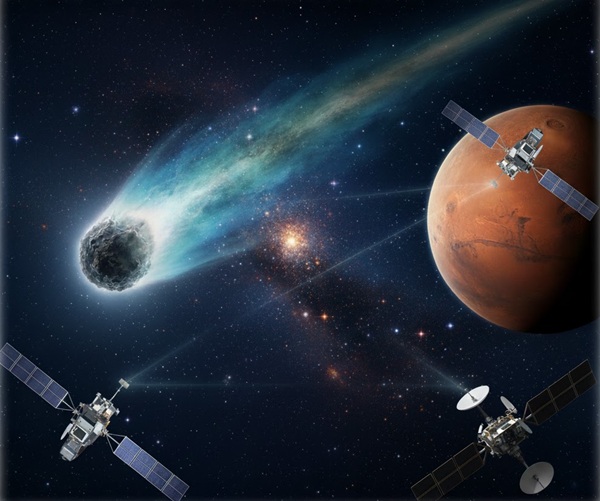
Between October one and seven, two spacecraft — ExoMars Trace Gas Orbiter (TGO) and Mars Express — tracked the comet’s journey as it made a close pass by Mars. At its nearest approach on October three, it came within thirty million kilometers of the Red Planet, giving scientists a unique front-row seat.
Mars Orbiters Lock Eyes on a Cosmic Speck
Spotting an object ten thousand to one hundred thousand times fainter than Mars itself was no small task. TGO used its CaSSIS camera system to follow the faint glow of 3I/ATLAS against the black backdrop of space.
In the images, the comet appears as a blurred, moving point — its coma glowing softly as solar radiation begins to warm its icy heart. The nucleus, no more than a kilometer wide, remained invisible at this distance, like trying to spot a single mobile phone on the Moon from Earth.
These rare observations demonstrate how spacecraft designed to study Mars can pivot to capture once-in-a-lifetime interstellar events.
The Awakening Coma: Sunlight Ignites a Ghostly Halo
As the comet moves closer to the Sun, heat frees frozen gas and dust, forming a coma spanning thousands of kilometers. This luminous cloud, though faint, carries essential clues about the comet’s composition.
The tail — usually stretching for millions of kilometers — hasn’t appeared yet in these early images. But what happens when sunlight intensifies its activity? In the coming weeks, astronomers expect the comet to flare brighter, making its tail more visible to telescopes across the Solar System.
Cracking the Code: Searching the Data for Clues
While TGO managed to catch 3I/ATLAS, Mars Express struggled with shorter exposure times. But scientists are stacking multiple frames, hoping to reveal the elusive traveler hiding in the noise.
Spectrometers on both orbiters — including OMEGA, SPICAM, and NOMAD — are now being used to examine the comet’s light spectrum. Will they detect its chemical fingerprint? If successful, these measurements could tell us what kind of cosmic neighborhood this object came from.
“The comet is around ten thousand to one hundred thousand times fainter than our usual target,” said Nick Thomas, principal investigator for CaSSIS. “It’s one of the most challenging observations we’ve ever attempted.”
An Ancient Traveler: Older Than the Solar System
Comet 3I/ATLAS isn’t just any visitor. It’s only the third interstellar comet ever observed, after 1I/ʻOumuamua in twenty seventeen and 2I/Borisov in twenty nineteen.
Discovered on July one, twenty twenty-five by the Asteroid Terrestrial-impact Last Alert System (ATLAS) in Chile, this icy body may be three billion years older than our Solar System, which itself is four-point-six billion years old.
Think about it: before the Sun even formed, this comet was already wandering through the dark. What secrets could it hold about distant star nurseries?
Looking Ahead: From Mars to Jupiter
Next month, Jupiter Icy Moons Explorer (Juice) will target 3I/ATLAS after its closest approach to the Sun, hoping to observe a more active and luminous comet. Although Juice will be farther away, its instruments could capture new details as the coma and tail intensify.
The data won’t arrive until February twenty twenty-six, but the anticipation is already building among planetary scientists.
The Future of Interstellar Encounters
ESA’s upcoming Comet Interceptor mission, launching in twenty twenty-nine, is designed to wait in orbit and sprint toward an unexpected target — possibly another interstellar visitor like 3I/ATLAS.
“When Comet Interceptor was selected in twenty nineteen, we only knew of one interstellar object,” said Michael Kueppers, the mission’s project scientist. “Now, with three known examples, we’re beginning to see just how diverse these travelers can be.”
Even if Interceptor never reaches an interstellar comet, it will pioneer rapid-response missions that could one day let us study these outsiders up close.
A Final Question: What Stories Do the Stars Whisper?
3I/ATLAS isn’t just a comet — it’s a time capsule from another star system. Each data point gathered by Mars orbiters or future missions brings us a step closer to understanding how planetary systems are born, evolve, and drift through the galaxy.
As this ghostly traveler speeds away, one question lingers: What secrets will the next interstellar visitor bring?
Source: An Ancient Wanderer Near Mars: What Secrets Does This Interstellar Comet Hide?
Could Ancient Oceans on Uranus’ Moons Rewrite the Story of Life Beyond Earth?
Could Ancient Oceans on Uranus’ Moons Rewrite the Story of Life Beyond Earth?