Amazon unveils first quantum computing chip that reduces error correction cost by 90%
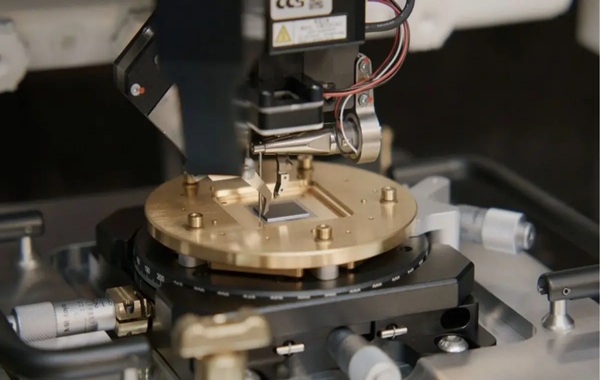
Amazon has unveiled its first quantum computing chip that uses scalable architecture and reduces error correction cost by up to 90%. Called ‘Ocelot’, the chip is developed by a team of the AWS Center for Quantum Computing at the California Institute of Technology.
Amazon claims that the Ocelot represents a breakthrough in the pursuit of building fault-tolerant quantum computers capable of solving problems of commercial and scientific importance that are beyond the reach of today’s conventional computers.
The team used a novel design for Ocelot’s architecture, building error correction from the ground up and using the ‘cat qubit’.
AWS combined cat qubit and additional quantum error correction components
Cat qubits – named after the famous Schrödinger’s cat thought experiment –intrinsically suppress certain forms of errors, reducing the resources required for quantum error correction, according to Amazon.
The company revealed that AWS researchers, for the first time, combined cat qubit technology and additional quantum error correction components onto a microchip that can be manufactured in a scalable fashion using processes borrowed from the microelectronics industry.
“With the recent advancements in quantum research, it is no longer a matter of if, but when practical, fault-tolerant quantum computers will be available for real-world applications. Ocelot is an important step on that journey,” said Oskar Painter, AWS director of Quantum Hardware.
“In the future, quantum chips built according to the Ocelot architecture could cost as little as one-fifth of current approaches, due to the drastically reduced number of resources required for error correction. Concretely, we believe this will accelerate our timeline to a practical quantum computer by up to five years.”
Logical qubit memory
Published in Nature, the findings reveal that using a superconducting quantum circuit, researchers realized a logical qubit memory formed from the concatenation of encoded bosonic cat qubits with an outer repetition code of distance d = 5. A stabilizing circuit passively protects cat qubits against bit flips. The repetition code, using ancilla transmons for syndrome measurement, corrects cat qubit phase flips.
“We study the performance and scaling of the logical qubit memory, finding that the phase-flip correcting repetition code operates below the threshold. The logical bit-flip error is suppressed with increasing cat qubit mean photon number, enabled by our realization of a cat-transmon noise-biased CX gate,” said researchers in the study.
Researchers revealed that one of the biggest challenges with quantum computers is that they’re incredibly sensitive to the smallest changes, or ‘noise’ in their environment.
Vibrations, heat, electromagnetic interference from cell phones and Wi-Fi networks, or even cosmic rays and radiation from outer space, can all knock qubits out of their quantum state, causing errors in the quantum computation being performed, according to a press release.
They underlined that such issues have historically made it extremely challenging to build quantum computers that can perform reliable, error-free calculations of any significant complexity.
“The biggest challenge isn’t just building more qubits, It’s making them work reliably,” said Painter.
Researchers revealed that to solve this problem, quantum computers rely on quantum error correction that uses special encodings of quantum information across multiple qubits—in the form of ‘logical’ qubits—to shield quantum information from the environment.
This also enables the detection and correction of errors as they occur. Unfortunately, given the sheer number of qubits required to get accurate results, current approaches to quantum error correction have come at a huge, and therefore prohibitive, cost, as per the press release.
Source: Interesting Engineering
Australia to turn abandoned mine into air energy hub, powering 80,000 homes
Amazon unveils first quantum computing chip that reduces error correction cost by 90%