AI Unlocks Ancient Secrets: Scientists Virtually Unfurl 2,000-Year-Old Herculaneum Scroll
It’s been left unread for nearly 2,000 years, last glimpsed when the Roman Empire ruled over Europe.
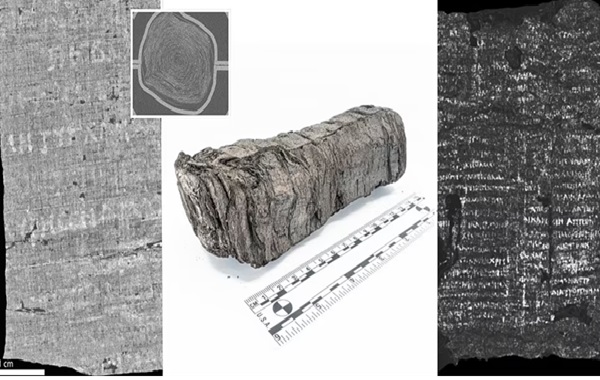
Now, scientists have used AI to virtually unfurl one of the Herculaneum scrolls – the ancient documents buried by the eruption of Mount Vesuvius in AD 79.
Known as PHerc. 172, this particular scroll is housed at the Bodleian Libraries in Oxford, and is covered in ancient Greek text written in carbon-based ink.
‘It’s an incredible moment in history as librarians, computer scientists and scholars of the classical period are collaborating to see the unseen,’ said Richard Ovenden, senior executive Bodleian Libraries.
‘The astonishing strides forward made with imaging, and AI are enabling us to look inside scrolls that have not been read for almost 2,000 years.’
The Herculaneum scrolls are thought to contain profound philosophical and literary texts from ancient Greek and Roman scholars.
The problem is that any attempts to unroll the burnt cylinders will turn them to dust because they are so fragile – meaning the words would be lost forever.
So, scientists have been turning to ingenious methods such as x-ray scanning, ink-detection software and AI to virtually ‘unroll’ them.

Scientists used Diamond Light Source to create 3D scans and a digital reconstruction of scroll PHerc.172, one of three Herculaneum scrolls housed at Bodleian Libraries.
They then used AI to identify the ink markings on the papyrus – a material similar to paper, made from the pith of the papyrus plant.
Even if scientists were able to physically unfurl the scroll, these ink markings would be invisible to the naked eye due to the burnt papyrus.
Experts have interpreted a few fragments of words of PHerc.172, but they’re still yet to decipher full sentences.
One of the first words to be translated is the Ancient Greek διατροπή, a word found in other Herculaneum scrolls that would mean something like ‘confusion, agitation, or disgust’.
The word appears twice within a few columns of text, but what exactly it’s referring to is as yet unknown.
Similarly, in another segment, the sequence of Greek letters τυγχαν may be the beginning of the verb τυγχάνω, which means ‘to happen’.
Intriguingly, the ink seems to appear more clearly in the outer wraps of the scroll, and in some cases, is it only clear every other line – which suggests the scribe dipped their pen once every two lines.


‘A human hand wrote this text 2,000 years ago, and it’s an unforgettable experience to be the first person in that time to see it,’ the team say.
The AI focuses solely on detection of the ink and does not have any understanding of language and cannot recognise characters.
In this way, AI operates much like 18th-century copyists, who were employed to meticulously replicate what they saw in the scrolls without comprehending the text.
Researchers now hope to reach the end of the papyrus (the innermost part of the carbonised scroll) where the colophon with the title of the work may be preserved.
‘This scroll contains more recoverable text than we have ever seen in a scanned Herculaneum scroll,’ said Dr Brent Seales, co-founder of the Vesuvius Challenge.
‘Despite these exciting results, much work remains to improve our software methods so that we can read the entirety of this and the other Herculaneum scroll.’
Experts are putting a call-out to engineers who can develop AI methods to reveal more of the hidden text as part of the ‘Vesuvius Challenge’ – with a hefty cash prize up for grabs.
Earlier this year, students won $700,000 (£550,000) when they used AI to work out what’s written on another one of the scrolls, held by the Institut de France in Paris.


The saga of the Herculaneum scrolls goes back nearly 2,000 years when the Italian settlements of Pompeii, Torre Annunziata, Stabiae and Herculaneum were destroyed by the Vesuvius eruption of AD 79, killing an estimated 16,000 people.
One of the buildings buried in Herculaneum was a large villa, possibly belonging to Lucius Calpurnius Piso Caesonius, the father-in-law of Julius Caesar.
The large library of the villa contained more than 1,800 papyrus scrolls that were turned to carbon lumps in the eruption.
In the 1750s, excavations began on the villa and a number of scrolls were destroyed or thrown away in the belief that they were worthless chunks of charcoal.
Unfortunately, hundreds more were destroyed during attempts to unroll the scrolls, which are mostly held at the National Library in Naples.
A few hundred scrolls were excavated that were never opened, and remain rolled up with their contents sealed away – waiting to reveal potentially profound lessons for modern society.
In 1756, Abbot Piagio, conserver of ancient manuscripts in the Vatican Library, invented a machine that could unroll a single manuscript in four years, but it unfortunately destroyed a lot of the work.
In the early 1800s, PHerc.172 and other scrolls were given to the future George IV of England by Ferdinand IV, the king of Naples and Sicily – allegedly in exchange for some kangaroos – before winding up at the Bodleian Library.


Modern attempts have focused on digital methods to read the texts without physically unrolling the papyri to prevent damage.
Known as ‘virtual unrolling’, such attempts commonly use X-rays and other light sources to scan the objects and reveal previously unknown text.
One technique called shortwave infrared hyperspectral imaging picks up variations in the way light bounces off the black ink on the papyrus.
A newly discovered passage from one of the scrolls using this technique has revealed that Plato spent his last night blasting a slave girl’s ‘lack of rhythm’ as she played the flute.
The philosopher, who was suffering from a fever, had been listening to music and welcoming guests before he died at the age of 80 or 81 in around 348BC.
The scroll also helped to confirm that Plato was buried at the Academy of Athens, which he founded, but adds the detail that the ancient thinker’s resting place was in a designated garden within the university grounds.
Source: daily mail
Ancient DNA Reveals 11,000 Years of Sheep-Human Coevolution
AI Unlocks Ancient Secrets: Scientists Virtually Unfurl 2,000-Year-Old Herculaneum Scroll/AI Unlocks Ancient Secrets: Scientists Virtually Unfurl 2,000-Year-Old Herculaneum Scroll/AI Unlocks Ancient Secrets: Scientists Virtually Unfurl 2,000-Year-Old Herculaneum Scroll