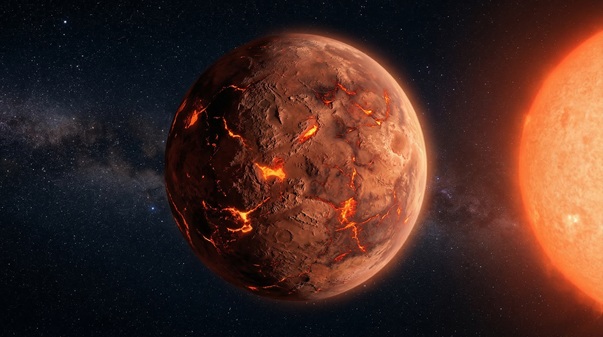
A Strange Earth-Sized Planet Near Us: Could TOI-4616 b Reveal the Fate of Alien Atmospheres?
Astronomers have discovered thousands of worlds beyond our solar system. Yet occasionally a new planet emerges that scientists consider especially valuable. The recently identified exoplanet TOI-4616 b is one such world. At first glance it may appear ordinary—a rocky planet orbiting a dim red dwarf star. However, closer examination reveals that it could become a crucial reference point for future studies of terrestrial planets and their atmospheres.
Researchers describe the system as a benchmark for highly irradiated rocky planets. In other words, TOI-4616 b may help scientists understand how Earth-sized planets evolve when they orbit extremely close to small stars. Could its harsh environment reveal how planetary atmospheres survive—or disappear—over billions of years?
The discovery was presented in a study titled “TOI-4616 b: a benchmark Earth-sized planet transiting a nearby M4 dwarf.” The research was led by doctoral researcher Francis Zong Lang at the Center for Space and Habitability at the University of Bern in Switzerland. The paper has been submitted to the journal Monthly Notices of the Royal Astronomical Society and is currently available as a preprint on the arXiv server.
Exoplanets Around M-Dwarf Stars: Why These Planetary Systems Dominate the Galaxy
Astronomers have now confirmed more than six thousand exoplanets. With each new discovery, patterns begin to emerge. One of the most striking patterns involves small red dwarf stars, also known as M-type stars.
These stars are the most common stellar objects in our galaxy. Because they are smaller and dimmer than Sun-like stars, planets passing in front of them create stronger transit signals. As a result, astronomers can detect small rocky planets around them more easily.
Consequently, research shows that M-dwarfs host a remarkable abundance of terrestrial planets. Some even contain tightly packed planetary systems. Perhaps the most famous example is the TRAPPIST‑1 planetary system, which contains seven Earth-sized worlds.
Why does this matter? Because rocky planets around M-dwarfs provide rare opportunities to study planetary atmospheres. Their host stars are small and faint. Therefore, when planets pass in front of them, telescopes can measure atmospheric signatures with greater precision.
However, these planets also face severe environmental challenges. Could their atmospheres survive intense stellar radiation? Or are they stripped away early in their history?
TOI-4616 b Earth-Sized Exoplanet: Discovery Through the TESS Space Telescope
The discovery of TOI-4616 b was made using the Transiting Exoplanet Survey Satellite (TESS), a mission designed to identify planets through the transit method. When a planet crosses the face of its star from our perspective, the star’s brightness drops slightly. By analyzing these tiny dips, astronomers can infer the planet’s size and orbital period.
Researchers reported both the discovery and statistical validation of the planet. In other words, multiple observations confirmed that the signal truly came from a planet rather than from stellar noise or observational error.
TOI-4616 b orbits a nearby mid-type M-dwarf star located about ninety-one light-years from Earth. Although this distance might sound enormous, it is relatively close on a galactic scale. Because the system is nearby, astronomers can study it in much greater detail than many other exoplanets.
The host star itself exhibits typical characteristics of a cool red dwarf:
Radius: about zero point one eight eight nine solar radii
Mass: about zero point one eight eight one solar masses
Surface temperature: roughly three thousand one hundred fifty Kelvin
Despite its modest size and brightness, this star has become an ideal laboratory for studying extreme planetary environments.
Extreme Radiation and Atmospheric Escape on TOI-4616 b
TOI-4616 b is roughly one point two two times the radius of Earth. That places it firmly in the category of Earth-sized rocky planets.
However, its orbit is dramatically different from Earth’s.
The planet circles its star in only one point five five days. Consequently, it sits extremely close to the star and experiences intense radiation. Its equilibrium temperature reaches approximately five hundred twenty-five Kelvin—far hotter than Earth’s surface.
This environment raises an important scientific question: Can a rocky planet retain its atmosphere under such extreme conditions?
Planets orbiting M-dwarfs often struggle to hold onto their atmospheres for several reasons.
First, these stars produce powerful stellar flares and high-energy radiation. Over time, this radiation can strip away atmospheric gases.
Second, M-dwarfs spend a long period in a pre-main-sequence phase. During this early stage, they shine far brighter than they do later in life. Any nearby planets may experience billions of years of intense heating before the star stabilizes.
Therefore, many scientists suspect that close-orbiting rocky planets around red dwarfs lose their primordial hydrogen-rich atmospheres early in their evolution.
But the story may not end there.
Secondary Atmospheres and Planetary Survival Around Red Dwarfs
Although primary atmospheres may vanish, planets can sometimes develop secondary atmospheres. These atmospheres form through geological processes such as volcanism, outgassing, and chemical reactions within the planet’s interior.
Carbon dioxide–dominated atmospheres may be especially resilient. Because CO₂ molecules are heavier than hydrogen, they are more difficult for stellar radiation to remove.
Additionally, a strong planetary magnetic field could shield the atmosphere from charged stellar particles. Earth’s magnetic field performs this role today.
Therefore scientists ask:
Could TOI-4616 b still possess a thin but stable atmosphere?
Or has its environment already stripped it bare?
At present, researchers cannot answer these questions with certainty. However, that uncertainty makes the planet scientifically valuable.
Why TOI-4616 b Is a Benchmark Exoplanet for Atmospheric Studies
TOI-4616 b occupies a unique position among known exoplanets. It lies between two categories:
Earth-sized planets orbiting earlier M-dwarf stars
Planets orbiting ultra-cool dwarfs
Because of this intermediate status, the system allows astronomers to compare planetary behavior across different stellar environments.
Even more importantly, scientists have gathered decades of observational data about the host star. Historical records extend back to nineteen fifty-four, providing a long baseline for studying stellar activity.
Later surveys also contributed key measurements. For example:
Pan‑STARRS observed the star in two thousand eleven.
SNO/Artemis telescope system conducted follow-up observations in two thousand twenty-five.
Because of these extensive observations, astronomers know the star’s properties with unusual precision. That reliability transforms the system into a reference case for theoretical models.
Researchers therefore describe TOI-4616 b as “well-suited for comparative investigations of planetary structure and evolution in the strongly irradiated regime.”
In simpler terms, scientists can use it as a cosmic benchmark.
Future Observations With the James Webb Space Telescope
One of the primary goals of modern astronomy is to study exoplanet atmospheres directly. The most powerful instrument currently available for that purpose is the James Webb Space Telescope.
When a planet passes in front of its star, some starlight filters through the planet’s atmosphere. Molecules in the atmosphere absorb specific wavelengths of light. By analyzing these absorption patterns, astronomers can identify gases such as water vapor, carbon dioxide, or methane.
However, not every exoplanet system provides ideal observing conditions. Some stars are poorly characterized. Others produce only a few measurable transits.
TOI-4616 b stands out because the host star is relatively bright and well studied. Consequently, future missions may analyze the planet’s atmospheric composition with unprecedented detail.
What will scientists discover?
Could they detect traces of a surviving atmosphere?
Could they measure how quickly gases escape into space?
Or will the planet prove completely barren?
Each possibility would reveal new information about planetary evolution.
A Cosmic Laboratory for Understanding Rocky Exoplanets
Ultimately, TOI-4616 b represents more than just another entry in the growing catalog of exoplanets. Instead, it offers a natural laboratory for studying how rocky worlds behave in extreme stellar environments.
The planet’s proximity to Earth makes it accessible to multiple observatories. Meanwhile, decades of stellar observations provide a strong foundation for modeling the system.
By comparing TOI-4616 b with other planets orbiting M-dwarfs, astronomers may finally answer several long-standing questions:
How long can a rocky planet retain its atmosphere near a red dwarf?
What role do volcanism and interior processes play in rebuilding atmospheres?
Can magnetic fields protect planets from stellar radiation?
And perhaps most importantly, how common are Earth-like conditions in the galaxy?
Every new observation brings scientists closer to these answers. For now, TOI-4616 b stands as one of the most promising test cases for understanding the complex relationship between stars, planets, and atmospheres.
Source: A Strange Earth-Sized Planet Near Us: Could TOI-4616 b Reveal the Fate of Alien Atmospheres?
Could Alien Civilizations Build Dyson Bubbles? Scientists Say Stability Might Be Achievable
Could Alien Civilizations Build Dyson Bubbles? Scientists Say Stability Might Be Achievable
A Strange Earth-Sized Planet Near Us: Could TOI-4616 b Reveal the Fate of Alien Atmospheres?
Sources
Lang, F. Z., et al. “TOI-4616 b: a benchmark Earth-sized planet transiting a nearby M4 dwarf.” Preprint available on arXiv.
Observational data from Transiting Exoplanet Survey Satellite (TESS).
Follow-up observations from Pan‑STARRS and SNO/Artemis telescope system.
Background research on exoplanets published in Monthly Notices of the Royal Astronomical Society.
A Strange Earth-Sized Planet Near Us: Could TOI-4616 b Reveal the Fate of Alien Atmospheres?