A Hidden State Between Liquid And Solid May Have Been Found
Glass might look and feel like a perfectly ordered solid, but up close its chaotic arrangement of particles more closely resemble the tumultuous mess of a freefalling liquid frozen in time.
Known as amorphous solids, materials in this state defy easy explanation. New research involving computation and simulation is yielding clues. In particular, it suggests that, somewhere in between liquid and solid states is a kind of rearrangement we didn’t know existed.
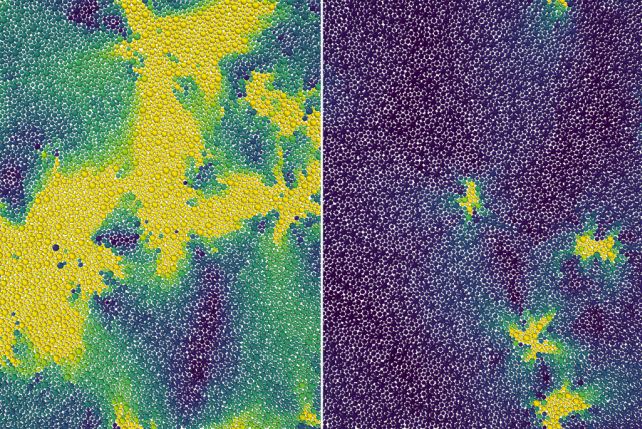
According to scientists Dimitrios Fraggedakis, Muhammad Hasyim, and Kranthi Mandadapu of the University of California, Berkeley, there is a behavior on the temperature boundary of supercooled liquids and solids where the static particles remain excited, ‘twitching’ in place.
We’re largely familiar with three fundamental states of matter in everyday life: solid, liquid, and gas, or vapor. Each is defined by the relationships between their particles and surrounds.
When one of these changes into another one – a solid melting into a liquid, or a liquid evaporating into a gas, for instance – this is known as a state transition.
But matter is quite a bit more complex than just those three basic states. Atoms can become so hot, for example, their charges fly apart to form a plasma. Cooled right down, some classes of particle can lose their identity altogether to blend into a quantum blur.
Amorphous solids are strange mixes of well-ordered solids and loosely-bound liquids. Where particles within solids tend to form predictable connections with their neighbors once they lock into place at suitably low temperatures, amorphic solids have the disordered arrangement of a liquid.Just how these seemingly haphazard connections switch from viscous streams of flowing molecules to a static landscape is far from obvious.
Using glass as the most familiar example, its constituent elements of oxygen and silicon flow when heated. Cooled slowly, those particles have time to form into an ordered crystal structure called quartz. If it cools quickly, the particles somehow retain a disordered arrangement; this is the point at which it becomes an amorphous solid, and the temperature at which it occurs is the onset temperature.
Fraggedakis, Hasyim, and Mandadapu used computation and simulation, combined with the results of past experiments, to determine that this transition might not be so neat, featuring a special activity of particles sitting between their normal liquid and supercooled states.