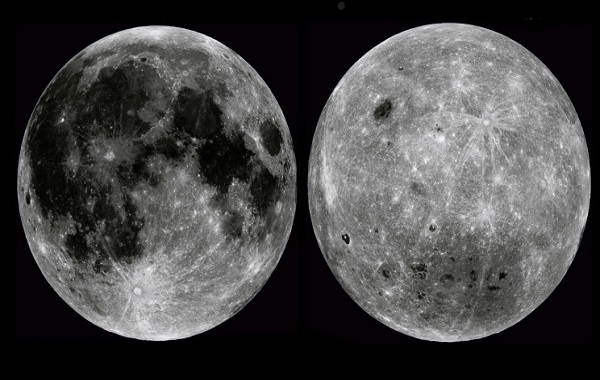
A colossal ancient impact may have led to the differences between the Moon’s near and far sides
The differences were created by the heat generated through the impact.
One of the Moon’s longest-standing mysteries is why its near and far sides are so different. The nearside is known for its lunar mare while the far side is almost completely without large-scale mare features.
Now, a new study reveals that these differences may have emerged from a colossal giant impact billions of years ago, according to a new study published in the journal Science Advances on Friday.
Heat generating impacts
“We know that big impacts like the one that formed the South Pole–Aitken would create a lot of heat,” said Matt Jones, a Ph.D. candidate at Brown University and the study’s lead author.
“The question is how that heat affects the Moon’s interior dynamics. What we show is that under any plausible conditions at the time that SPA formed, it ends up concentrating these heat-producing elements on the nearside. We expect that this contributed to the mantle melting that produced the lava flows we see on the surface.”
PKT and the South Pole–Aitken
The discovery also revealed where another exciting moon feature derived from. Today, the nearside seems to contain a compositional anomaly known as the Procellarum KREEP Terrane (PKT). These terms refer to a concentration of potassium (K), rare earth elements (REE), phosphorus (P), along with heat-producing elements like thorium. The researchers’ new work explores the origins of this PKT.
“How the PKT formed is arguably the most significant open question in lunar science,” Jones concluded. “And the South Pole–Aitken impact is one of the most significant events in lunar history. This work brings those two things together, and I think our results are really exciting.”
Abstract:
The formation of the largest and most ancient lunar impact basin, South Pole–Aitken (SPA), was a defining event in the Moon’s evolution. Using numerical simulations, we show that widespread mantle heating from the SPA impact can catalyze the formation of the long-lived nearside-farside lunar asymmetry in incompatible elements and surface volcanic deposits, which has remained unexplained since its discovery in the Apollo era. The impact-induced heat drives hemisphere-scale mantle convection, which would sequester Th- and Ti-rich lunar magma ocean cumulates in the nearside hemisphere within a few hundred million years if they remain immediately beneath the lunar crust at the time of the SPA impact. A warm initial upper mantle facilitates generation of a pronounced compositional asymmetry consistent with the observed lunar asymmetry.
Source: Interesting Engineering
A Powerful ‘Space Laser’ Has Been Detected Beaming From Deep Space
A Powerful ‘Space Laser’ Has Been Detected Beaming From Deep Space
A colossal ancient impact may have led to the differences between the Moon’s near and far sides