A Black Hole 100 Times More Massive Than the Milky Way – What Now?
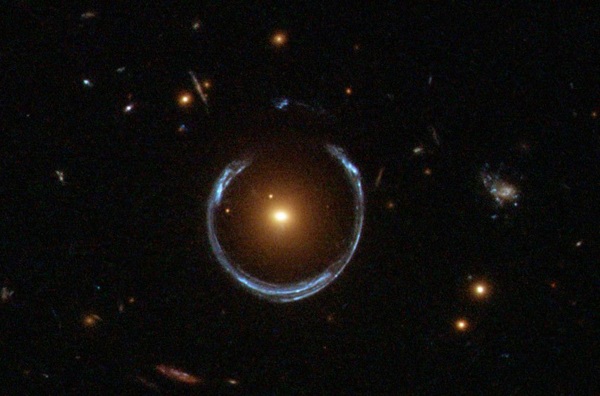
Discovered in 2007, the Cosmic Horseshoe is a breathtaking example of gravitational lensing, a phenomenon predicted by Einstein’s theory of general relativity. This effect occurs when a massive foreground galaxy bends and magnifies the light from a more distant background galaxy, creating a striking visual distortion known as an Einstein Ring. Situated approximately 5.5 billion light-years away, the Cosmic Horseshoe has now revealed an even more astonishing discovery—a black hole of unimaginable mass.
An Ultra-Massive Black Hole with 36 Billion Solar Masses
At the center of the foreground galaxy lies an Ultra-Massive Black Hole (UMBH) with a staggering mass of 36 billion times that of our Sun. The term UMBH is often used to describe supermassive black holes (SMBHs) exceeding 5 billion solar masses. While astronomers have long known that the largest galaxies harbor colossal black holes, this discovery pushes the boundaries of what was previously thought possible.
A Monstrous Black Hole in a Gigantic Galaxy
The lensing galaxy in the Cosmic Horseshoe is named LRG 3-757, an exceptionally bright and massive Luminous Red Galaxy (LRG). These rare galaxies shine intensely in the infrared spectrum and are among the most massive galaxies ever observed. LRG 3-757 is approximately 100 times more massive than the Milky Way, making it a prime candidate for hosting one of the most enormous black holes ever detected.
The Crucial Link Between Black Holes and Their Host Galaxies
Supermassive black holes are found at the center of virtually all massive galaxies, with a well-established correlation between their mass and the properties of their host galaxies. A key relationship, known as the MBH-sigmae Relation, links the mass of a black hole to the velocity dispersion of stars in the galactic bulge. Higher velocity dispersion—where stars move at a greater variety of speeds—usually indicates a more massive black hole.
However, the UMBH in LRG 3-757 deviates significantly from this established relationship. With a mass far exceeding what the MBH-sigmae Relation predicts, this black hole presents a fascinating anomaly.

Why Does the Cosmic Horseshoe’s Black Hole Defy Expectations?
Several theories could explain why this black hole is so massive relative to its galaxy’s velocity dispersion:
1. Fossil Group Evolution and Past Galaxy Mergers
LRG 3-757 is likely a fossil group, meaning it has evolved into an isolated, massive galaxy over billions of years with little interaction with other galaxies. These galaxies are thought to result from early mergers of large galaxy clusters, leaving behind a single dominant structure. The merger history of LRG 3-757 may have contributed to its black hole’s excessive growth.
2. Stellar Scouring from Past Mergers
When two massive galaxies merge, their black holes also merge, forming a binary system that expels surrounding stars. This process, known as scouring, could have altered the velocity dispersion of stars while leaving the black hole’s mass relatively unchanged. As a result, the MBH-sigmae relation may not apply in the same way to galaxies that have undergone extreme mergers.
3. Ancient Quasar Activity and Extreme Accretion
Another possibility is that this ultra-massive black hole is a remnant of an ancient quasar—an extremely luminous galactic nucleus powered by a voraciously feeding black hole. During the early universe, some quasars underwent rapid and extreme accretion episodes, allowing their black holes to grow much faster than their host galaxies.

4. Active Galactic Nucleus (AGN) Feedback Disrupting Star Formation
Ultra-massive black holes often release immense energy through jets and outflows when they are actively consuming matter, a process known as AGN feedback. This feedback can disrupt star formation and alter the central structure of the host galaxy, possibly decoupling the growth of the black hole from the velocity dispersion.
A New Era of Discovery: Future Observations Await
The discovery of this exceptional black hole is just the beginning. Upcoming missions, including the Euclid Space Telescope, are expected to uncover hundreds of thousands of new gravitational lenses in the coming years. Additionally, the Extremely Large Telescope (ELT) will provide astronomers with unparalleled tools to study the dynamics of these cosmic giants in greater detail.
These advances promise to reshape our understanding of how ultra-massive black holes form, evolve, and interact with their host galaxies. As our observational capabilities grow, we may uncover even more extraordinary black holes lurking in the depths of the universe, pushing the limits of what we thought possible.
Source: A Black Hole 100 Times More Massive Than the Milky Way – What Now?
Do We Live in a Special Region of the Cosmos? Scientists Investigate
Do We Live in a Special Region of the Cosmos? Scientists Investigate
A Black Hole 100 Times More Massive Than the Milky Way – What Now?