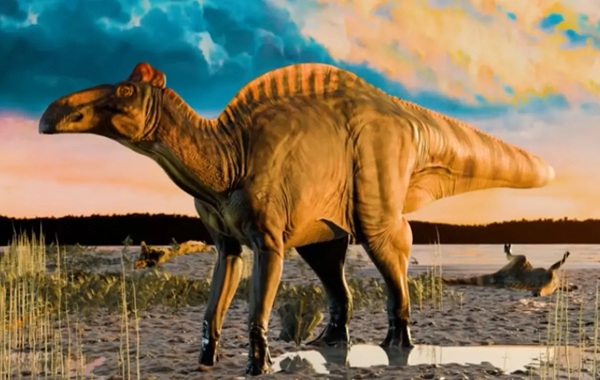
66 million-year-old duck-billed dinosaur ‘mummies’ reveal first-ever full-body view
Paleontologists in the United States have unveiled a duck-billed dinosaur specimen with its fleshy surface intact.
The mummified dinosaur specimen from approximately 66 million years ago has preserved fine details of scales and hooves.
This was made possible by a process called clay templating, in which the external fleshy surface of the dinosaur was preserved over the skeleton after burial by a thin clay mask no more than 1/100th of an inch thick.
The scientists from the University of Chicago used a number of imaging techniques to reconstruct the fleshy appearance of the animal in life, from a tall crest over the neck and trunk to a spike row over its tail and hooves sheathing its toes.
Combined with fossilized footprints, the appearance of a duck-billed dinosaur is at hand at a level of detail that was never seen before.
Dinosaur mummy zone
Senior author of the study, Paul Sereno, PhD, Professor of Organismal Biology and Anatomy at the University of Chicago, and his team relocated the sites in east-central Wyoming where several famous dinosaur mummies were discovered in the early 20th century.
The team mapped out a compact “mummy zone,” and excavated two new Edmontosaurus mummies — a late juvenile and an early adult — according to a press release by the university. The two species had large continuous areas of preserved external skin surface.
The senior author clarifies that these dinosaur mummies are not like the human-prepared mummies found in Egypt or elsewhere.
In both the dinosaur mummy specimens, the skin, spikes, and hooves have not been preserved as tissue but as a sub-millimeter clay film that formed on the carcass surface soon after burial.
“This is a mask, a template, a clay layer so thin you could blow it away,” Sereno said. “It was attracted to the outside of the carcass in a fluke event of preservation.”
Imaging tools come into play
The team then used imaging tools, such as hospital and micro-CT scans, thin sections, X-ray spectroscopy, clay analyses, and examination of the discovery site. The process helped them understand how the unique preservation occurred.
The sun-dried carcasses were covered up suddenly in a flash flood, and a biofilm on the carcass surface electrostatically pulled clay out of the wet sediment to congeal a thin template layer. The process was able to capture the true surface in three dimensions. In due course of time, the organic material decayed, and the skeleton underneath fossilized over longer timescales.
The team had to clean the fossil to expose the soft, paper-thin clay boundary. They then used 3D surface imaging, CT scans, and contemporary footprints to follow the soft anatomy, characterize the sediment inside and outside the mummy, and fit the hooves back into a footprint.
The digital artists joined the team to reconstruct the fleshy appearance and movement of the duckbill, walking on soft mud near the very end of the dinosaur era.
“It’s the first time we’ve had a complete, fleshed-out view of a large dinosaur that we can really feel confident about,” stated Sereno.
“The badlands in Wyoming where the finds were made is a unique ‘mummy zone’ that has more surprises in store from fossils collected over years of visits by teams of university undergrads.”
Complete fleshy profile of a large dinosaur
The team was able to reconstruct a complete, fleshy profile of Edmontosaurus annectens. The team identified a continuous midline feature that began as a fleshy crest along the neck and trunk and transitioned over the hips into a single row of spikes running down the tail — each spike positioned over a single vertebra and fitted to each other.
The lower body and tail had the largest polygonal scales, although most were tiny pebble-like scales just 1–4 millimeters across, surprisingly small for a dinosaur growing to over 40 feet in length. Wrinkles preserved over the ribcage suggest the skin of this duckbill was thin, the release said.
One of the most interesting finds in the whole process was the hooves of the fossilized dinosaur. The team used CT scans of the mummy’s feet and 3D images of the best-preserved duckbill footprint from the same time period, fitting the former into the latter. Unlike the forefoot that touches the ground only with its hooves, the hind feet have a fleshy heel pad behind the hooves.
“There are so many amazing ‘firsts’ preserved in these duck-billed mummies — the earliest hooves documented in a land vertebrate, the first confirmed hooved reptile, and the first hooved four-legged animal with different forelimb and hindlimb posture,” Sereno concluded.
Source: Interesting Engineering
Near-Complete Fossil in Argentina Is One of The World’s Oldest Dinosaurs
66 million-year-old duck-billed dinosaur ‘mummies’ reveal first-ever full-body view